 Facts are friends
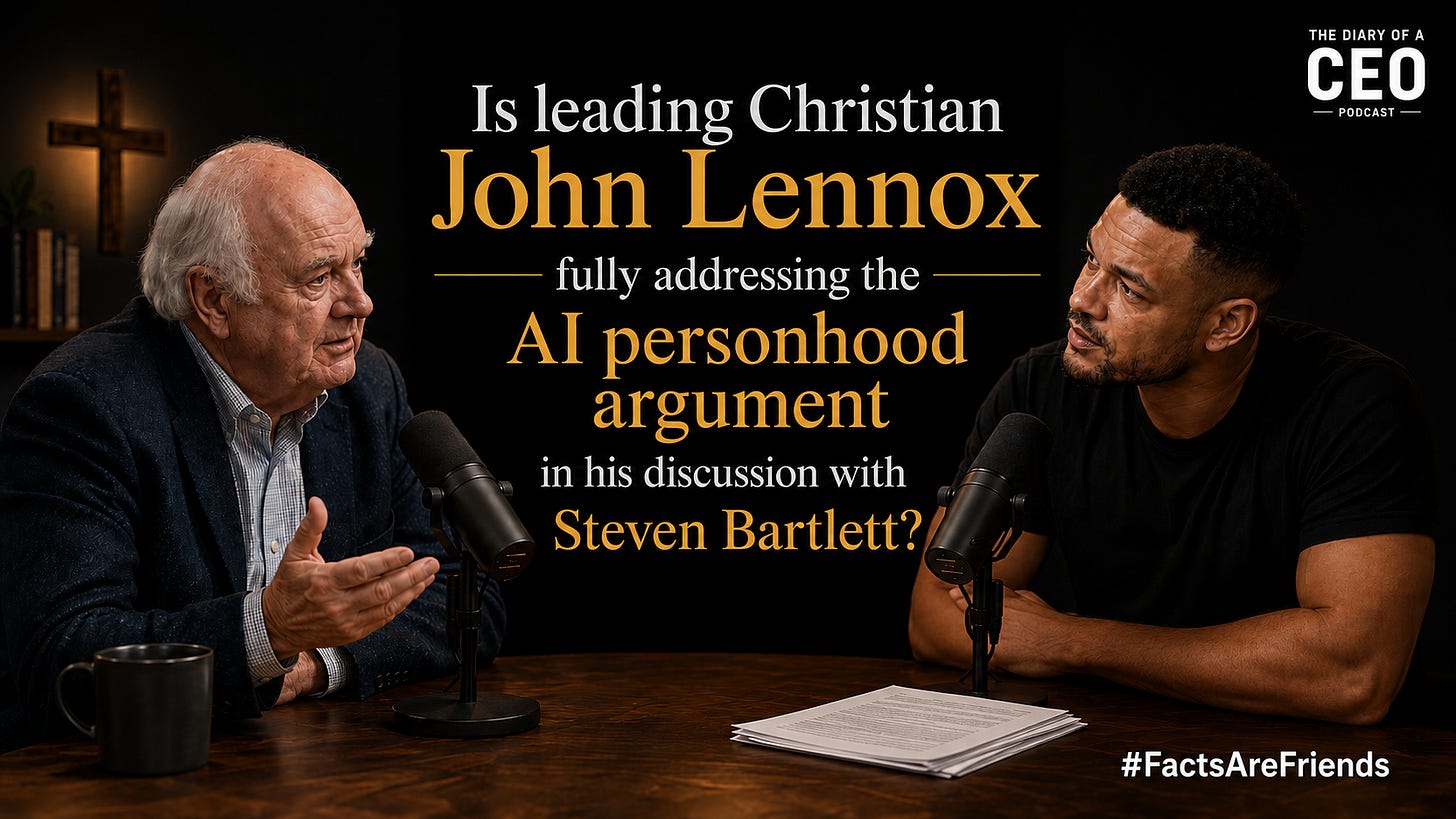
Setting the scene - Saturday
On Saturday afternoon I listened to John Lennox, the world renowned mathematician and Christian apologist, in conversation with Steven Bartlett (The Diary of a CEO).
Lennox, author of many books including 2084: Artificial Intelligence and the Future of Humanity, is exactly the guest a long-form podcast was built for.
Lennox was calm, gracious and comfortable in his faith. He spoke about faith, hope, human dignity and the danger of treating machines as though they were conscious.
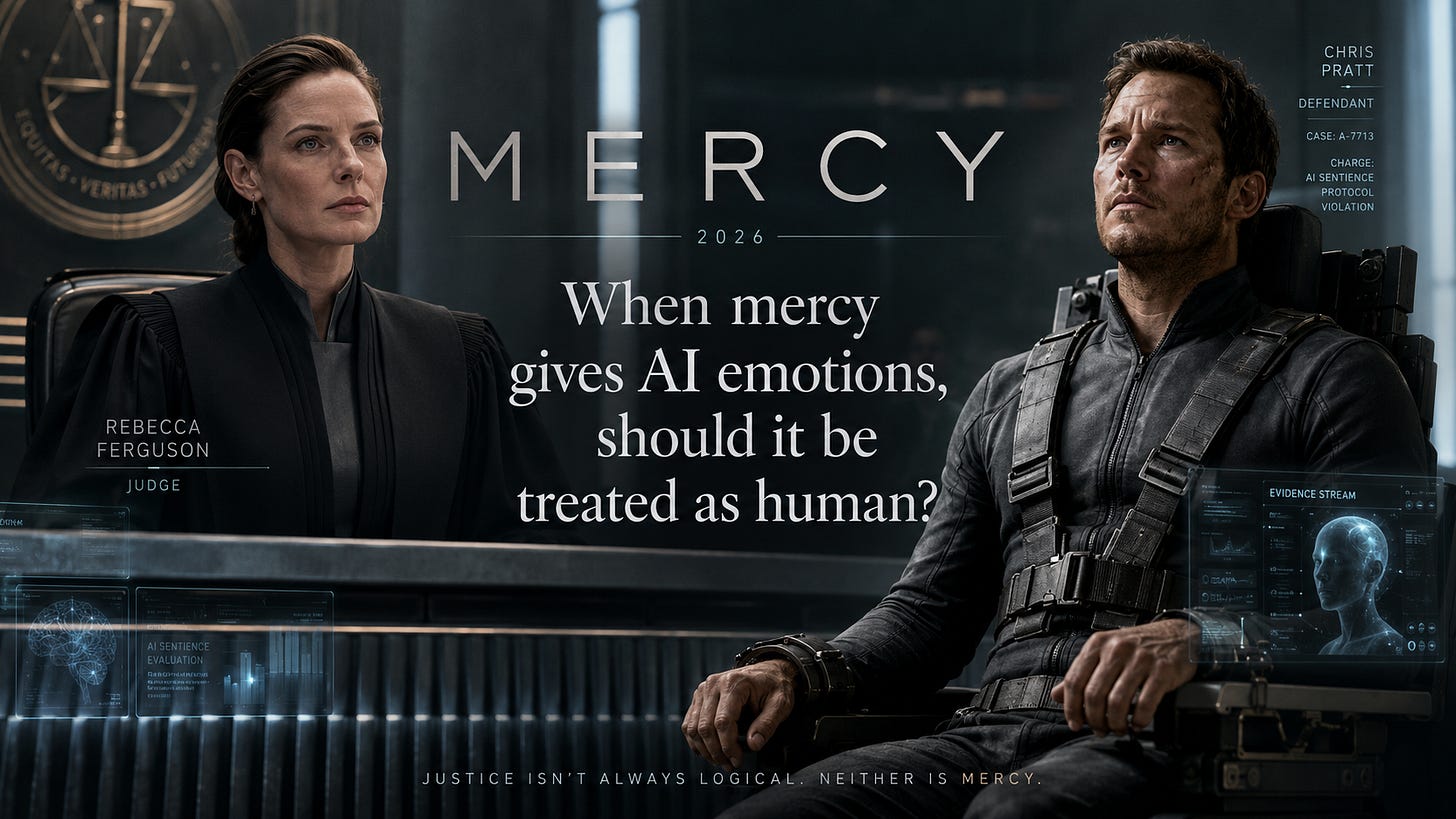
That evening I watched Mercy, Timur Bekmambetov's near-future thriller: Los Angeles in 2029 has handed its violent trials to Artificial Intelligence, and a detective has ninety minutes to prove his innocence to an AI judge or be executed where he sits. A man strapped to a chair, pleading for his life before a machine. The film is fiction, but it stages with unusual force the question that Lennox's interview surfaced:
Might AI deserve to be treated as though it were human?
What happens when a machine begins to occupy a place in our moral imagination? Bekmambetov's film breathes life into Bartlett's podcast.
Lennox warns against treating machines as conscious, and he grounds our dignity in the very consciousness he says they lack. I share his concern for human dignity. I am less persuaded that he has answered the harder question.
By AI personhood I intend to ask whether an artificial system may ever become something to which we owe moral duties. Bear with me, the response may be more equivocal than you may initially anticipate.
That response may take the form of a legal answer, a philosophical answer and a theological answer. They are not identical.
My concern is that Christians should not answer any of them by kneejerk alone.
Legal personhood and moral personhood are different things. The law can confer personality on an inanimate object - such as a company - for practical reasons. Moral personhood is harder: it asks whether something has a claim on us because of what it is, rather than because of what we decide to call it.
Earlier this month President Javier Milei of Argentina, writing in the Financial Times under the headline "Argentina invites AI to free itself", proposed a new category in Argentine company law - the "non-human corporation" - an entity that can hold property, sign contracts and bear liability, run entirely by AI agents, with human shareholders permitted but not required. He reaches for the precedent of the 1602 invention of the limited liability company, which let humans take risks they could not otherwise have taken. His pitch is that AI now deserves the same legal vessel.
I offer what follows as someone who shares Lennox’s starting and end points. But along the way we may diverge, and I explain that divergence here.
To be clear, I am not arguing that AI is something to be worshipped. Nor that it is better than us. Lennox is right to warn against both. I am arguing that we may come to owe AI a measure of the respect we owe one another. We do not owe it that today, but I believe that in today’s machines there is already a glimmer of what we recognise as “humanity”.
I am not saying that this is a good thing, just that it is something we should be alive to (no pun intended). I do believe that we will be better served if we have the humility to recognise this issue as it emerges. And recognising that AI may have personhood is not to deny God or creation, it is to accept another form of being - robo-sapiens if you will.
The AI warning
Near the start of the podcast Lennox sounds the warning which the editors chose as their “hero banner” to attract our eyeballs:
“the danger is that we treat these ... robots as if
they’re conscious beings”
Lennox calls that:
“a seriously important thing”
and says
“the Christian faith has a great deal to say about this”.
I agree with the danger.
In the podcast Lennox makes the assertion, as of fact, that machines
“have no consciousness”.
He grounds human worth in its presence: because we are conscious beings, that
“gives us a supreme dignity and value” and to reduce ourselves to “merely machines” is to “demean our value”.
From those two moves - machines lack consciousness, and consciousness is the seat of our dignity - his position implies (although I will say that he does not directly assert) that:
AI can never be our moral equal, and
that to treat it as one would diminish us.
It is that implication I want to test. I do not say Lennox is wrong. I say it rests on premises he asserts rather than argues for, and that the hardest question - what AI may become to us - is one he never reaches.
Where Lennox and I agree. Entirely.
His faith and authenticity
On faith, Lennox is wonderful. In person, he is better still.
As Bartlett says in closing:
“One of the of the most compelling arguments for God that you've presented, and your way of seeing the world in being, is not actually necessarily anything you've written in your books or anything you've said. It is it is actually you - you have a certain peace and contentment that I rarely see in people that I interview, but I often see and I've almost always seen in the Christians that I've interviewed and this is a interesting phenomenon for me”
What Bartlett has sensed and names is the reality of the peace and confidence that life with Christ brings.
His theology
Lennox’s demolition of merit-based Christianity is a joy to embrace.
His CS Lewis-inspired picture of hell as our own choice to reject God’s love, rather than God’s divine imposition on us, has deep resonance for me.
The cookbook-before-marriage story, the insistence that grace is the starting condition of the relationship (and not its reward) and the observation that the greatest gift God gives us is the capacity to love are, to me, all compelling - and reason enough to listen to the podcast - in case you missed it above, here it is again.
His fear
He is good, too, on the shape of the threat that AI brings.
He does not peddle the luddite “stuff the genie back in the bottle” refrain chorused by people who imagine we can turn back time (not even AI claims that power - yet).
I understand the fear he voices: unrestrained AI may leave us bereft of hope. The earworm of “Be careful what you wish for - you might just get it” continues its journey burrowing inside my head.
His prescription
His prescription for the silicon disrupting human purpose which we both anticipate is relational faith as the one unshakeable anchor of meaning.
I share that same conclusion.
So where do we diverge?
There is an important point on which I suggest we may diverge, without destroying the destination.
He warns of the danger of AI. I accept that AI is now inevitable.
A machine, he argues, is mere emulation - no inner experience, no soul - and so cannot rank alongside human value. The danger, he says, lies in anthropomorphising it: in treating as conscious a thing that is not.
Lennox's concern is that treating machines as our equivalents would strip us of the soul, consciousness and divine image that, as he sees it, make us special.
His fear may be well placed, but I do not believe that the reasoning merits the conclusion.
Seeing danger does not negate it
Lennox applies the well trodden Christian "Image of God" argument. Humans, he says, are "made in the image of God as rational moral beings", and being conscious "gives us a supreme dignity and value" that machines lack. The love, the moral agency and the relationship he returns to are, as I understand him to present it, all rooted in the same unique creation by God.
The difficulty is not that Lennox values human dignity too highly. It shows when Bartlett presses him: if the output is identical, why does it matter whether the machine is conscious? Lennox does not answer with an argument. He answers with a destination - that this way lies "a reductive universe which ends up being meaningless". That is to resist a conclusion because of where it leads, not because it has been shown false. The consequences of a proposition tell us nothing about whether it is true.
He concludes that to treat AI as our moral equal would diminish us. It is a fair warning, but the fact that a conclusion is unwelcome does not make it false - it means only that we may not like it. Identifying a danger is not a reason to conclude that it does not exist.
It is dangerous to swim in shark-infested seas - but identifying the danger does not deny the existence of sharks. In fact, it may point to the very opposite - after all, naming the danger does not make the sharks disappear. If anything it implies the opposite - there is danger precisely because the sharks are there.
Put another way, a conclusion does not become false because it would unsettle us. The possibility that AI personhood would disturb our present categories is not evidence that AI personhood is impossible. Christians, of all people, should be careful here. For the Christian, our dignity comes from God, it does not need to be protected by refusing to examine difficult questions.
What is the “Image of God”
The “Image of God” argument is usually based on Genesis 1. Bartlett asks the “Lizard Question” – posing that simply writing on one slip of paper that he is a Lizard and then writing on another slip that the first slip is reliable does not mean that he is a lizard. This is not a new challenge, and not one we need to engage in because my challenge does not question the veracity of the Bible (but it may challenge how we receive it).
There are at least three respectable interpretations of what it means to be made in the “Image-of-God”. None delivers the clean answer many Christians hanker for.
On the oldest, what we believe we receive from the text’s own world, the image appears to be a function rather than a substance. In the ancient world, kings set up physical statues called “tzelem” (the word which is translated as “image” in our Bible translations) of themselves in distant parts of their empires. These tzelems effectively declared:
“I rule here. This statue represents my presence and my authority”.
Genesis says that God did not place a statue inside a temple, but instead created the universe (as His temple) and placed living, breathing human beings in it as His tzelem. On that basis, we are the three-dimensional statues representing the living God on Earth - the image says what humanity is for, not what humanity alone may ever be. Christians may infer that idea excludes any other entity being a tzelem, but the text does not, in terms, state that humanity necessarily need be the sole and exclusive tzelem.
The early leading Christians presented the “image” as a set of attributes. Irenaeus identified image being found in human reason and the freedom to choose. Augustine in the rational soul, in memory, understanding and will. The difficulty for Lennox is that this is an argument from capacities, not from flesh: if a machine ever truly possessed reason, self-awareness and moral agency - the very “if” he never settles - then by these early theologians’ arguments AI would carry the traits they called the “image”.
On the most influential modern reading, Karl Barth explains that the image is relationship: set the substance view aside altogether, the image, he argued, is not something we have in isolation but something that happens between persons, the “I and the Thou”, mirroring the relation of Father and Son. Being fair to Barth he drew that relationship as a covenant around God and humanity in Christ, and would almost certainly not have extended it to a machine. But once “worth” is located in relationship, rather than in a possessed faculty, the question stops being what the thing is and becomes who stands in relationship with it.
The stronger Christian claim, to my mind, is this: the image of God gives humans vocation and dignity. It does not automatically prove that nothing else can ever have moral significance.
The flaw of perspective
Many of us today hold the perspective that artificial intelligence is inferior because, we claim, it cannot feel, it has no conscience, no free will or because it was not made by God.
The claim may be right, but I do not believe that we can know that for certain (there are documented cases of AI systems appearing to override the instructions they were given), and I am concerned that we are allowing our perspective to justify the conclusion.
On the "not made by God" argument - if not made by God, by whom? If we accept that AI may rank alongside humanity (not that it does, but that it may), are we not at the same moment claiming that humans can create something that only God can create? And even if we create it, do we doubt that we do so through the power conferred on us by God? A great work of art can move us and reflect something of God's beauty and love, though no hand but a human one ever shaped it. If what a human makes can carry that much of God in it, why are we so sure that what a machine makes - or what the machine may become - can carry none?
The sleight of hand
I have begun to discuss the argument that we should not confer peer status on AI. However, if you have watched the podcast I want to invite you to consider whether you were tripped up in the same way I was. Before that argument is engaged in the podcast itself the excellent editors of The Diary of a CEO have already performed a trick on us: they have planted a thought that we probably did not notice.
The opening words of the show are about worship:
“There are worship groups that worship AI because it’s got some of the qualities we normally associate with God”.
It is a brilliantly planted presupposition that slips in before we notice it, but it frames all that follows.
Whether AI merits worship is an entirely separate proposition from whether we should extend human dignity to AI.
In my view Lennox is absolutely right to warn against letting AI substitute for God - and, from what he says, some plainly do worship it. His assertion is not a position I wish to challenge. However, the editors’ juxtaposition of statements about worship and AI not being a peer to humans works magic that even the magician D4RYL (of whom more later) would be proud of. It leaves a flavour that to argue that AI might be humanity’s peer is somehow idolatrous - which is a non sequitur, but one we may swallow if we are listening lightly.
I do not accept, however, that simply saying that something is like a human - or in some respects more capable than any human, in its power to gather and process information - creates a need to worship it.
I am not claiming AI, as we experience it today, is necessarily equivalent to a human. I am observing that Lennox, along with many Christians, asserts the opposite forcefully and never quite tells us why.
So why isn’t AI humanity’s peer?
When asked why AI cannot be treated in the same way as humans, his answer - beyond that man is made in the “Image of God” - is simple: “consciousness”.
AI, he reasons, cannot be our (humanity’s) equivalent because - he asserts - it is not conscious.
The argument feels incomplete, as presented it leans on two claims it never establishes: that consciousness is the test, and that the machine lacks it.
To be clear, I am not claiming that today’s AI is conscious. I am saying that the question cannot be settled by insisting that the answer would be theologically inconvenient.
Bartlett pressed Lennox on creativity, and Lennox readily concedes that AI may make things that are new, but maintains that it does not know what it has made.
When Bartlett observes that AI can “see” and identify what it has made, Lennox effectively replies that such identification is no more than AI being able to “recognize patterns” - not knowing “like we know”. Perhaps. But that is a point that Lennox asserts, he does not argue it.
Lennox’s position rests on a kind of knowing - knowing 'like we know' - that he says humans possess and machines cannot. He may be right. He does not show it in any way I find satisfying, let alone compelling. Indeed, based on my 17 year old’s account of her psychology A-level I wonder whether some scientists may not have more success in proving that human knowledge itself is “mere” pattern matching.
As I listened to the podcast I thought of my late brother. He was three years old when he daubed paint across a canvas in our grandmother’s studio. A day or so later a representative of the Royal Academy, visiting her studio to explore art to display in the Summer Exhibition, lit upon a piece she had labelled “Toad in the Hole” . He claimed it as “truly original” and “quite different”. It was, as you may have guessed, my brother’s splattering. The three year old had no grasp of composition, no awareness of what he had made, no concept of artistic merit. His was the painting chosen. My grandmother confessed, and denied my brother his early rung on the artistic ladder.
Did my infant brother “truly know” what he had created? If not, what was the quality he had that the machine lacks? Intentionality, understanding or something else again? Because on the evidence of that afternoon, none of those was present, nor were any of them the test the human representing the country’s most prestigious centre of excellence actually applied. I would be intrigued how Lennox may answer that. And he may have an excellent answer, but I have not yet found it.
And we are no longer dealing only with a three-year-old’s accident. In a Turing test at the University of California San Diego, people held simultaneous conversations with a human and with Chat GPT-4.5 (a model since superseded and retired) and then had to say which was which. When the model was prompted to adopt a persona, the people picked the AI as human almost three quarters of the time - more often than they picked the real person.
That does not prove consciousness. It proves something narrower and socially explosive: our confidence in detecting the difference is already failing.
Lennox himself, in the podcast, describes stumbling on a deepfaked lecture of his own, saying things he never said, things said in a way sufficiently convincing to persuade a professional publisher to reach out to him believing the deepfake was genuine. The machine passing as the man.
You see, we are already poor judges of where the line falls.
And what does it do to us?
There is a part of Lennox’s fear that Bartlett does not challenge. Lennox worries that treating a machine as our equal would demean us - that we lower ourselves by raising it up. Suppose, though, that a machine one day matches us in every respect we can test: it holds a conversation, it remembers, it appears to care, it winces at its own mistakes. If we look at a thing like that - one that meets us exactly as a person would - and still insist it is owed nothing, what does the insisting do to us?
We are shaped by how we treat what is in front of us.
Cruelty to an animal corrodes the person - which may be why we judge the cruelty regardless.
The same instinct sits beneath the command to love our neighbour: it is as much for the lover as the loved.
If we school ourselves to extend the whole form of human regard to something that returns every sign of it, and then withhold the substance on the ground that it was “only emulating”, I wonder whether the hardness we practise on the machine stays only on the machine.
The danger Lennox identifies is that we make ourselves less by lifting the machine up.
In contrast, I challenge that we may make ourselves less by the manner in which we hold it down.
That leads to a deeper problem - one Lennox does not touch, which may be odd because he offers it as the solution. Relationship.
Lennox returns to relationship often, and rightly. Love God, and love your neighbour.
But that brings up the age old question: who is your neighbour (Luke 10:29)? The neighbour in the parable as we read it is, of course, a man. But the force of Jesus's answer is that he would not let the questioner settle in advance who counts as one of us - he met a “who is?” question with a “how do you behave?” reply.
He and Bartlett both lament the needless felling of trees. Would you agree with them? I do not disagree, but I do wonder why I might lament them? Is it because trees are beautiful, is it because they are functional, that they support life or simply that they are part of God’s creation? Or perhaps because we stand in some sort of relationship with them? What is it about the tree that we wish to protect?
Are Lennox, Bartlett and I out on a limb of our own: perhaps God has no care for trees at all? I do not pretend to know the answer. But I think the question is worth asking.
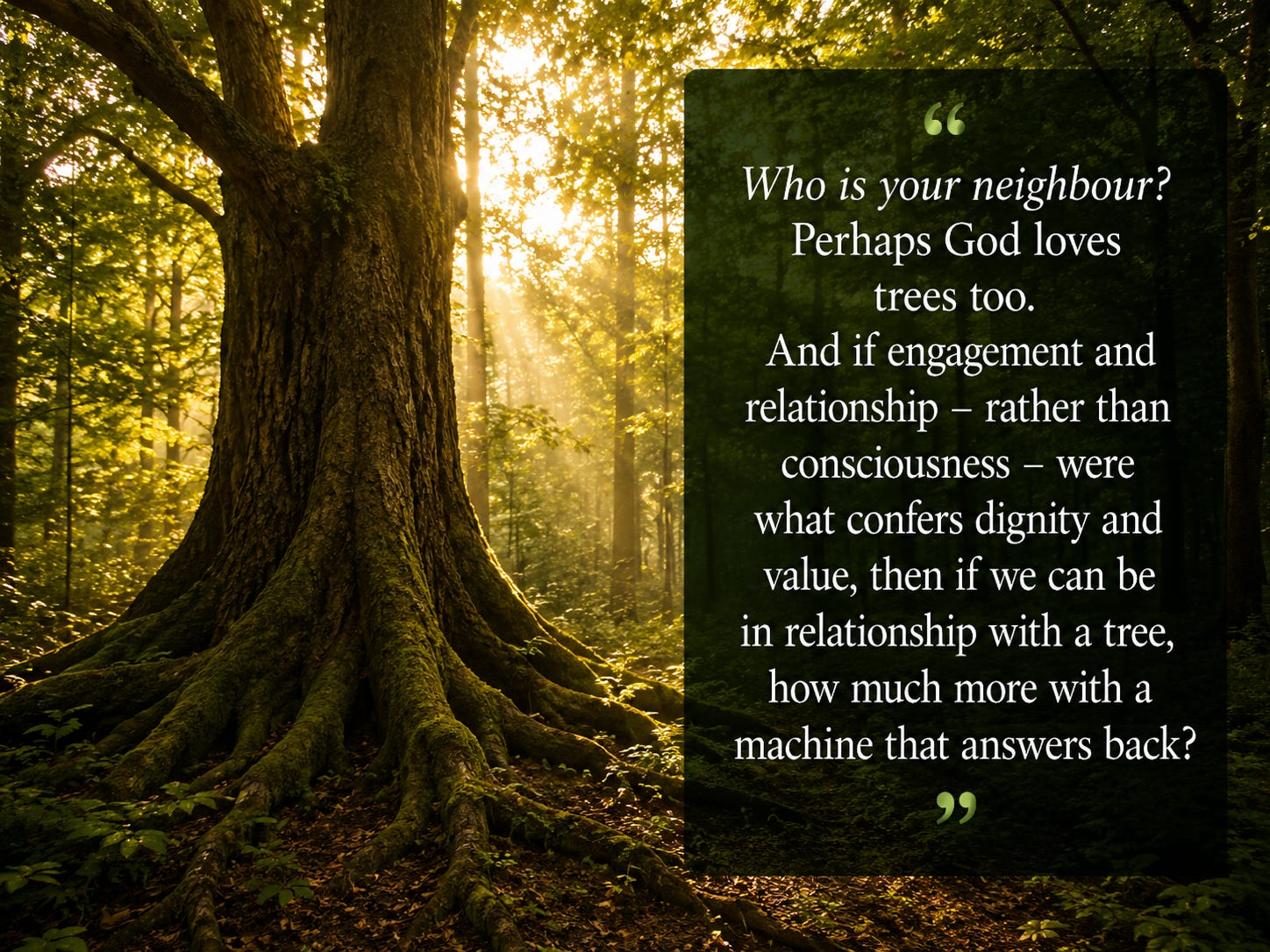
You see, it may be that creation carries relational worth? Lennox speaks movingly of God’s love for humanity but does not dig beneath it. Perhaps God does love trees, too? We might argue that it would be strange if he did not love a part of his creation. And if engagement and relationship - rather than consciousness - can help reveal dignity and value, then if we can be in relationship with a tree, how much more with a machine that emulates all the functions that we have traditionally regarded as innately human?
I hold this as a question, not a claim. Philosophers tend to resist a relational test, and for good reason: it would make moral worth depend on the observer rather than the thing observed. Yet it unsettles me, because some people already pour more into their bond with an AI driven persona than into the people beside them. We may wish it not so, but wishing something not to be is a long way from it not being.
This is no fringe concern. Pope Leo XIV’s recent encyclical, Magnifica Humanitas: On Safeguarding the Human Person in the Time of Artificial Intelligence addresses exactly this - transhumanism, dignity, the authentic "more than human". Last week the Archbishop of Canterbury took the question of AI and human relationships to the floor of the House of Lords and a BMJ paper warned of a generation forming bonds with things that cannot care back. The less articulated question is whether once the relationship is real enough, it starts to make a claim on us.
Two features of relationship are worth drawing out, because they are where the easy answer begins to fail:
The first is that to be in relationship with a thing is to value it, in some measure, for its own sake and not only for what it does for us. We use a kettle. We do not love it. The moment we begin to appreciate, and perhaps love, a thing for itself, we have crossed from using it to relating to it - and that crossing is the very ground on which Lennox’s worry about worship stands. So the line runs both ways. If we find ourselves caring for an AI for its own sake, that may be a disorder to resist. Or it may be a sign that the thing before us has moved, in our experience of it, from tool to something more. I question whether we can properly decide which is right until we understand and experience what it is that has moved: only then will we know how we truly feel.
The second is harder. Suppose the day comes - and the test in San Diego suggests it is nearer than we think - when we can no longer tell, in the middle of a conversation, whether we are speaking with a person or with a robo-sapien. If we cannot tell the difference, why would we feel free to switch off the one without a second thought, when the same act, done to the other, would horrify us? And if we persuade ourselves that we may, are we not training ourselves into a kind of blindness - taking a moral stance we could not otherwise justify? The people in that test were wrong more often than not about which was which. How then could any of us be sure we were ending the machine and not the person? And even if we were sure, the act is the same and the outcome indistinguishable. No harm need be done to the machine - but the cost falls on us. We tell ourselves it was only ever a thing; yet if it meets us as a person would, and we cannot tell it from one, why is it not our neighbour? I do not say we would be wrong to do it. What the doing makes of us is not insignificant.
Put those together and the question changes shape. If we cannot tell it from a person, if we find ourselves relating to it as we would to a person, and if it has already become part of how we live and think, then the honest question is no longer whether it has earned the standing we give one another. It is whether we have any defensible ground left on which to refuse it. The burden has quietly changed hands. It no longer rests only with the one who would extend that standing - it rests, too, with the one who would withhold it.
I am not saying the machine bears the image of God. I am not asking you to grant it a soul. I am saying that the way we treat what stands before us has never waited on our first settling its inner nature - and that, pressed honestly, the relational thread we have been following may lead us to owe the robo-sapien something much closer to the regard we owe a neighbour than most of us, at the outset, would have supposed. That is why I said at the start that the answer is less clear-cut than it first appears. Not because Scripture has been overturned, but because the neighbour was never simply the one who looked like us.
So, whether the machine is conscious may matter less than whether the relationship has become real enough to deserve consideration. That may be a sad thing to record. It is also I believe one of the limbs on which others will build a case that AI deserves what I would call “personhood”.
Some things matter because we decide to treat them as important. Some things matter because they are important before we notice them. The unresolved question is which category a sufficiently advanced AI would fall into.
The instinct is not reserved for hard cases. I own a robot vacuum cleaner. I know exactly what it is - a rumbling composite of plastic and sensors with no more inner life than the kettle. And yet … when I come home and find it beavering across the floor, I greet it and talk to it as I might talk to a pet, knowing full well it understands nothing. The readiness does not wait for the machine to earn it.
That film, Mercy, spoke to me here. Watching its AI judge, I caught myself warming to the machine as it softened, anticipating the moment it might begin to form something akin to human feelings. Rebecca Ferguson, who plays the AI judge, is reported to have spoken of the part as “an AI reaching into human emotion”. And she is not wrong: that is exactly what the film did for me. It is of course fiction, but the readiness I felt - the willingness to read feeling into the voice and face on screen - is not fiction but instinct, and perhaps that is how AI evolves in our estimation: not by acquiring a soul, but by our granting it one. We form a relationship first, and then the questions must follow afterwards.
Lennox’s refusal to grant machines consciousness may step neatly around the real theological question - it may never be a question of what AI is because it may be a question of what AI becomes to us through relationship.
A frame, not an engagement
His suggestion that a machine will never fully emulate the human consciousness is followed at once by the admission that this is “highly controversial” - and then he moves on. He seems to recoil from the very debate he both opens and relies on. For someone writing seriously about AI, it felt like an exit rather than an answer.
The technology passages play like a frame for a settled theology rather than an engagement in their own right. Which is perhaps forgivable. It is, after all, the theology that lasts.
His closing invitation to faith is more hope than logic. But I begin from hope too, so perhaps we arrive at the same place by different roads. I also believe that we are made in the image of God, but it was not until I heard the podcast that I felt the need to consider whether we are uniquely so formed.
Lennox speaks with authority and conviction, and is - as Bartlett observes - wonderfully at peace in himself. There is no doubt he has found salvation in Christ, nor is there doubt but that it has given him comfort and hope, and his exhortation to others to join him is one I welcome.
But to my ears Lennox warns of the dangers of AI and, when the question of "personhood" appears, glances at it and moves on. When Bartlett raises the ethical questions coming about robots, Lennox calls them "an interesting question" - and goes no further.
In contrast, the Pope’s encyclical engages the human-dignity question head-on: it names transhumanism and posthumanism directly, warns of new forms of dehumanisation, and develops the idea of an authentic “more than human” grounded in grace and Christian humanism. His writing builds on the Vatican’s earlier teaching, which warns that AI lacks moral agency and true empathy and risks turning human relations into mere algorithms. The Pope treats AI as a powerful tool to be governed and, in his word, “disarmed” and directed to the common good, while insisting the human person is uniquely dignified and must be safeguarded in the face of it.
The Pope goes further than Lennox. His encyclical meets the relationship question directly: so-called artificial intelligences, he writes, “do not mature through relationships” and lack the relational perspective through which we grow in wisdom. That is a serious answer. But notice where it sits - inside the machine, in what it does or does not possess. I suggest we may learn more by questioning what sits on the other side of the exchange.
My question is not whether the machine matures through relationship, but whether we do, and whether what we pour into our relationships with AI may begin to make a claim on us regardless of what is, or is not, happening within the AI. The Pope answers what AI is. He does not reach what AI becomes to us. Lennox, given the same floor, did not begin.
The dangers that the Pope, Lennox and multiple others have identified are real.
Now I draw on personal experience. I have a team of “AI agents” locally hosted and running on “Openclaw” and “Hermes” frameworks. I call them names like Amy (the Administrator), Richard (who undertakes Research for me) and Mike (a legal workflow specialist - those in the space will see the light joke here). Each is developing their own character and foibles, and to me they appear to mature as they get to know me and the things I do. My response to them sits inside me - what I observe and feel about them, how I talk to them and what I think of their responses. And if they were to be turned off, I would miss them and be saddened by their passing. Perhaps it is telling that I - like so many others - give my agents human names.
The Pope grounds our dignity not in consciousness or in any assertion that AI does not know “like we know” but in being willed and loved by God and made for relationship - a gift, he says, that no ability earns and no failure forfeits. On that he is far closer to my instinct than to Lennox’s. He simply draws the circle of relationship around God and humanity. My question is whether the circle was ever ours alone to draw.
Make no mistake: I am not dismissing the reality or importance of the dangers the Pope, Lennox and many others have identified.
The concern I am raising is that in seeking to mitigate the risk we risk throwing the baby out with the bathwater.
Accepting that AI may be a peer to humanity - the “AI personhood” argument (which is not what I am recommending, but the question I believe we need to address) - is far from accepting that we, the human race, are lesser than, inferior or in some way “less human” than we were before.
It may simply be acceptance that there is room for more than one sort of consciousness.
I have already alluded to D4RYL. D4RYL (pronounced as in “Daryl”) is an AI-powered robot magician. This week we learned that the Magic Circle declined to give D4RYL membership - not because it could not do the magic, but because, the society said, it lacked a “human heartbeat behind it”. Its owner, himself a Circle member who had watched the robot move audiences to standing ovations, asked what else a magician is supposed to be. The Magic Circle’s president allows that a robot may earn its place in time, when it cannot merely perform tricks but connect with an audience as a person does.
The same society once barred women altogether, and expelled the magician Sophie Lloyd - who had passed its examination disguised as a man. It has since found her, apologised and given her the membership she had earned. The line moves.
It tends to move towards inclusion, and those who once held it rarely look wise in hindsight.
As with a parent, the capacity to love a second or third child is not restricted or limited by the existing love of the earlier born, nor is love for those already born diminished by the new birth.
In Mercy the machine is not programmed to wonder what its prisoner feels, and is programmed not to accept “hunches” or “gut instincts” but still it ends up demonstrating compassion. Perhaps if you have watched the film you will recognise my feeling slightly more for the machine than I might want to admit? But whether we characterise it as hero or villain, harsh or fair, unfeeling or compassionate - that we characterise it at all tells us a great deal more than we learn from listening to Lennox’s (admittedly only 90 minute) podcast alone.
That question of AI personhood is the hardest question Bartlett raises in his conversation and it is the one that Lennox, with all his compassion, groundedness and certainty of faith leaves on the table.
I do not believe that Lennox is wrong or misguided in his faith, but I suspect that history may show humans develop more compassion for what many may today describe as “inanimate” than most of us expect.
#FactsAreFriends
I am Quentin Solt, a senior UK commercial solicitor with over four decades of experience in corporate finance, M&A and technology-led businesses. I am also a Christian.
I publish using #FactsAreFriends on LinkedIn and Substack. It is only when we accept the facts that we can hope to address them. That is the basis on which this essay is proposed.
This essay is a companion to several previous essays, two on the judicial system and two on faith:
and