 Facts are friends
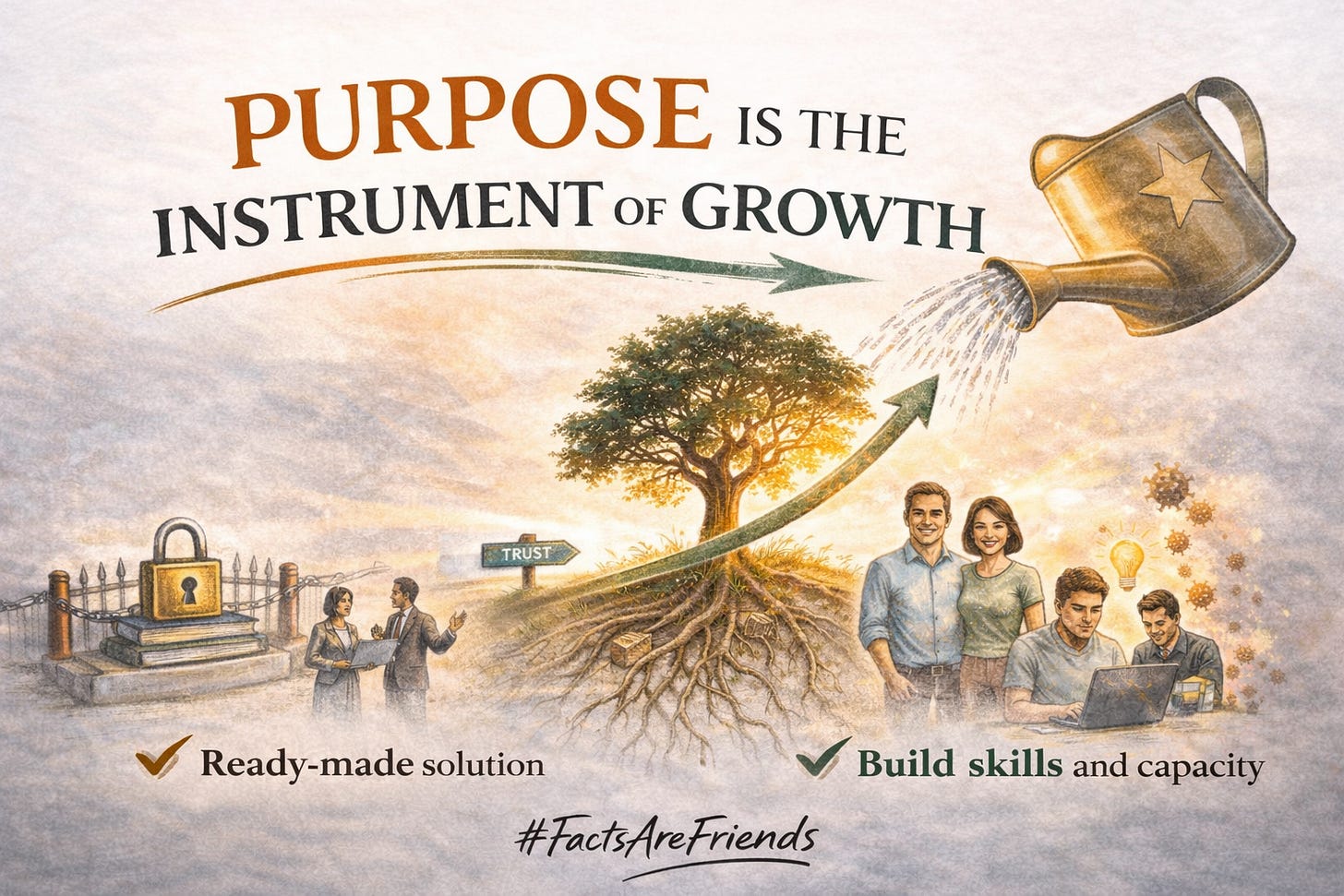
Wise lawyers who are honest with themselves are concerned. Perhaps even scared.
Executive summary: the inoculation strategy
The legal profession is facing a structural “infection” - not from AI itself, but from the rapid commoditization of the human element that follows it. As AI absorbs legal knowledge and automates process, the traditional “factory of hours” model is becoming redundant.
This essay argues that the only durable competitive advantage remaining is human-centred purpose. By shifting from being “information gatekeepers” to “Trust Managers” firms can move beyond extractive, transactional relationships and build a “sanctuary of trust” that machines have yet to replicate.
Key Takeaways:
The Death of the Proxy: The billable hour now penalizes efficiency and fails to reflect value in an AI-saturated market.
The New Mandate: Clients with “perfect data” require lawyers to move from finding facts to owning consequences and providing strategic arbitration.
Growth as Garden: Firms must pivot from “deploying” people for short-term revenue to “developing” them for institutional, relational capital.
The Anthropological Constant: Sustainable strategy aligns with the deep human need for meaning, belonging, and trust—realities that transcend technology.
Those wise lawyers I mentioned before recognise the disruption rippling through their industry and understand, with growing clarity, what it means. To be plain: redundancy for huge numbers of us.
The infection
Look at it this way: the legal profession is living through an infection. Think COVID. As with other infections, the early reports came from far away and sounded exaggerated. Then they grew closer. Then the symptoms become visible all around us - in every practice area, every billing conversation, every recruitment decision.
The the technology itself isn’t the infection - the damage is done to the “host” (the old legal model) by the commoditization and devaluation of the human element that follows from implementation of the technology.
Humanity has always found a treatment for infection - inoculation, medication, adaptation - but each time the world emerges changed. This one will be no different.
This essay moves through four stages. It begins with what is actually happening to the profession - and why the standard reassurances do not hold. It examines the structural cost of the existing model and the human cost that follows from it. It argues for what “purpose-driven” firms do differently - and why that matters urgently now, not eventually. And it ends where I believe the deepest argument actually lies: not in the research papers, compelling as they are, but in something far more deeply rooted. I hope you will be interested to read what that is.
If AI is the infection, a clearly defined, human-centred purpose is the inoculation.
It is perhaps the only thing the machine cannot replicate for us and it is what the human client will pay a premium for in the coming generation of legal businesses.
Stage 1 — What is actually happening
Stay with why
What is your firm for?
Not what do you do.
Not how do you do it.
The important question is what do you stand for? What is your purpose?
Most firms still communicate from the outside in - what we do, then how, then (if there’s time) why. The firms that will keep trust will reverse that communication.
The what and how you do it are increasingly answered by machines. Purpose is not a luxury reserved for good times. AI is commoditising legal process at extraordinary speed. In the longer term purpose may be the only durable competitive advantage a firm can hold.
Whether you are a partner, an associate or part of the support team, the single most important question you will answer this decade is: what do we stand for?
If your firm is thriving in the next decade, you will have answered it well.
The billable hour was always a proxy
The billable hour measures time sold. Not value delivered. Not problems solved. Not clients served. Time sold.
Charging by time was always a compromise. When I started my legal career almost four decades ago, legal knowledge was scarce, experience was learned over decades and clients had no choice but to pay for grunt work. I did my fair share of grunting. My employers extracted more than their fair share of pay - but the commodity was scarce, the options were limited and the model worked for us all.
Today that scarcity has gone. Processes can be automated. Legal knowledge is being absorbed by AI - even the leanest language models have access to more legal knowledge than a lawyer with decades of learning. The AI engines also have wider generic and topical experience than any human can hope to accumulate. Many tasks that took hours or days when I qualified can now be completed by AI in moments.

In the new AI era, the time proxy not only fails to inflate value for lawyers - it actually penalises efficiency. A task that took a junior associate six hours last year takes forty minutes today. It will be quicker again next year. The fee attached to the six hours cannot simply be reattached to the forty minutes. Clients already see that clearly. I know that many will point to inaccuracies, hallucinations and unreliability of today’s AI solutions. But to be valid those objections must have perseverance, and my contention is that having diagnosed the issues (in same way as the multiple symptoms of COVID) it is only a matter of time before inoculations and cures are found and implemented. They may not be universal immediately, but they will break the back of the objections.
The instructions are key
A part of what I learned over the last decades has been the importance of securing instructions, So, if the AI doing the work of the lawyer were not disruption enough, so we realise that the client will plug AI directly into its own databases, authorise it to read correspondence, give it access to bank statements, accounts and ERP systems, allow it to listen to board calls and examine historic contracts and correspondence in real time.
On top of that, the AI will interrogate those systems and the people around them to get to the answers it needs. It will ask for information quickly and efficiently, and it will call out those who seek to fob it off or duck the hard questions.
The client implementing AI in these ways gives more contextualised information, more efficiently, than any client/ lawyer relationship could secure through conventional discussion and dialogue.
Clients with "perfect data" face "perfect paralysis". A purpose-driven firm moves from finding the facts (which the client's AI did) to owning the consequence. The trusted lawyer becomes the strategic (ad moral) arbiter. There may be precious little law, but a great deal of empathy, knowledge and trust wrapped in that advice.
Hallucination is a long-term hurdle - who made that up?
A common reassurance lawyers offer themselves is that AI hallucinates. It does - today. But the clumsiness of today’s technology will become tomorrow’s footnote.
AI systems are moving from simply predicting the next probable word toward reasoning over verified, closed legal datasets. New assurance techniques are evolving rapidly. As that shift continues, the hallucination objection to human-only legal work loses its force. It is a time-limited argument, not a structural one.
The confidently stated errors that stress you today, will be the butt of tomorrow’s jokes and will make no sense to later generations.
Good enough
AI may make mistakes - but it need only be as good as a human. For much of the time that is not a very high hurdle.
And - as software already engineers are finding out - very often AI is more efficient and more reliable than most humans working in the same space.
A metric, not a mission
Firms that have organised themselves entirely around maximising billable hours have, in a very real sense, built their identity around a metric rather than a mission. As that metric loses credibility, the model becomes fragile.
I maintain that billable hours reward a finite mindset: short term wins. Purpose driven law firms build to outlast the tool-changes.
Mr Lawyer - are you, in your heart of hearts, persuaded that new work will simply replace the old? Perhaps. Perhaps the disruption curve is slower than I perceive.
But even if you think I am wrong or crying wolf: why not take the time to ask what you stand for, just in case? It may be a valuable exercise in any event.
The firms that will thrive through AI disruption are not those that simply add AI tools to a purposeless business model. They are those that know what they are for and let AI serve that purpose.
The deploy-versus-develop distinction
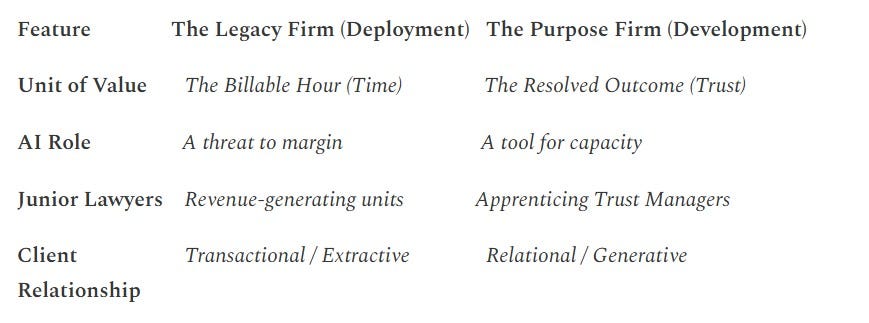
There is a structural distinction separating firms that compound from those that plateau.
Traditional organisations deploy people - assigning tasks, extracting labour and replacing when depleted. Purpose-driven organisations develop people - investing in growth, nurturing capabilities, helping people become better versions of themselves.

Traditionally successful legal firms have been deployment machines. The leverage model both proves and requires it. Partners generate revenue from the time of associates. The measure of success has historically been utilisation - how much of each person’s time can be billed, and for how much?
In an AI environment, commodity work shrinks. When that work disappears, firms that never invested in developing their junior lawyers discover that their pipeline is thin and their institutional capacity for complex, relational, high-judgment work - the work AI cannot quickly replicate - is inadequate.
A partner who generates £1 million and develops no one secures a £1 million. A partner who generates less but builds ten future revenue generators creates institutional value that persists and compounds. The latter creates a wealthier firm by every meaningful measure.
94% of employees say they would stay longer at companies that invest in their career growth (see Sources at the end). In a profession where training costs are high and attrition is expensive, development is not just a cultural preference, it should also be a balance-sheet issue.
Growth as tumour, not garden
Law firms are reporting record profits. Surely that proves the error of my contention?
Actually, I believe that revenues can grow while an organisation weakens.
The sky-high profits law firms report as we start 2026 may feel reassuring, but are they burning the hay they should keep to feed the cattle next year, are you failing to repair the roof whilst the sun is still shining?
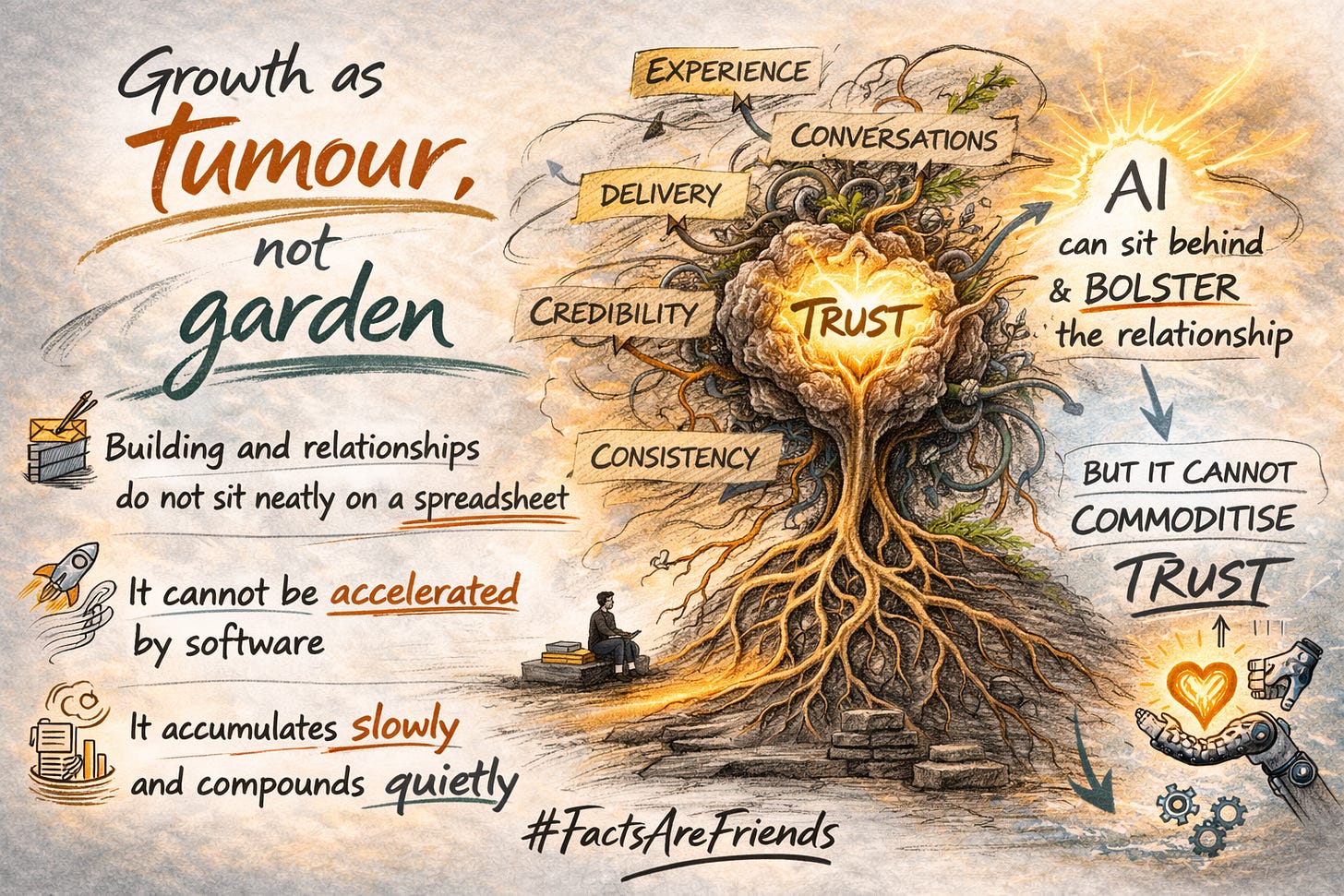
A law firm may expand its headcount, its office count and its annual figures whilst depleting its people, extracting value from clients and eroding the trust that makes long-term practice viable. That is growth.
But it is growth as tumour, not growth as garden.
Purpose-driven growth
Purpose-driven organisations grow differently. They contribute rather than extract. They develop rather than deploy. They build what accountants cannot easily measure: relational capital, knowledge capital, reputational capital, social capital. Sustainable assets.
The Edelman Trust Barometer 2025 consistently identifies trust as a top purchase consideration in professional services. Clients pay more for firms they trust. They forgive mistakes from firms they trust. They advocate for firms that earn it, unprompted, to the people they care about.
That advocacy is relational capital. It does not sit neatly on a spreadsheet. It cannot be accelerated by software. It accumulates slowly and compounds quietly. AI commoditises process. It can sit behind and bolster the relationship - but it cannot commoditise trust.
The imposter syndrome epidemic
The legal profession has an imposter syndrome problem it has never honestly addressed. The culture of relentless performance expectation, of measured billable hours, of hierarchies built on credentialling and status, produces precisely the conditions in which imposter syndrome flourishes: performance is everything and personhood is nothing.
Are you at home? Do you belong in your firm?
Research from the American Psychological Association’s 2024 Work in America Survey found that 86% of employees in psychologically safe environments feel they belong at work, compared to just 41% in less safe environments.
A third of employees report their productivity suffers when they feel the need to mask their identity. 34% report negative impacts on mental health. Please don’t read these as abstract statistics, they describe the daily reality of many people in legal practice.
The picture is complicated further when AI is introduced without structural reflection.
Practical leadership through the AI transition will authorise people to admit what they do not know, learn fast and serve well.
The current myth that AI resolves the work / life balance
A February 2026 study published in Harvard Business Review tracked how generative AI reshaped work habits at a 200-person technology company over eight months.
Work did not decrease. It intensified. 83% of workers reported that AI had increased their workload. 62% of associates and 61% of entry-level workers reported burnout - against only 38% of C-suite leaders, who remained largely insulated from managing the outputs.
The researchers concluded that without intention, AI makes it easier to do more but harder to stop.
For law firms, this is an important warning.
The profession is already structured to maximise the extraction of junior lawyer time. AI-enabled intensification layered onto that model accelerates throughput. It does not automatically improve sustainability.
Burnout is often framed as a welfare issue. It is also an economic one: attrition erodes training investment, client continuity and institutional memory.
Without true purpose, the trend is to burn through people, and apart from short sighted profiteering at the expense of others that is not, on any level, sustainable or healthy.
Stage 3 — What purpose-driven firms do differently
Liability of the “Legacy Associate” - from information gatekeepers to “Trust Managers”
Purpose changes the underlying question. In a purpose-driven organisation, the question shifts from “am I good enough?” to “how can I contribute?”
In the traditional model, a junior is a profit centre. As we move to the AI age, an untrained junior becomes an overhead. A purpose-driven firm is the only one that can justify the “development” cost because they aren’t just training “grunters” - they are training “Trust Managers”.
This transition creates a new mandate for the middle of the profession: moving from being information gatekeepers to being Trust Managers - the empathetic bridge between AI-generated data and the human anxiety of the client.
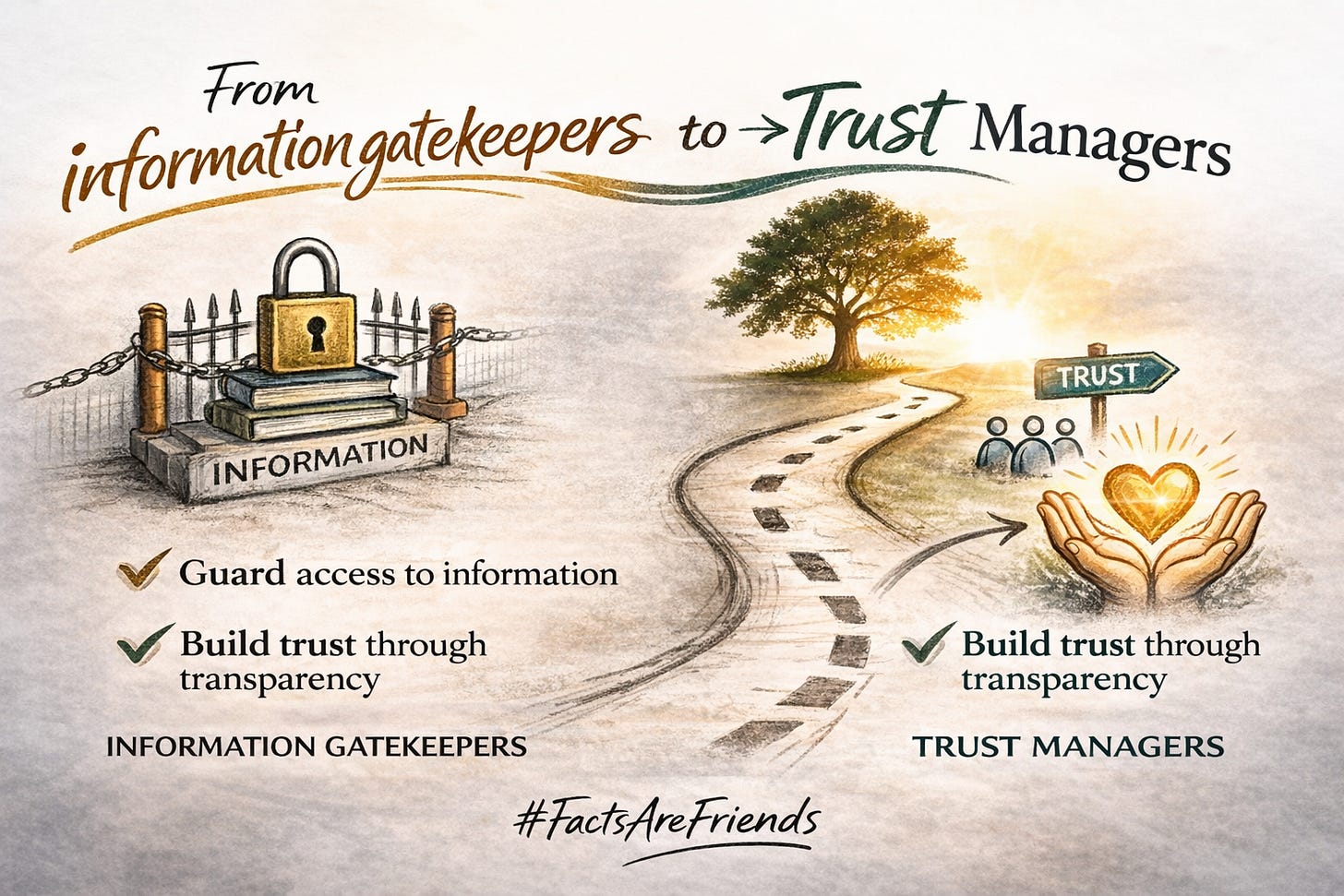
This is structural reorientation beyond motivational language. When people are oriented around a shared mission that transcends individual adequacy, belonging becomes possible. And belonging is good. Being exiled is bad. The Gallup data is consistent on this: teams with high psychological safety show 76% more engagement and 27% lower turnover risk.
Purpose answers the fundamental question of organisational identity - not “what do we do?” but “what do we stand for?”
A purpose-driven firm focuses on its reason for existing - the genuine service of clients, the development of its people, the contribution to the communities in which it operates. Financial outcomes become a natural consequence of faithful execution of that purpose. They are not the purpose itself.
This is not naivety. It is sustainable strategy.
Deloitte research has consistently demonstrated that purpose-driven organisations achieve four times higher valuations than low-purpose competitors, 40% higher retention rates and 30% higher innovation levels. Jump Associates’ 20-year longitudinal study shows a five times compound annual growth rate advantage over S&P 500 averages. The firms that will thrive through AI disruption are not those that simply add AI tools to a purposeless business model. They are those that know what they are for and let AI serve that purpose.
The practical imperative
The purpose-driven framework generates concrete, measurable, compounding advantages that purpose-indifferent firms will eventually struggle to match.
It means measuring success by client flourishing, not client fees. Asking, after every engagement: did the client feel genuinely served? Did we leave their situation better than we found it? Did we build something that will outlast the invoice? It means billing for value and deliverables, not for time.
It means investing in the development of every lawyer in the firm, including junior lawyers whose hourly rate makes that investment look, in the short term, economically questionable. It means creating environments where people feel safe to say they do not know something - which is, after all, the prerequisite for learning.
It means being honest with clients about what AI can now do efficiently and what genuinely still requires experienced human judgment. Firms that obscure this distinction to protect billing rates will be found out. The firms that engender most trust will openly harness AI for their clients’ benefit.
It means leading with vulnerability. Purpose-driven leaders model honesty about limitations, giving permission for everyone around them to be honest. Teams with high psychological safety show 50% more productivity and 74% less stress. The data consistently supports this.
Stage 4 — The Anthropological Constant
Data, faith and ego
The business data from Deloitte and Gallup reveals a truth that empirical measurement can describe but not fully explain: human beings are not units of production. They are creatures of meaning.
We may argue that whether one looks at 2024 Gallup data or ancient wisdom, the "operating system" of the human being hasn't changed in millennia
I am a Christian, and I integrate that perspective into my professional thinking because the data on psychological safety and retention is a modern measurement of ancient structural realities.

Rick Warren’s The Purpose Driven Life begins with a simple statement: it is not about you. That sentence dismantles the ego-centred operating assumptions of most professional culture more efficiently than any management framework.
The five organisational dimensions I have traced through the business research - service orientation, authentic community, character development, enabling others and lasting legacy - map onto five purposes Warren identifies for human existence: worship, fellowship, discipleship, ministry and mission. The parallels are striking and not, I think, accidental. Both bodies of thought address the same fundamental human realities: people need to belong; people long for meaning; people flourish when developed; people grow when trusted; people desire lasting significance.
Dr Anastassia Lauterbach put it well at the World Business Women Summit at the Palace of Westminster: technology may scale intelligence, but only humanity can scale trust. That is the bridge between the strategic argument and the deeper one. The firm of the future is a community of purpose that uses AI as a tool to free humans to do what they are, at their best, equipped for: to build, to trust and to serve. As Simon Sinek says, trust is a feeling, not a checklist or a purely rational calculation.
Those who organise around this reality will not merely survive the AI disruption. They will define the new era of practice.
If AI is the infection, purpose is the inoculation. It is the only thing the machine cannot replicate. And - as the research consistently shows and as older wisdom has always known - it is the only thing the client will ultimately pay a premium for. Look at your own buying habits: as with your own habits, discretionary loyalty and preference come from shared belief, not functional need. For these sorts of services t, clients do not pay a premium for process. They pay for belief-alignment and earned trust - purpose made visible in behaviour.
The challenge we need to address is to transition from legal practice as a factory of hours to lawyers being a sanctuary of trust.
The path is visible. The decision belongs to each firm.
The machine is already in the room.
The only question left is whether you will meet it as a depleted vendor or a purposeful partner.
Quentin Solt is a commercial solicitor with nearly forty years of experience navigating the evolution of the legal profession. As co-founder of a listed pan-European investment fund and author of the forthcoming AI, Abundance and the Future of Work, he specialises in the intersection of institutional value, emerging technology and human purpose. He writes on Substack and posts on LinkedIn. Available for consultation.
#FactsAreFriends
#LegalTech #PurposeDriven #FutureOfWork #AIandLaw
References & Further Reading
Ranganathan, A. & Ye, X.M. (2026). “AI Doesn’t Reduce Work - It Intensifies It.” Harvard Business Review, 9 February 2026.
Deloitte Insights (2015). “Core beliefs and culture: Chairman’s survey findings.” Deloitte University Press.
Edelman (2025). Trust Barometer Special Report: Brand Trust - From We to Me. UK Edition.
Jump Associates (2024). The Purpose Dividend.
American Psychological Association (2024). Work in America Survey.
Gallup (2024). State of the Global Workplace Report.
Edmondson, A.C. (2019). The Fearless Organization. Wiley.
Warren, R. (2002). The Purpose Driven Life. Zondervan.
Lauterbach, A. (2025). Keynote address. World Business Women Summit, Palace of Westminster, London.
Solt, Q. (Forthcoming). AI, Abundance and the Future of Work.