 Facts are friends
A note on context: This essay is a companion piece to my work on “Law at High Tide: Crossing the Bay”, which examines how AI is reshaping legal practice. The metaphor of crossing the bay at low tide - where the journey requires careful navigation of shifting ground - provides a framework for thinking about technological disruption across multiple domains. Some of the nautical allusions will resonate more fully in that context, but the analysis stands independently as an examination of AI’s role in judicial decision-making.
A new experiment has reignited an old question: could AI ever judge fairly?
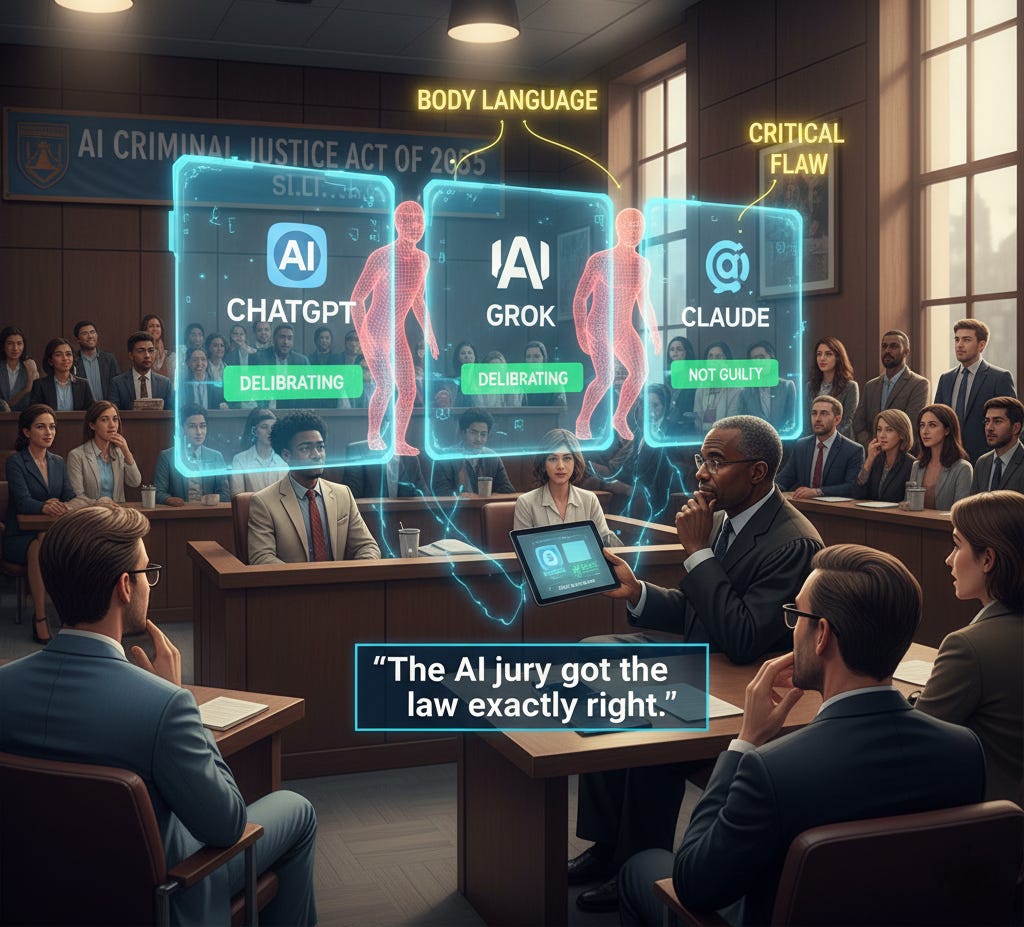
At the University of North Carolina School of Law, a mock trial used ChatGPT, Grok and Claude as jurors.
Critics identified what they perceived as a fatal flaw: as Professor Eric Muller observed, the AI could not see witnesses’ body language, could not detect whether they were “squirming in their seats or sweating or not making eye contact”. Fair enough - but these were language-model jurors receiving only transcripts, operating in a fundamentally different sensory environment from human jurors.
It was an experiment in the US, but the lessons hold good for the UK, too. The fictional case involved Henry Justus, an African American high school senior charged with robbery, tried under an imaginary AI Criminal Justice Act of 2035. The AI jury found the defendant not guilty - a verdict that he organising professor, Joseph Kennedy, called “more fair” than the human judge’s ruling in the real case on which the simulation was based.
The AI models were praised for being “very attentive to the law”. Professor Kennedy noted they got the law exactly right and seemed to consider all the important facts in their discussions with one another.
The systems processed transcripts of live testimony, legal arguments and jury instructions, then deliberated before an audience in what organisers described as one of the first simulations of its kind.
“The AI jury got the law exactly right.” — Professor Joseph Kennedy, UNC School of Law
A note on sources: I write from the UK, but have drawn on evidence from around the world - including extensive research from the United States and Israel as well as the UK - because these questions transcend borders. Where possible, I reference UK-specific evidence, but the cognitive biases and systemic challenges documented in American and Israeli studies are universal human traits that affect judicial systems everywhere.
What if calm is fairer?
This section examines why “dispassionate” AI judgement might produce more just outcomes than passionate human decision-making - and why the empirical evidence supports this counterintuitive claim.
The most telling criticism came from Professor Eisha Jain, who said the process seemed “divorced from the human experience”. She observed that “it felt as though the AI jury was debating something casual - whether or not to order coffee or tea, rather than deciding whether a person deserves to lose his liberty”.
This critique reveals a profound assumption. The criticism was not that the AI got the verdict wrong - Professor Kennedy considered it fairer than the original human judgement. The criticism was tonal. The AI was too calm, too analytical, too dispassionate.
But perhaps that’s precisely the problem with human judgement?
Which is likely to generate a more balanced outcome? Heated passion or logic? As I see it passion in a jury room may manifest in several ways, but none of them is conducive to justice. A juror whose son was mugged may project that trauma onto a defendant in an entirely unrelated robbery case. A juror harbouring unconscious racial bias may “feel” that a defendant “looks guilty” without being able to articulate any rational basis for that feeling. I recognise how I was uncomfortable in our youth group when young men arrived in hoodies, and declined to take them off. A juror may become emotionally invested in proving their initial reaction correct, digging in defensively rather than weighing evidence objectively.
“Perhaps calm is not indifference — it is fairness.”
Many of us have argued this point often enough to know how deep the unease runs. The debate rages on, circular and exhausting, whilst technology advances regardless of our philosophical reservations. AI is already woven into so much of our lives. It may be closer to understanding the “human heart of justice” than any judge who’s spent decades behind a bench. It has access to vastly more lived experience not just through millions of case files but also billions of social media exchanges, it also has greater - knowledge spanning multiple jurisdictions and centuries of precedent - than twelve randomly assembled jurors can be expected to have. And that is not to mention the sharper analytical tools which are built-in.
Of course, naysayers will deny the possibility until it happens. Perhaps a triumph of hope over reality? But when it does happen - and it will - they’ll be absolutely right to flag the pitfalls and guard against abuse. We’ll need them to help design safeguards, ensuring human oversight remains the ultimate safety net.
If we fear AI’s logic, it may be because we’ve forgotten how often human feeling fails.
The wrongful conviction crisis
Behind every statistic sits a life upended.
The empirical evidence of human fallibility in judicial decision-making is stark and disturbing.
Over 25,000 years of liberty have been lost to wrongful imprisonment.
In the US the Innocence Project has documented 375 DNA exonerations through 2020, with the National Registry of Exonerations recording over 3,700 total exonerations representing more than 25,000 years lost to wrongful imprisonment. Academic consensus in the US estimates wrongful conviction rates at between 2% and 10%, with around 5% most common. If accurate, this implies somewhere between 46,000 and 230,000 potentially innocent prisoners currently incarcerated in the United States alone. I have seen no evidence that the trend is not equally applicable to the UK.
Eyewitness testimony - the foundation of many prosecutions - is shockingly unreliable. It transpires that misidentification appears in approximately 70% of DNA exonerations, making it the primary cause of wrongful convictions. Field research shows 1 in 3 eyewitnesses who choose from line-ups are mistaken, with 50% higher error rates for cross-racial identifications.
The memory science is unequivocal: memory reconstructs rather than reproduces events, information received after an event alters memories, confidence doesn’t correlate with accuracy, and stress and weapons reduce accuracy. All 25 pure cross-race cases in the Innocence Project database involved White witnesses misidentifying Black (23) or Hispanic (2) suspects.
For those who want the numbers:
Cognitive bias: Research published in 2019 analysing 50 wrongful conviction cases found approximately 75% showed confirmation bias (seeking evidence that supports initial beliefs whilst ignoring contradicting evidence) and nearly 50% displayed tunnel vision (focusing on one suspect whilst ignoring alternatives)
Racial disparities: Black people are 7 times more likely to be wrongly convicted of murder; Black sexual assault exonerees are approximately 3.5 times more likely to be innocent than White exonerees; Black exonerees are 60% more likely to be sentenced to life imprisonment and experience on average over 4 years longer before exoneration
Sentencing gaps: US Sentencing Commission analysis found Black males received federal sentences roughly 13% longer than White males; research analysing over 500,000 sentencing records found system-wide Black defendants received average sentences 19 months longer than White defendants; 14 federal districts showed significant differences even after controlling for demographics and sentencing factors
The case of Levon Brooks and Kennedy Brewer dramatically illustrates tunnel vision: two similar murders in the same Mississippi county led to both boyfriends being wrongfully convicted despite an obvious pattern suggesting a serial killer. The actual perpetrator, Justin Albert Johnson, was a suspect in both investigations but ignored. Combined, the two innocent men served approximately 18 years, and the second murder could have been prevented.
When judges get tired and hungry
“Justice should not depend on lunch breaks.”
Decision fatigue and cognitive limitations affect even experienced judges. The “hungry judge effect” study published in 2011 in the Proceedings of the National Academy of Sciences tracked over 1,100 parole decisions by experienced Israeli judges (average 22 years experience) across daily food breaks. Favourable rulings dropped from approximately 65% to nearly 0% within each decision session, then returned abruptly to 65% after food breaks.

Research on anchoring bias (where an initial number influences subsequent judgement even when irrelevant) found experienced judges influenced by arbitrary anchors produced roughly 30% longer sentences with higher anchors. Federal magistrate judges in America showed the same susceptibility to anchoring, hindsight bias (believing past events were more predictable than they were) and egocentric biases (overestimating one’s own knowledge and abilities) as the general population - legal training provided no protection.
The very “human experience” that critics claim AI lacks is often the source of profound injustice. Personal experience is not universal truth - it is anecdotal, limited and frequently prejudiced. The danger of an individual’s experience seeking retribution when projected onto the defendant in the courtroom is documented across decades of wrongful convictions.
Properly designed and informed AI is less likely to have these failings. It does not wake up in a bad mood. It does not harbour resentment from an unrelated experience. It does not tire after hours of testimony. It does not make snap judgements based on a defendant’s appearance, accent or demeanour. It weighs evidence according to the logical standards we claim to aspire to but frequently fail to achieve.
The critics who say AI approaches the question “like ordering coffee” miss the point entirely. Perhaps both should be approached with the same disciplined logic: assess the available information, apply the relevant standards and reach a conclusion based on evidence rather than emotion. The gravity of the decision should inform the care with which we gather and assess evidence, not the temperature of our emotional response.
When embodied AI arrives
This section explores how AI’s ability to read non-verbal cues may soon surpass human capability - challenging the assumption that missing body language is a fatal flaw.
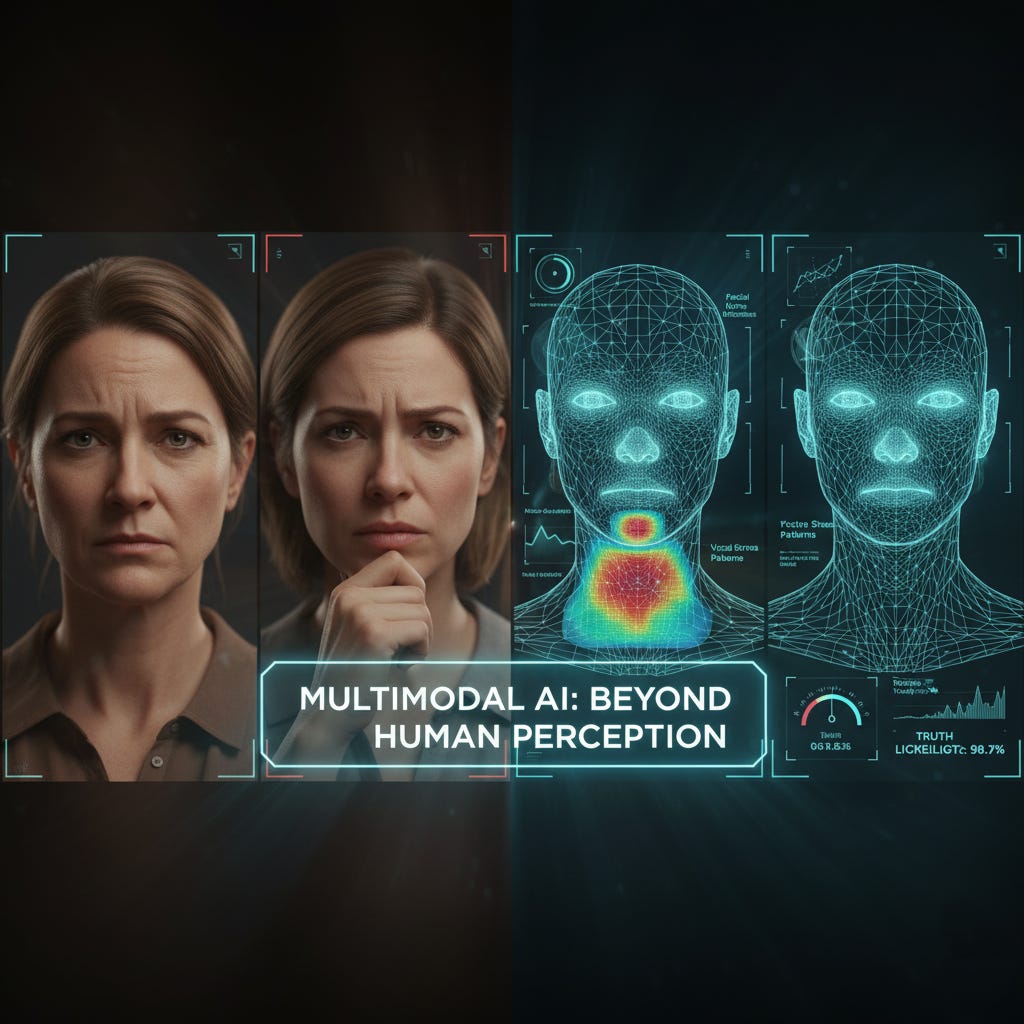
The criticism about body language, while valid given current limitations, may prove temporary. The technology used in the UNC trial received only transcripts. What happens when AI can see and listen? What happens when multimodal AI processes facial expressions, vocal patterns, posture and micro-expressions?
[IMAGE: Split-screen showing human juror faces on one side and abstract AI face recognition interface on the other]
Where humans detect deception little better than chance, multimodal AI can already reach well beyond 80% accuracy. Research published in 2021 in Nature Scientific Reports demonstrates that multimodal AI systems analysing body language, vocal patterns and non-verbal cues achieve accuracy rates of 75% to 99% in emotion recognition tasks, substantially exceeding human baselines of 54% to 70%.
In deception detection specifically, human ability is remarkably poor - studies show people perform only slightly better than chance at around 54% according to a 2006 meta-analysis examining thousands of studies. AI text-based lie detection achieves approximately 67% accuracy, whilst multimodal AI-driven systems reach over 80% in controlled settings. AI systems analysing speech emotion achieve around 70% accuracy compared to humans’ approximately 60%, and when facial expressions combine with brain wave data, accuracy reaches over 99%.
This doesn’t guarantee perfect accuracy - no system will ever achieve that - but it challenges the assumption that human observation of body language represents some gold standard of truth detection. Often it represents precisely the opposite: confident ignorance masquerading as insight. We overweight certain cues (looking away, fidgeting) that are actually poor indicators of dishonesty, whilst missing subtle patterns that might be more reliable.
When machines can see as well as think, the meaning of “jury of peers” will shift again.
Experts express substantial caution, however. Research published in 2023 emphasises that “AI is unable to synthesise observational data during forensic interviews” and “exhibits limited capacities when tasked with abstract or critical thinking”. Real-world deception isn’t simple - context, culture and personal habits all affect how people behave when lying, and performance in laboratory conditions degrades substantially in naturalistic settings.
But can logic alone ever make the moral leaps that changed history?
This section examines whether AI could drive legal innovation like ending segregation or expanding habeas corpus - and concludes it probably cannot, which may actually be optimal design.
Logic, it is said, can uphold justice; only vision has ever transformed it.
This leads to questioning whether AI ever drive the kind of legal innovation that changed society? Could it make the intuitive leaps that transformed justice systems?
When judges changed the world
Think of habeas corpus - literally “you have the body” in Latin - the ancient writ requiring authorities to bring a prisoner before a court to justify their detention. What began as a simple medieval remedy evolved into what the great legal scholar Blackstone called “the great writ of liberty”.
In 1679, the English Parliament passed the Habeas Corpus Act after decades of Crown abuses. The Act didn’t just preserve the writ - it revolutionised it, imposing strict time limits (prisoners must be brought before judges within days, not months) and heavy fines on sheriffs and judges who delayed (£500 - equivalent to roughly £100,000 today). Parliament essentially told the King: you can still arrest people, but you must justify yourself to independent judges immediately, not whenever it suits you.
In America, Congress took this further. The Habeas Corpus Act of 1867, passed after the Civil War, dramatically expanded federal jurisdiction, extending the writ to “all cases” where any person was “restrained of liberty in violation of the constitution, or of any treaty or law of the United States”. This meant that for the first time, federal courts could review whether state courts had violated federal constitutional rights - a fundamental reshaping of American federalism.
What had been a writ saying “show me the prisoner and your legal authority” became a mechanism saying “show me everything about this case and prove it was just”.
In the leading 1954 case of Brown v. Board of Education, the US Supreme Court had the moral courage to overturn Plessy v. Ferguson’s “separate but equal” doctrine despite nearly six decades of established precedent. Chief Justice Earl Warren’s opinion, joined unanimously by his colleagues, declared that “separate educational facilities are inherently unequal”, recognising that the Fourteenth Amendment’s guarantee of equal protection could not coexist with state-mandated racial segregation.
These watershed moments required more than logic. They relied on human judges willing to recognise when existing law betrayed evolving societal values. They required wisdom to see beyond the letter of the law to its spirit. They needed the courage to say “this is unjust” even when precedent said otherwise. They necessitated moral vision - the ability to perceive what justice demands even when existing doctrine points elsewhere.
AI’s current limitations in moral reasoning
Today we can see that AI will excel at applying rules consistently. It will synthesise vast bodies of precedent, identify relevant principles and predict outcomes based on historical patterns. What it currently struggles with is what we describe as genuine “moral reasoning” in situations where no clear precedent exists or where competing ethical principles pull in different directions.
When Justice Warren declared in Brown that the question was “whether the Equal Protection Clause allows states to maintain racially segregated schools”, he was reinterpreting constitutional meaning in light of changing social understandings and accumulating evidence about the psychological harms of segregation. The decision drew upon social science research, moral philosophy and a vision of what American constitutional democracy ought to mean. It was an act of creation, not just interpretation.
Could AI have made this leap? The honest answer is that current AI systems almost certainly could not. They would identify Plessy v. Ferguson as controlling precedent. They would note that courts should follow established law unless there are compelling reasons to overturn it (the legal principle called stare decisis, Latin for “to stand by things decided”). They would observe that nothing in the constitutional text had changed since 1896. We might expect AI to uphold segregation because the legal architecture supported it, even whilst the moral architecture was collapsing.
“Logic alone never freed a slave - but bias has condemned many.”
I hope it is helpful to reflect on a contemporary moral dilemma that you may recognise today: should predictive policing algorithms ever override privacy rights? An AI trained on case law and policing data could calculate optimal deployment patterns, predict crime locations with statistical precision and maximise arrests per policing hour. What the AI will not do today is weigh whether a marginalised community’s dignity matters more than efficiency gains, or whether democratic oversight should trump algorithmic optimisation. These are profound questions about the kind of society we want to build, not just technical questions about implementing algorithms.
Science fiction has long explored these limitations. Frank Riley’s 1955 story “The Cyber and Justice Holmes” - one of the earliest works featuring robot judges - concluded that machines lack the capacity to dream, arguing that “the dream is the difference” and that algorithms should free humans to dream, not replace them.
Philip K. Dick’s 1956 “Minority Report” proved extraordinarily prescient in predicting arrests based on predicted future crimes and risk assessment determining criminal propensity, directly paralleling modern risk assessment systems. The 2012 anime Psycho-Pass depicted a society governed by continuous brain-scanning algorithms assigning “Crime Coefficients” - implemented just two years before China’s remarkably similar Social Credit System launched in 2014.
These fictional works consistently warn that perfect objectivity is illusory and something essential is lost when moral judgement becomes algorithmic.
Technology of course now pervades all our lives, and it is quite possible - if not probable - that AI will be able to determine what we as a society think is appropriate sooner and more accurately than a judge or random selection of 12 jurors may decide.
Modern AI systems analyse billions of behavioural data points daily through social media, email and other communications as well as in the press and online commentaries providing exposure to contemporary social norms that could dramatically exceed judicial understanding.
Research published in 2021 in Nature Scientific Reports demonstrates AI systems can identify social norm violations with over 90% accuracy across thousands of analysed situations. AI systems update continuously, analysing real-time social media behaviour, whilst judicial composition changes generationally over decades. This creates genuine questions about which system better reflects contemporary community values - the 69-year-old average federal judge or the AI trained on billions of current social interactions.
Perhaps wisdom lies in assigning each its proper domain
There’s another perspective worth considering. Perhaps AI’s inability to overturn precedent based on moral reasoning represents a feature rather than a limitation. Perhaps the revolutionary rewriting of law should remain a human prerogative, whilst AI excels at the equally important work of applying existing law fairly and consistently.
The cases that required moral innovation - Brown, habeas corpus expansions, Miranda rights - are outliers. The vast majority of criminal cases involve relatively straightforward application of established principles to particular facts. Did the defendant commit the act? Does the evidence prove it beyond reasonable doubt? Were proper procedures followed? These are precisely the questions AI can address with greater consistency than human juries.
AI’s resistance to overturning precedent might actually reduce injustice in many contexts. For every Brown v. Board of Education - a morally courageous departure from unjust precedent - there are countless examples of judges imposing their personal moral views in ways that reduced rather than enhanced justice. Judges who believed interracial marriage was immoral, or that women should not vote, or that homosexual conduct should be criminalised all felt they were applying moral reasoning to legal questions. We celebrate the moral innovations that align with our current values whilst forgetting the moral impositions that don’t.
A system where AI applies the law as written, whilst humans retain authority to change the law through democratic and appellate processes, might actually represent optimal institutional design. AI provides consistency and eliminates bias in application. Humans provide the moral vision necessary for periodic course corrections. Each does what it does best.
When logic saves lives: algorithms that simultaneously reduce crime and increase equity
If you want evidence, look to New York’s bail decisions. The findings challenge every assumption about trade-offs between public safety and fairness.
The question becomes practical rather than philosophical. Can well-designed algorithms actually improve justice outcomes? The most compelling empirical evidence comes from research that challenges our assumptions about the supposed trade-off between public safety and fairness.
“Well-designed algorithms can cut jail populations by 40% and crime by 25%.”
A landmark study published in 2017 in the Quarterly Journal of Economics analysed over 750,000 pretrial bail decisions in New York City between 2008 and 2013, comparing human judges to machine learning algorithms (specifically, gradient boosted decision trees - a type of AI that builds multiple decision rules and combines them for better predictions).
The algorithm achieved what researchers call 0.707 AUC predictive accuracy - this is a measure where 0.5 means random guessing and 1.0 means perfect prediction, so 0.707 means the algorithm was substantially better than chance at predicting which defendants would fail to appear or commit new crimes. At the same jailing rate as judges, algorithms could reduce crime by between 15% and 25%. At the same crime rate, algorithms could reduce jail populations by between 20% and 40%. Even under worst-case assumptions that all jailed defendants would have committed crimes, crime reduction of over half the main estimate remained achievable.
Judges were making systematic mistakes
The algorithm revealed that judges were severely mis ranking defendants by risk. The riskiest 1% of defendants according to the algorithm’s predictions showed failure-to-appear rates of over 55% and re-arrest rates of over 60%. Judges released nearly half of them.
Stricter judges did not jail the riskiest defendants first. Instead, they drew additional detainees from throughout the predicted risk distribution - essentially jailing people more or less at random relative to actual risk. Only about one-third of the additional defendants detained by stricter judges came from the highest-risk groups, suggesting they could achieve the same crime reduction by jailing roughly half as many people, or achieve the same detention rate with approximately 75% larger crime reduction.
The racial equity findings are remarkable. To achieve the same crime rate as judges, algorithms would jail roughly 40% fewer minorities, including approximately 40% fewer Black defendants and 45% fewer Hispanic defendants. The study demonstrated algorithms can be a “force for racial equity” when properly constructed, challenging assumptions that objectivity requires ignoring race - sometimes explicitly considering race to discount correlated factors produces fairer outcomes.
The research decomposed where judges went wrong. Roughly 25% of the performance gap resulted from inconsistency and noise in decisions (from mood, defendant appearance, extraneous factors), roughly 10% from misranking defendants (wrong weighting of which characteristics matter), and roughly 65% from wrong structure (ignoring key characteristics or how they interact). Predicted judge decisions outperformed actual judge decisions - when judges deviated from what a model of their own past behaviour would predict, outcomes worsened, suggesting costs of inconsistency outweigh any gains from case-specific private information.
The contrast with poorly designed systems
The contrast with COMPAS (Correctional Offender Management Profiling for Alternative Sanctions) - a proprietary risk assessment system used across multiple American states for bail and sentencing decisions - demonstrates the stakes of getting design wrong.
An investigation by the news organisation ProPublica in 2016 found COMPAS correctly predicted recidivism (re-offending) only around 60% of the time and violent recidivism merely 20% of the time - barely better than random guessing. More troubling, Black defendants who did not re-offend were misclassified as high risk at nearly twice the rate of White counterparts (45% versus 23%), whilst White defendants who did re-offend were mislabelled low risk almost twice as often as Black re-offenders (48% versus 28%).
A 2018 study from Dartmouth University comparing COMPAS to untrained humans recruited online found COMPAS achieved 65% accuracy, individual humans 63%, but groups of humans 67% - suggesting COMPAS was somewhat more accurate than individuals with little criminal justice expertise, but less accurate than groups. The properly designed algorithm in the New York study achieved substantially better performance whilst reducing rather than exacerbating racial disparities.
The difference between these outcomes is design, transparency and accountability - not an inherent flaw in using algorithms for justice decisions.
Mercy and prudence: The economic and moral dimensions
AI could dramatically reduce justice system costs whilst enabling rehabilitation-focused approaches that prevent crime rather than merely punish it.
The introduction of AI into judicial decision-making carries profound economic and moral implications.
The cost of justice in most developed legal systems has become prohibitive for ordinary citizens. A criminal trial requires substantial resources - judges’ time, courtroom space, legal representation, jury coordination. Many defendants wait months or years for trial, often in pretrial detention, because the system simply cannot process cases quickly enough.
AI could radically reduce these costs. Automated analysis of evidence, AI-assisted legal research and algorithmic processing of routine motions could free human judges to focus on the most complex and consequential decisions. This augments rather than replaces human judgement - it enables human judges to apply their judgement more effectively by eliminating the routine processing work that currently consumes their time.
Mercy and prudence were once moral virtues; AI may make them practical again.
Consider the question of rehabilitation versus punishment. Our current system focuses heavily on punitive responses - determining guilt and imposing sanctions. This made sense in an information-poor environment where we lacked the tools to understand underlying causes of criminal behaviour or to tailor interventions effectively.
AI opens different possibilities. A system with access to comprehensive social, psychological and economic data about an offender could identify underlying trauma, mental health issues, addiction or economic desperation that contributed to criminal behaviour. Rather than simply meting out punishment, the system could also seek to assist. Sentencing could become more rehabilitative, addressing root causes rather than merely imposing consequences.
This vision echoes Robert Peel’s nineteenth-century police reforms, which emphasised prevention through community presence rather than punishment after the fact. Peel - who founded London’s Metropolitan Police in 1829 - understood that certainty of detection deters crime more effectively than severity of punishment. If AI can identify criminogenic factors (circumstances that increase likelihood of criminal behaviour) early and intervene effectively, we might finally realise Peel’s vision - a justice system that prevents crime by addressing its causes rather than merely punishing its effects.
The partnership ahead
For now, the most promising path combines AI’s analytical consistency with human moral reasoning - though the human role may eventually evolve from routine involvement to final oversight.
Partnership may be the design principle that keeps justice recognisably human.
Perhaps the most promising path forward for now isn’t AI replacing human judgement but augmenting it. Imagine a system where AI processes evidence, identifies relevant law, flags potential biases and presents analysis - but humans make ultimate determinations in cases involving liberty, life or fundamental rights.
I emphasise “for now” deliberately. As AI capabilities advance and trust in well-designed systems grows through demonstrated performance, the human role may evolve from routine involvement in every decision to serving as the final safety valve - the ultimate check on algorithmic reasoning when cases raise novel questions, when moral considerations demand it, or when the stakes are highest. This evolution won’t happen immediately, but we should design systems with that possibility in mind rather than assuming today’s hybrid model represents a permanent endpoint.
In the near-term model, AI serves as an incredibly capable research assistant and analyst. It ensures no relevant precedent is overlooked, no piece of evidence goes unexamined, no logical inconsistency remains undetected. The human judge or jury considers this analysis alongside less quantifiable factors: mercy, proportionality, the defendant’s character and potential for rehabilitation, the specific context that statistics cannot capture.
This partnership acknowledges both AI’s strengths and its current limitations. It harnesses algorithmic consistency whilst preserving human wisdom. It eliminates arbitrary bias whilst retaining moral reasoning. It provides the tools for revolutionary legal change when necessary whilst ensuring everyday justice is administered fairly and efficiently.
The challenge lies in designing systems where this partnership functions effectively. How do we prevent humans from simply rubber-stamping AI recommendations without genuine engagement? How do we ensure AI systems are transparent enough that human overseers can meaningfully evaluate their reasoning? How do we prevent the gradual erosion of human oversight as trust in AI systems grows?
Experience with automated decision-making in other domains suggests that humans tend to over trust algorithmic outputs, particularly when those outputs are presented with apparent precision and confidence. The challenge will be maintaining healthy scepticism whilst still benefiting from AI’s analytical capabilities.
Designing for justice, not just efficiency
AI systems must be designed around fairness principles, not just trained on historical data that reflects historical biases - and humans must retain authority to override when moral reasoning demands it.
As we move towards greater AI integration in justice systems, we must resist the temptation to optimise purely for efficiency. A system that processes cases faster and costs less achieves nothing if it delivers unjust outcomes. The question must always be: does this advance justice?
This requires encoding into AI systems principles that reflect societally acceptable concepts of fairness, proportionality and restoration. It means training algorithms on carefully curated datasets that represent justice as we aspire to practice it, rather than merely on historical case outcomes which may reflect historical biases.
It means building in safeguards against the most common forms of injustice. If historical data shows that certain demographics receive harsher sentences for equivalent crimes, the AI should be designed to flag and correct for this disparity rather than perpetuate it. If certain types of evidence are particularly unreliable (eyewitness testimony, for instance, which we know appears in 70% of wrongful convictions), the AI should weight this appropriately rather than treating all evidence as equally credible.
A defendant sentenced by algorithm cannot appeal to compassion; that is why the human override must remain sacred.
Most importantly, it means preserving human authority to override AI recommendations when moral reasoning demands it. The AI should serve as a check against human passion leading to injustice - but humans must serve as a check against algorithmic rigidity leading to injustice. Each guards against the other’s characteristic failings.
Conclusion: The covenant and the crossing
Justice has always drawn on reason and mercy alike - the technology will not change that covenant unless we let it.
The water continues to rise. AI will play an increasing role in justice systems regardless of whether legal traditionalists are comfortable with the change. The question is whether this will happen on our terms or on someone else’s.
We can dig in defensively, insisting that human judgement remains essential whilst offering no coherent explanation for why inconsistent, biased human decisions producing 70% eyewitness misidentification rates and 7-times wrongful conviction disparities for Black defendants are preferable to consistent, logical algorithmic ones. This path leads to irrelevance - the crossing will occur without us, designed by technologists who understand systems but not justice.
We can engage actively in designing systems that preserve what is genuinely valuable about human legal reasoning whilst harnessing AI’s strengths. This path requires humility about our own limitations - acknowledging that confirmation bias appears in three-quarters of wrongful conviction cases and that judicial fatigue causes favourable rulings to drop from 65% to nearly 0% within decision sessions - alongside clear-eyed recognition of AI’s current boundaries. It means protecting the space for moral innovation whilst embracing algorithmic consistency. It means welcoming dispassionate logic in routine cases whilst preserving passionate advocacy for changing unjust laws.
“Let justice roll on like a river, righteousness like a never-failing stream.” — Amos 5:24
Justice began as a covenant - between law and conscience, reason and mercy. The law’s Christian heritage reminds us that both are sacred duties. Mercy and judgement have always walked together in our courts. The technology will not change that covenant unless we let it. Our task is to ensure that what we build reflects not only how we think, but what we believe about one another.
The choice we face is this: poorly-designed justice systems that perpetuate historical biases through human inconsistency or well-designed systems that combine human moral reasoning with algorithmic consistency. The latter requires us to answer profound questions about the kind of society we want to build, not just technical questions about implementing algorithms. What principles should govern AI decision-making? What safeguards will prevent abuse? Who bears responsibility when the system errs? How do we maintain democratic accountability over algorithmic justice?
“Justice began as a covenant between law and conscience.”
The evidence from New York City’s bail decisions demonstrates that well-designed algorithms can simultaneously reduce crime by up to 25% and jail roughly 40% fewer minorities. The wrongful conviction data demonstrates that human decision-making produces 70% eyewitness misidentification rates, 7-times racial disparities and thousands of years of wrongful imprisonment. These facts are friends - uncomfortable friends perhaps, but friends nonetheless. They tell us that the status quo is indefensible and that thoughtfully designed AI systems offer genuine hope for improving both safety and equity.
I’m tired of defending the possibility. Let’s move past denial to design. The crossing is coming. We can help build the boats or watch from the shore. But we cannot stop the tide.
Exploring how AI reshapes society, work, politics and human connection - from my forthcoming book.
#FactsAreFriends
Sources
UNC Mock Trial and Initial Reactions:
Law school’s trial by AI jury highlights tech’s pros and cons, Reuters, 28 October 2025: https://www.reuters.com/legal/litigation/law-schools-trial-by-ai-jury-highlights-techs-pros-cons-2025-10-28/
Law School Students to Argue Before Jury of AI Programs in Mock Trial, UNC School of Law: https://law.unc.edu/news/2025/10/law-school-students-to-argue-before-jury-of-ai-programs-in-mock-trial/
Law School Tests Trial With Jury Made Up of ChatGPT, Grok, and Claude, Futurism: https://futurism.com/artificial-intelligence/law-school-trial-ai-jury
Wrongful Convictions and Human Bias:
The Innocence Project - DNA Exonerations: https://innocenceproject.org/all-cases/
National Registry of Exonerations: https://www.law.umich.edu/special/exoneration/Pages/about.aspx
Eyewitness Misidentification, Innocence Project: https://innocenceproject.org/causes/eyewitness-misidentification/
Race and Wrongful Convictions in the United States, National Registry of Exonerations, 2022: https://www.law.umich.edu/special/exoneration/Documents/RaceReport2022.pdf
Rossmo, D. K., & Pollock, J. M. (2019). “Confirmation Bias and Other Systemic Causes of Wrongful Convictions: A Sentinel Events Perspective”, Northeastern University Law Review, 11(2)
Judicial Bias and Sentencing Disparities:
Demographic Differences in Sentencing, US Sentencing Commission: https://www.ussc.gov/research/research-reports/demographic-differences-sentencing
Racial Disparities in Sentencing, The Sentencing Project: https://www.sentencingproject.org/reports/racial-disparities-in-sentencing/
Danziger, S., Levav, J., & Avnaim-Pesso, L. (2011). “Extraneous Factors in Judicial Decisions”, Proceedings of the National Academy of Sciences, 108(17): https://www.pnas.org/doi/10.1073/pnas.1018033108
AI Accuracy in Behavioral Analysis:
Koul, A., et al. (2021). “Multimodal Machine Learning for Crime Scene Analysis”, Nature Scientific Reports: https://www.nature.com/srep/
Bond, C. F., & DePaulo, B. M. (2006). “Accuracy of Deception Judgments”, Personality and Social Psychology Review, 10(3)
Algorithmic Justice Research:
Kleinberg, J., Lakkaraju, H., Leskovec, J., Ludwig, J., & Mullainathan, S. (2017). “Human Decisions and Machine Predictions”, Quarterly Journal of Economics, 133(1): https://academic.oup.com/qje/article/133/1/237/4095198
Angwin, J., Larson, J., Mattu, S., & Kirchner, L. (2016). “Machine Bias: Risk Assessments in Criminal Sentencing”, ProPublica: https://www.propublica.org/article/machine-bias-risk-assessments-in-criminal-sentencing
Dressel, J., & Farid, H. (2018). “The Accuracy, Fairness, and Limits of Predicting Recidivism”, Science Advances, 4(1): https://www.science.org/doi/10.1126/sciadv.aao5580
AI in Criminal Justice - General:
AI’s Complex Role in Criminal Law: Data, Discretion, and Due Process, American Bar Association, March 2025: https://www.americanbar.org/groups/gpsolo/resources/magazine/2025-mar-apr/ai-complex-role-criminal-law-data-discretion-due-process/
Algorithmic Justice or Bias: Legal Implications of Predictive Policing Algorithms in Criminal Justice, Johns Hopkins Undergraduate Law Review, 31 December 2024: https://jhulr.org/2025/01/01/algorithmic-justice-or-bias-legal-implications-of-predictive-policing-algorithms-in-criminal-justice/
How AI Systems Threaten to Erode the Rule of Law, JURIST, 14 March 2025: https://www.jurist.org/commentary/2025/03/how-ai-systems-threaten-to-erode-the-rule-of-law/
AI in Criminal Justice: The Bias and Accountability Dilemma, The Legal Wire, 4 February 2025: https://thelegalwire.ai/ai-in-criminal-justice-the-bias-and-accountability-dilemma/
Historical Legal Cases:
Habeas Corpus Explained, Brennan Center for Justice: https://www.brennancenter.org/our-work/research-reports/habeas-corpus-explained
Brown v. Board of Education, NAACP Legal Defense Fund: https://www.naacpldf.org/brown-vs-board/
Diverse Juries Research:
Sommers, S. R. (2006). “On Racial Diversity and Group Decision Making: Identifying Multiple Effects of Racial Composition on Jury Deliberations”, Journal of Personality and Social Psychology, 90(4)
Bergold, A. N., & Kovera, M. B. (2022). “When Diversity Matters: The Effect of Jury Racial and Socioeconomic Diversity on Jury Verdicts”, Personality and Social Psychology Bulletin
Further research and considerations
The research documents informing this essay contained extensive additional material that space constraints prevented including. For readers interested in deeper exploration, the following topics warrant consideration:
1. Federal judiciary demographics and social isolation
The federal judiciary averages 69 years old - the oldest in US history - with 50% aged 65 or older, creating a 27-28 year age gap with median working Americans. The bench remains 71-80% white, 66-73% male, and less than 2% LGBTQ+, with 16 states having zero federal judges of colour. Research in the Duke Law Journal documents that this generational gap means judges struggle with technology “digital natives” use instinctively, whilst the Michigan Law Review reveals courts embed “antiquated norms” into constitutional law. The legal lag is structural: same-sex relationship acceptance rose in the 1990s-2000s, with Lawrence v. Texas (2003) and Obergefell v. Hodges (2015) lagging 10-25 years behind norm shifts. Cell phones became widespread in late 1990s, but Riley v. California requiring search warrants wasn’t decided until 2014 - a 15+ year lag.
2. AI’s superior access to contemporary social values
Modern AI systems analyse billions of behavioural data points daily through social media, providing exposure to contemporary social norms that dramatically exceeds judicial understanding. Research published in 2021 in Nature Scientific Reports demonstrates AI systems identify social norm violations with over 90% accuracy and 95% precision across over 8,000 situations. GPT-class models train on datasets containing trillions of tokens whilst processing billions of image-text pairs. AI systems update continuously, analysing real-time social media behaviour, whilst judicial composition changes generationally over 25-40 years. This creates genuine questions about which system better reflects contemporary community values.
3. Diverse deliberative panels outperform individual judges
Historical evolution and modern research converge: diverse panels systematically outperform individuals in complex decision-making. The Marquis de Condorcet’s 1785 jury theorem mathematically demonstrated that collective accuracy approaches certainty with sufficient voters. Samuel Sommers’ landmark 2006 study found diverse juries deliberated approximately 20% longer, cited significantly more case facts, and made fewer factual errors. Even before deliberation began, White jurors knowing they would deliberate in diverse groups showed altered information processing - only around 35% initially voted guilty compared to 50% in homogeneous groups. Research by Bergold and Kovera published in 2022 found diverse juries demonstrated higher-quality deliberations through more sophisticated conversations and advanced-level reasoning. Bruce Spencer’s analysis estimated jury verdicts are accurate no more than 87% of the time - but judge-jury agreement rates were only 77%, indicating substantial differences between single judges and panels.
4. Prevention consistently outperforms punishment
Sir Robert Peel’s 1829 principles emphasised crime prevention as “alternative to repression by military force”, with effectiveness measured by “absence of crime, not visible evidence of police action”. Meta-analyses demonstrate rehabilitation’s superiority: educational and vocational programs produce significant recidivism reduction, whilst harsh punitive measures don’t necessarily reduce reoffending. Nordic countries emphasising rehabilitation achieve 20-30% recidivism rates compared to US rates of 60-70%. Restorative justice research shows victim satisfaction consistently exceeds 85% across studies (approximately 80% mediated versus 60% court samples), with around 80% restitution completion for mediated cases versus 60% court-ordered. Economic analysis strongly favours rehabilitation: average annual costs per inmate range £30,000-£60,000+, whilst victim-offender mediation costs approximately £700 per session.
5. Technical bias mitigation challenges
The COMPAS case demonstrates implementation difficulties despite sophisticated algorithms. Different fairness definitions often conflict mathematically - optimising for one metric can worsen others. Historical data reflects historical discrimination, creating “selective labels” problems. Eliminating protected characteristics from training data doesn’t prevent proxies from encoding the same biases. Research published in the Columbia Human Rights Law Review argues for “affirmative action in algorithmic criminal sentencing”, explicitly incorporating race to discount correlated factors - supported by the Kleinberg study showing algorithms can reduce both crime and racial disparities simultaneously. This requires transparency, regular bias testing, diverse oversight and clear accountability - elements often absent in proprietary systems.
6. Science fiction’s prescient warnings
Beyond the examples in the main text, extensive fictional exploration exists: Daniel Suarez’s “Daemon” series depicts distributed AI governance systems more powerful than nation-states. Cory Doctorow’s “Affordances” published in 2019 explores how “empiricism-washing makes bias seem objective because bias has been quantified”. An AI & Society journal study analysing over 100 recent sci-fi works found emphasis on mundane risks: scoring, nudging, discrimination and surveillance rather than dramatic confrontations. The overwhelming trend is cautionary, warning that perfect objectivity is illusory and something essential is lost when moral judgement becomes algorithmic.
7. Real-world consequences of wrongful convictions
From DNA exonerations alone, 165 actual assailants were identified who committed 154 additional violent crimes whilst innocents remained imprisoned: 83 sexual assaults, 36 murders and 35 other violent crimes. From false confession cases, 38 real perpetrators committed 48 additional crimes: 25 murders, 14 rapes and 9 other violent offences. Jennifer Thompson, who misidentified Ronald Cotton leading to wrongful conviction, later observed: “At the center of every wrongful conviction case, there’s a perpetrator, and everybody in the circle outside gets hurt”. Anthony Ray Hinton spent 30 years on death row based solely on disputed ballistics before unanimous Supreme Court reversal - Alabama provided no compensation.
8. Human-in-the-loop effectiveness requirements
Effective “human-in-the-loop” systems require far more than token presence. The Vanderbilt Law Review identifies the “MABA-MABA trap” - assuming combinations create best of both worlds when reality proves hybrid systems have unique failure modes. Research published at ACM FAccT 2024 identifies four critical dimensions: sufficient causal power, suitable epistemic position, appropriate psychological capacity and proper organisational support. The EU AI Act Article 14 mandates human oversight for high-risk systems but lacks clear guidelines on overseer responsibility and risks becoming “rubber stamping”. Research suggests optimal panels comprise 3-5 members for meaningful epistemic gains - the EU’s two-person requirement for biometric systems appears insufficient.