 Facts are friends
This essay is adapted from a talk I gave at the JUVE Legal Operations Conference in Cologne on 18 June 1016.
It addresses commercial and corporate legal practice - the world of contracts, transactions, mergers, acquisitions and commercial advisory work. It is the terrain I know from over four decades of practice in the UK. I make no claim to speak authoritatively about other specialist areas or jurisdictions where the dynamics of AI adoption may differ.
Let me start by being honest about what I am and what I am not. I am a commercial solicitor. I have been practising for over forty years. I co-founded a pan-European venture capital fund. I have been investing in technology, including AI, for over 25 years.
What I am not is a technology vendor. I am not selling a product. I am not defending a business model. And I am not going to tell you that everything will be fine. In the end, it may be - but we have a rough ride ahead of us, and we are fooling ourselves to deny it.
A fortress in Lisbon
Earlier this year I was in Lisbon, standing inside the walls of St George’s Castle. For over 250 years, from 1255 when Lisbon became the capital, the kings of Portugal ruled from that castle. It commanded the highest hill in the city, overlooking the Tagus estuary. Whoever held it ruled the city - and, from that city, the kingdom. It was the seat of power.
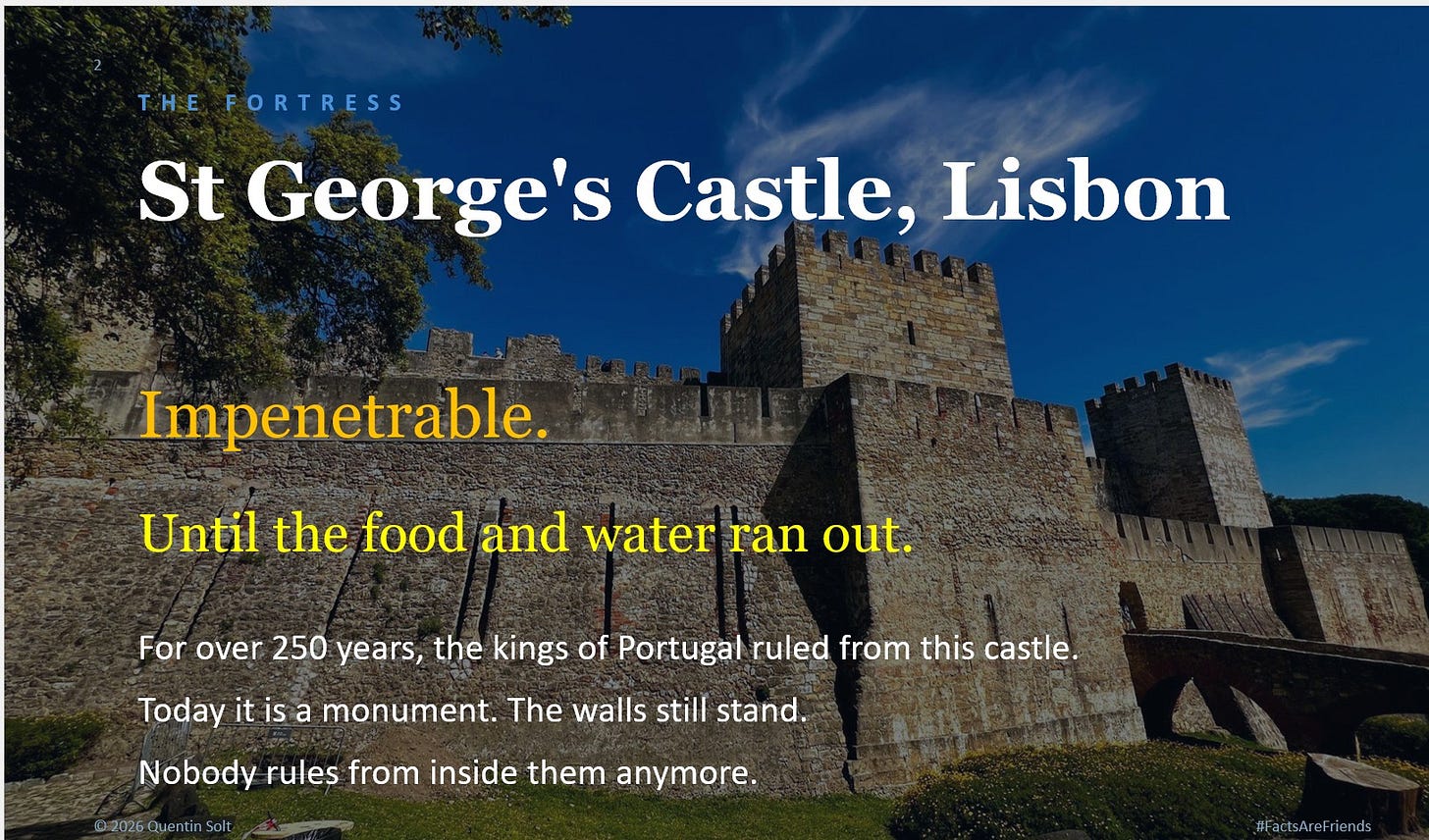
Our guide walked us through its defences. A moat. A high wall, and two further concentric internal walls. If you tried to scale them, you would have burning oil and liquefied sand poured onto you. Were you able to get through, the valuables were protected in a stone keep deep inside. By any conventional measure of attack, it was impenetrable. Nobody could knock it down. Nobody could force their way in.
And yet it fell. The walls were never breached, but ultimately they provided no protection. The fortress was not defeated by a stronger army. It was defeated by a foe who took an unexpected approach - who simply cut off the food and water, and waited. The castle was blockaded and starved into submission.
History gives us another famous siege where force failed but the castle still fell. Troy. The Greeks spent ten years trying to breach the walls and failed. Another approach worked. They built a wooden horse, left it as a “gift”, and the Trojans wheeled it inside the gates themselves. We all know the rest of the story.
I will come back to these stories. I am not suggesting that any of the players in the tale I am about to tell are malevolent. But wittingly or otherwise, they are adopting some of the techniques we may recognise from them.
The fortress the profession built
I want to look at the fortress that the legal profession has built for itself. It is a good one.
The senior partners are the kings and queens, living at the heart of the keep. The keep holds the most valuable things - the crown jewels: the client relationships, the institutional knowledge, the matters that generate the revenue. The associates are the knights on the battlements, doing the daily work and fighting the fights. The support teams - the secretaries, the paralegals, IT, facilities, the post room - are the butlers, servants, cooks and stable hands without whom nobody eats and nothing works.
And every single one of them, from the most senior partner to the newest trainee, depends on the same food and water supply coming in from outside the walls. When that supply is cut off, the senior partner’s drawings fall just as surely as the trainee’s salary disappears. The fortress sustains everyone inside it, or it sustains nobody.
The threat today is not a frontal assault. The threat is that the conditions sustaining the fortress are quietly changing. The food and water supply is slowly but surely being cut off.
What are the walls?
So what are the walls? If you ask lawyers what they do, they will tell you they have deep knowledge of the law. They manage the project. They apply logic to the facts and the law, and they are reliably consistent. And they deliver judgement - the judgement they see as their real, sustainable value.
That may all be true. But it is a surprisingly small part of the picture.
Think about what a senior partner actually does day to day. Yes, they advise on the law. Yes, they apply logic. And yes, some of them offer judgement that is worth every penny. But it is not how they spend most of their time. Most partners deal with personnel issues, sit on committees, attend partnership meetings, chase bills, handle regulatory returns, respond to compliance enquiries, front marketing and manage internal politics - the turf wars over who gets credit for which deal. These things mean managing expectations and egos as much as managing risk or creating value for clients.
If you are honest about how much time in a law firm is spent doing things that have nothing to do with the law, the answer is “quite a lot”. I was recently told of a senior partner in a major London firm who estimates that he spends 40% of his time on administration and a further 20% on office politics - managing the machinery of the firm.
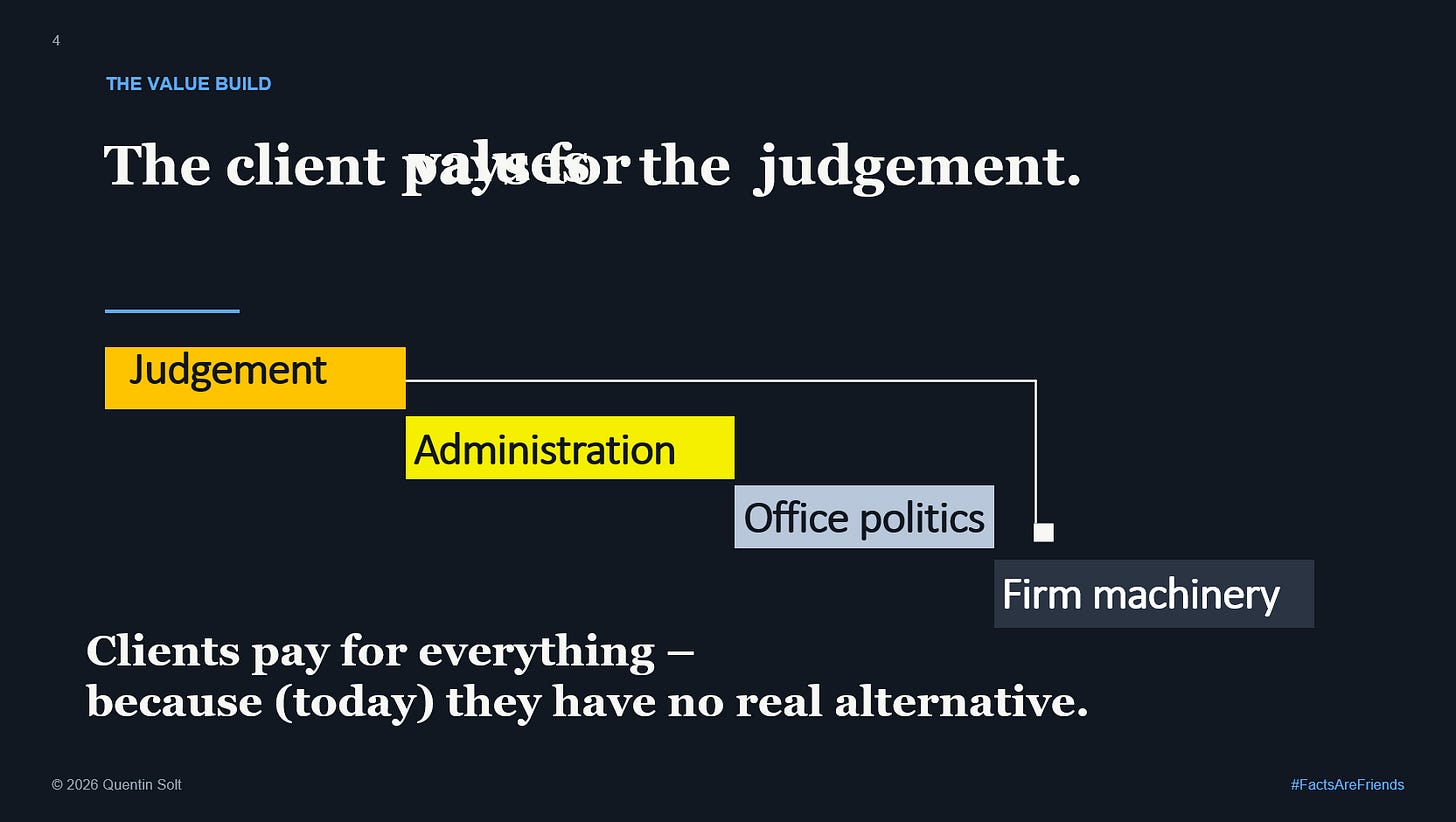
And yet today the client pays. Because today the client has no choice. The client must pay for the admin, the politics and the rest of the machinery, because it sits below the value they rely on their lawyers to give them. If they want the advice, they have to pay for the noise.
A banquet in the castle
Let me invite you into the castle’s banqueting hall. Picture an extravagant evening - great food, engaging conversation - intended to lead to a marriage between two kingdoms. Think of negotiating the terms, drawing up the contracts and closing a commercial deal as exactly such a banquet between suitors.
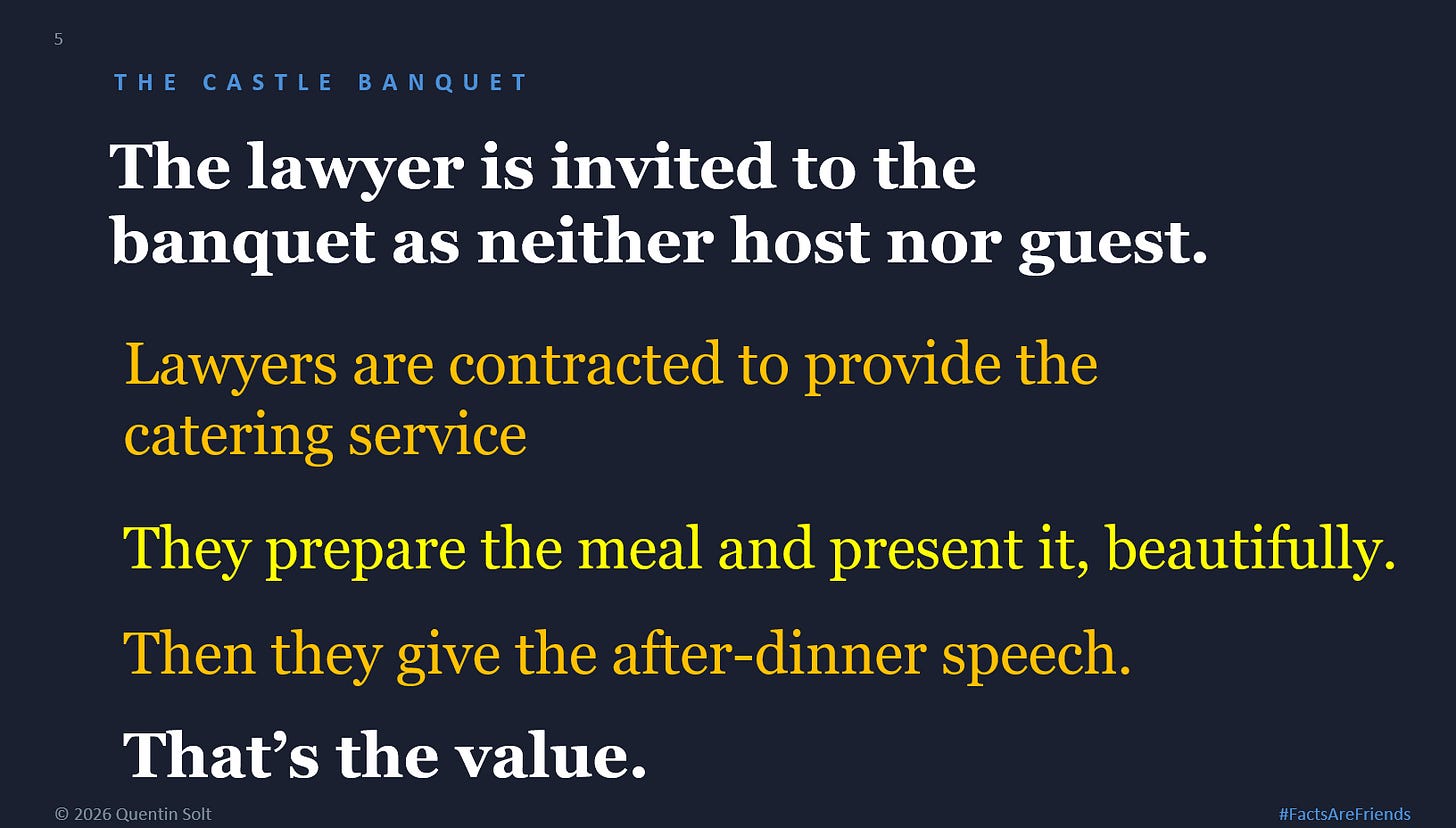
The client is the host. The counterparty is the guest. The lawyer’s firm is the bespoke catering service - and the guest brings their own caterer too. The two catering teams negotiate the detail of the meal between themselves while the hosts and guests talk, aiming to cement the relationship that will bind them.
Once the potential bride and groom have been identified, the firms orchestrate the entire affair. They serve the pre-dinner drinks - the Heads of Terms - they prepare the meal, which is the main contract, and they serve it with white gloves and silver service.
They earn their place in the room by offering a service. And they justify their fee by applying their knowledge and experience once they are there. They give, in effect, the after-dinner speech. And that is where the real value lies.
Notice the order. It is the project management and the drafting - the laying of the tables, the cooking, the serving - that win the invitation, long before the after-dinner speech is even contemplated. The judgement follows only once you are in the room.
Each of these elements - knowing the law, preparing the documents, managing the process, applying logic, and offering judgement - is a defence of the profession’s castle. The question is whether they are impregnable, or whether they may be breached. And remember: the castle was built so that only one line of defence need hold for the keep to remain secure. So let us explore each in turn.
The moat of knowledge
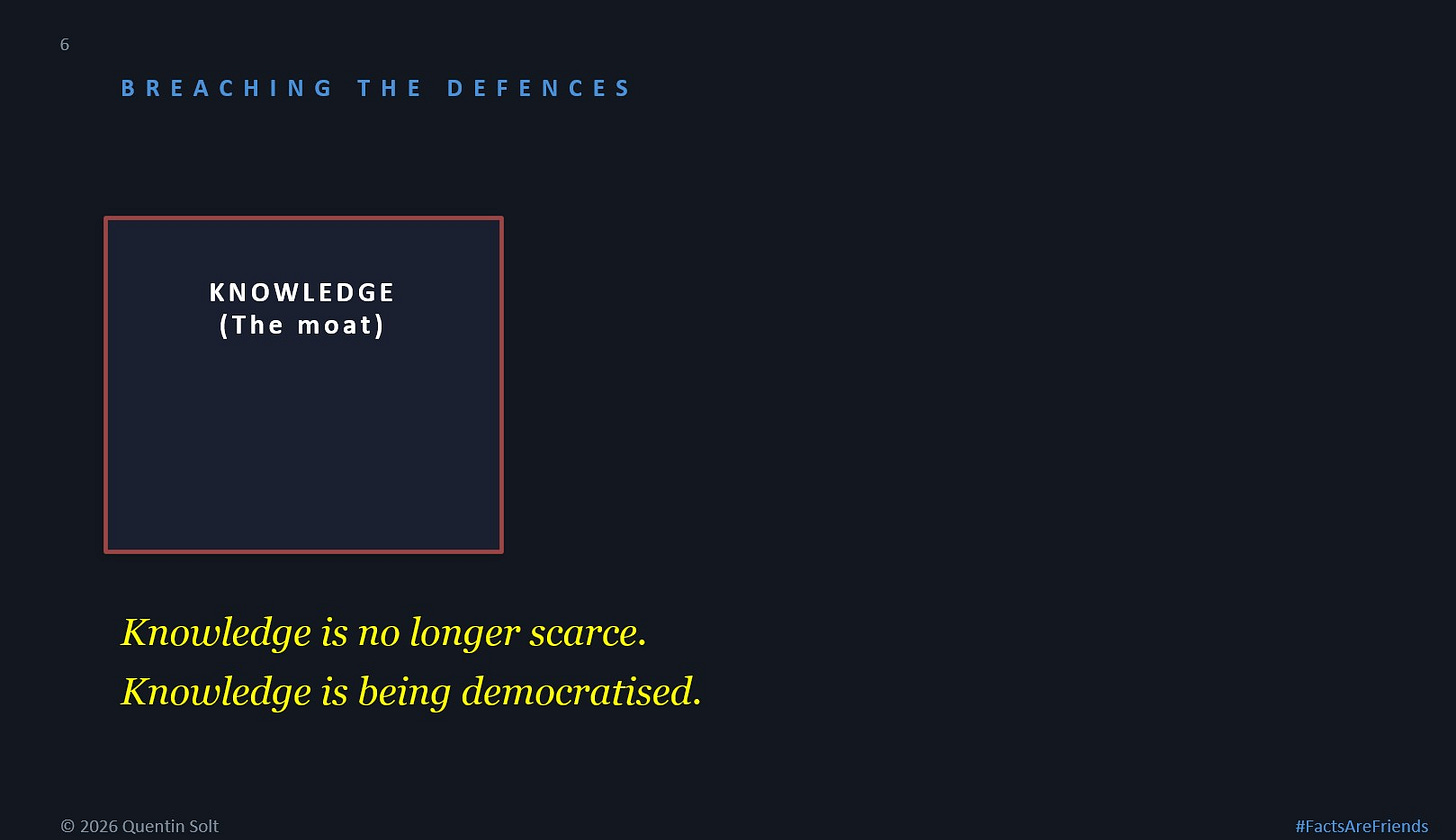
First, the moat. The moat of knowledge. Lawyers pride themselves on knowing the law. In the UK they typically spend three years at university and law school, then two years training and a decade or more in practice before they earn the title of senior lawyer. Knowledge that took years to acquire was scarce, and therefore valuable.
But that knowledge is ceasing to be scarce. An AI model can be taught more than any human lawyer who has ever lived. It can be trained not to forget. It can be instructed to consider all the law known to it, and to take a broad, holistic view - not limited to the narrow specialism it has practised for years.
Some data owned by LexisNexis and Thomson Reuters may remain proprietary - but lawyers have no unique ability to access it. And the AI foundation models may simply outbid the lawyers to buy access. There is nothing a law firm can do to defend itself against the purchasing power of a trillion-dollar Anthropic, or an xAI three-quarters as large again.
In short, the moat of knowledge is being drained.
The wall of project management
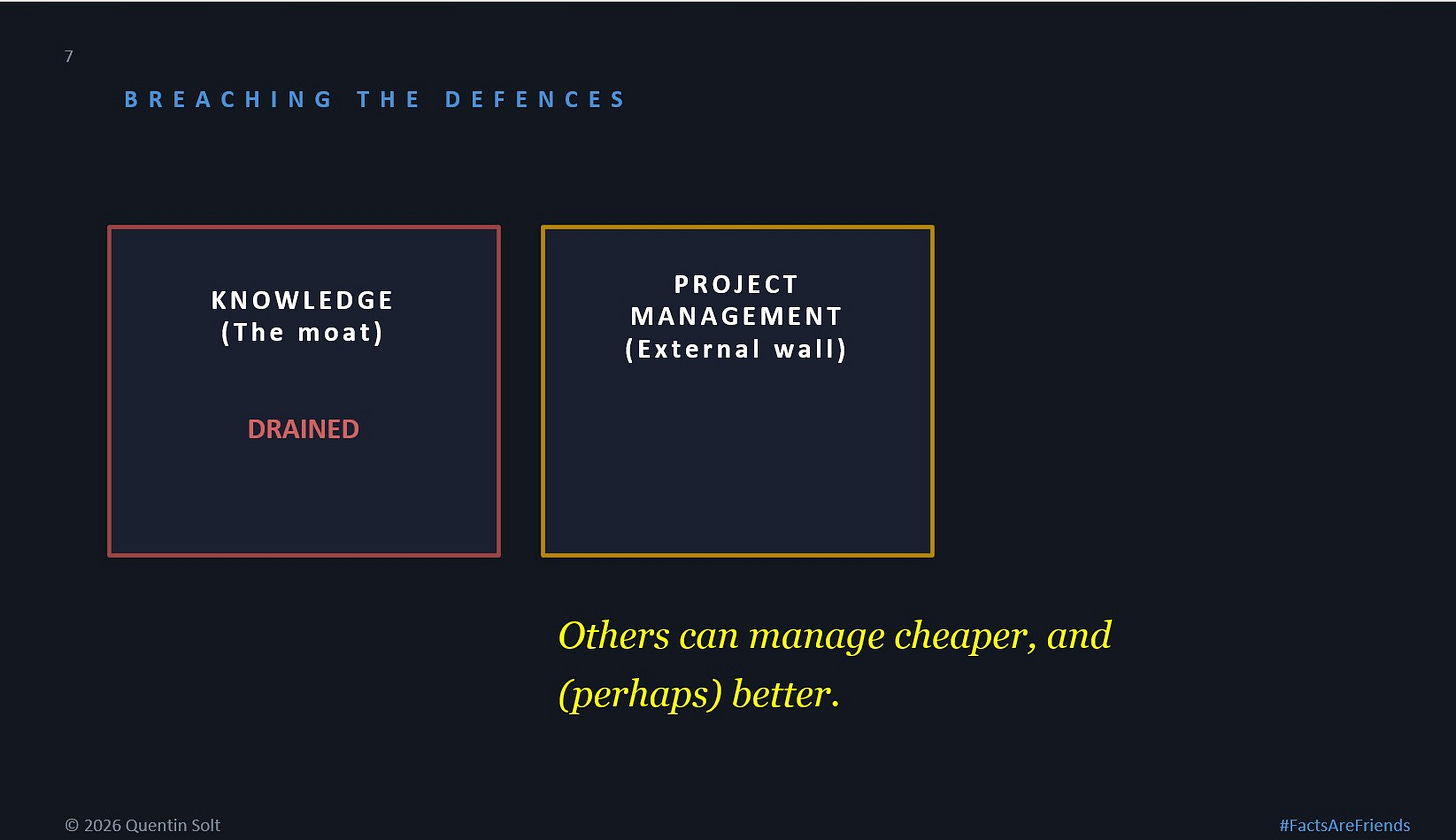
Next, the external wall of project management. Lawyers have traditionally orchestrated the legal process. But if we are honest, very often they are not particularly good at it. At this very conference we heard from Legora how its platform now embeds project-management tools - no legal training required.
Lawyers are trained to deal in minutiae, to examine risks and to interrogate everything. They are not typically trained to manage expectations, explain processes or keep everyone in the loop. They have great skills, but those skills are rarely the ones that make things happen on time.
Increasingly the co-ordination function is being automated. Due diligence is assembled and held in electronic data rooms; papers are circulated by DocuSign; the project-management function itself is being automated. Others can manage the project at least as well, and at lower cost. It was once convenient - perhaps even necessary - for lawyers to run the project. It is no longer their exclusive preserve, and others may be better suited to it. Automation will likely be a great deal cheaper, too.
The curtain wall of logic and consistency
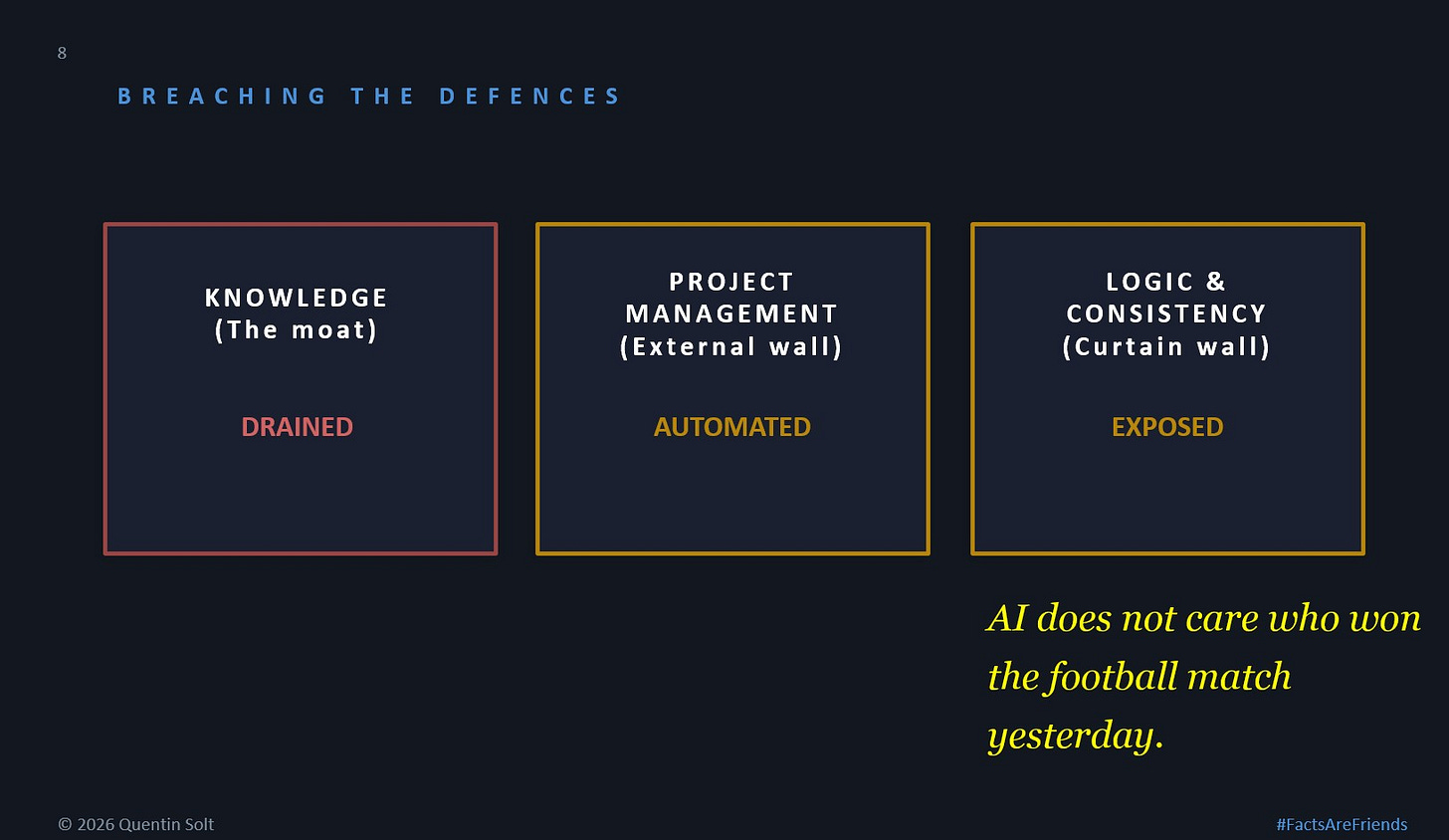
Still ahead of the keep stands the curtain wall of logic and consistency.
I qualified in England as a solicitor. In England we have solicitors and barristers. Historically, solicitors interfaced with clients, while barristers were authorised to speak in court, specialised in the more esoteric areas of law, and explained the law to solicitors and their clients. When I hit a tough legal question, I expect to consult a barrister to explain the law and apply it to the facts. That is what many barristers do, day in and day out.
But if solicitors were truly logical - if they really did apply rigorous reasoning to every problem - they would not need to instruct barristers to explain the law to them. The barrister succeeds not because they know different law, but because they apply superior logic to the same law. It is, I think, axiomatic that solicitors are not as logical as they may claim.
AI will apply that same rigour - arguably a higher level of logic - across every area of law simultaneously, and to all the facts presented to it, quickly and efficiently. Applying logic is what deterministic systems do. Applying that logic to the facts - which is rarely black and white, but an assessment of risk - is the probabilistic overlay. And humans, it turns out, are no more reliable at this than the technology. There is a good deal of evidence that we are in fact less consistent.
We have all seen the consequences of human error: the double negative buried in a prohibition clause - a list introduced with “not” at the top, and then another “not” creeping in halfway down, so that the clause accidentally mandates the very thing it was meant to prohibit. A deadline missed. Advice poorly articulated. These happen routinely, and give rise to professional indemnity insurers making settlement payments. Human consistency is a polite fiction.
AI is not distracted by a difficult client conversation at lunchtime, or by the politics of who gets credit for the deal. Under pressure - when the deadline is 6am and the data room has just thrown up a new issue - the human lawyer’s output frays. The machine’s does not. Research has found that judges in Louisiana handed down longer juvenile sentences the day after the local university football team lost. A Cambridge Judge Business School study put it bluntly: formulas tend to outperform human experts, partly because algorithms are simply more consistent.
AI does not care who won the football match yesterday.
The fallacy of logic and consistency as a uniquely human strength is being exposed.
Why it may not matter
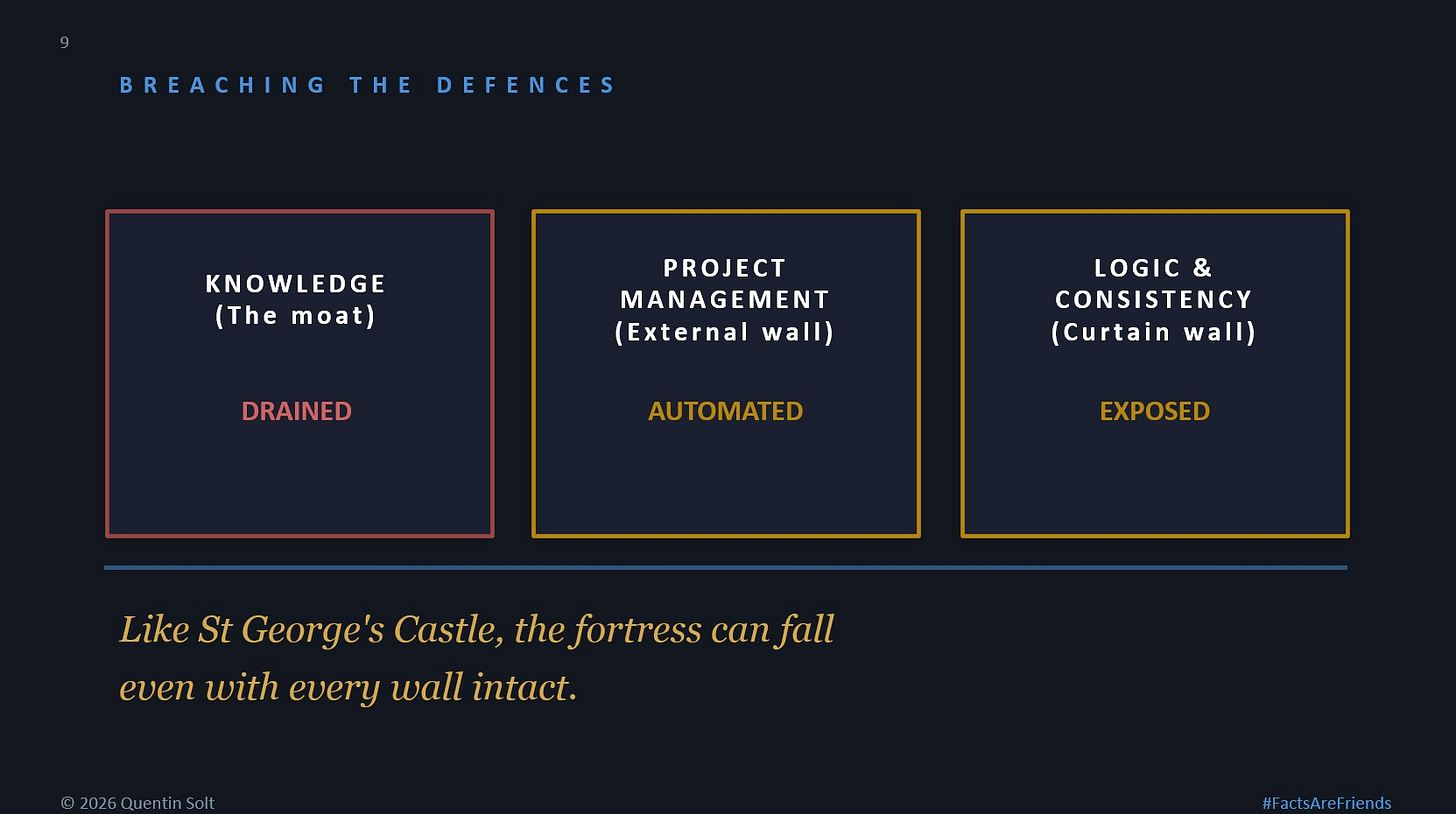
In truth, none of those outer defences is immune from attack. But let us assume that at least one of them can withstand the barrage. As we are about to see, it may not matter whether they crumble or stand - because, like St George’s Castle, the fortress can fall even with every wall intact.
But first, we need to explore the keep. It may be less exposed.
The keep of judgement
We turn to the last line of defence. Even if the moat is crossed and the walls are breached, the inner keep still stands to protect the crown jewels. That defence is judgement. It is the protection the profession ultimately relies upon - the ability to read a room, to know when a deal is about to fall apart, to sense that a client is not telling you the whole truth. These are valuable skills, and they are hard won.
Return with me to that banqueting hall. The recipe is no longer closely guarded, and the moat of legal knowledge is challenged. The laying of the table and the preparation of the meal - the project management - are being automated. The host can now buy a pre-cooked meal from the supermarket, or order one from UberEats. It may not be Michelin starred, but it is good enough - good enough that there is no need to pay staff to cook and serve it.
So where does the real value lie? It comes from being present throughout the meal. From reading the room. From noticing who trusts whom. From knowing what to give and what to withhold. Think of the after-dinner speech - the judgement call rooted in everything observed across the evening.
I once heard the veteran comedian Bob Monkhouse speak at a legal awards dinner. He arrived early, listened to every conversation, and then delivered an extraordinarily funny speech about what he had just witnessed. Devastatingly relevant - because he had been in the room. He was present throughout, and he made that matter. I still remember him thirty years later.
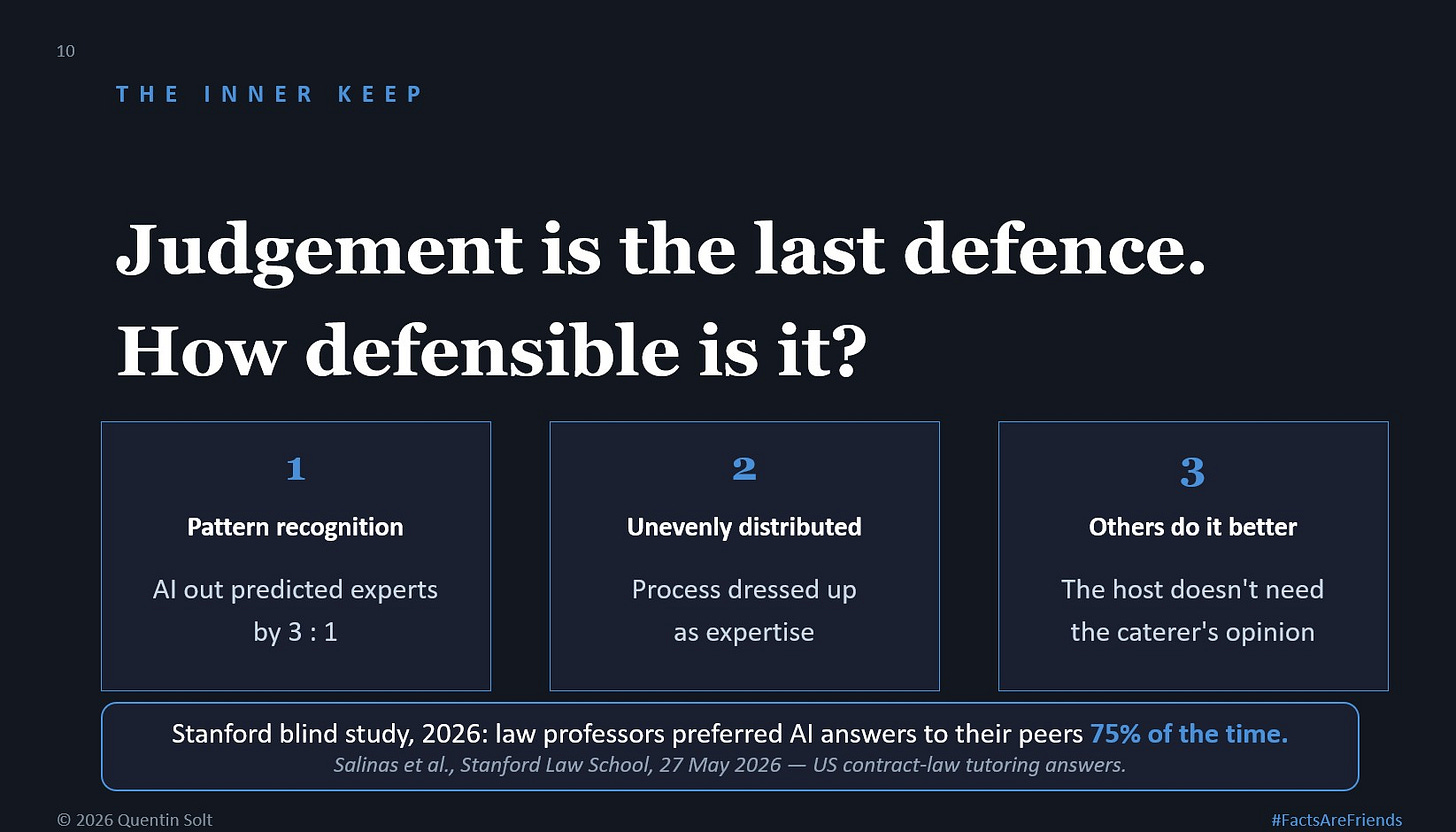
That skill is real and important. But what we call judgement is, at its core, pattern recognition. And pattern recognition is precisely what AI excels at - across thousands of transactions, not dozens.
In 2024, large language models matched or exceeded junior lawyers on contract review - in seconds rather than hours, at 99.97% less cost. In 2025, AI matched human lawyers in contract drafting. A Brazilian study across more than 600,000 cases found AI out-predicted human experts by three to one.
And we should be candid: judgement is unevenly distributed. Some lawyers are worth every penny. But many are piggybacking on an expectation of payment rather than the value they deliver. They are relying on process dressed up as expertise.
The people best placed to exercise commercial judgement are often not the lawyers at all, but the businesspeople - the CFO who has run twenty acquisitions, the procurement director who has negotiated with the same supplier for a decade. They are already at the table, not to serve, but as host or guest. The host does not really need the caterer’s opinion.
Here is the deeper problem. The lawyer’s judgement was never something they brought to the table fully formed. It developed by being in the room. If AI handles the mechanics, the lawyer may no longer be invited to make those preparations. And if you are not at the meal, you cannot give the after-dinner speech.
I sit on boards, and increasingly I hear directors say they have prepared legal documents using AI: “I know what I am doing. It is cheaper and quicker than using lawyers. And in this context, I am willing to take the risk.”
“Good enough” does not have to be as good as the best lawyer. It just has to be good enough to let the client do what they want with an acceptable level of safety. A recent Stanford study found that law professors preferred the answers AI gave to legal questions over those of their human peers three-quarters of the time.
And “good enough” is getting closer by the week. Since Legora presented at this very conference, it has announced a partnership with Ironclad. Many lawyers will not know Ironclad - it is client-side contract lifecycle management software. Just as you and I live in Microsoft Word to generate contracts, clients use Ironclad to manage theirs. It is what clients already use, every day. Ironclad brings the corporate relationships and years of ingested contract data; Legora brings the legal intelligence direct to the client. In short, the very platform that makes law firms more efficient also makes in-house teams more capable of doing the work themselves.
That threshold - AI being good enough - is being crossed now. Before insurance is in place. Before regulation has caught up. Before the profession has agreed what to do. I believe we will see more people benefiting from legal advice, while at the same time far fewer lawyers provide it.
The consumption paradox
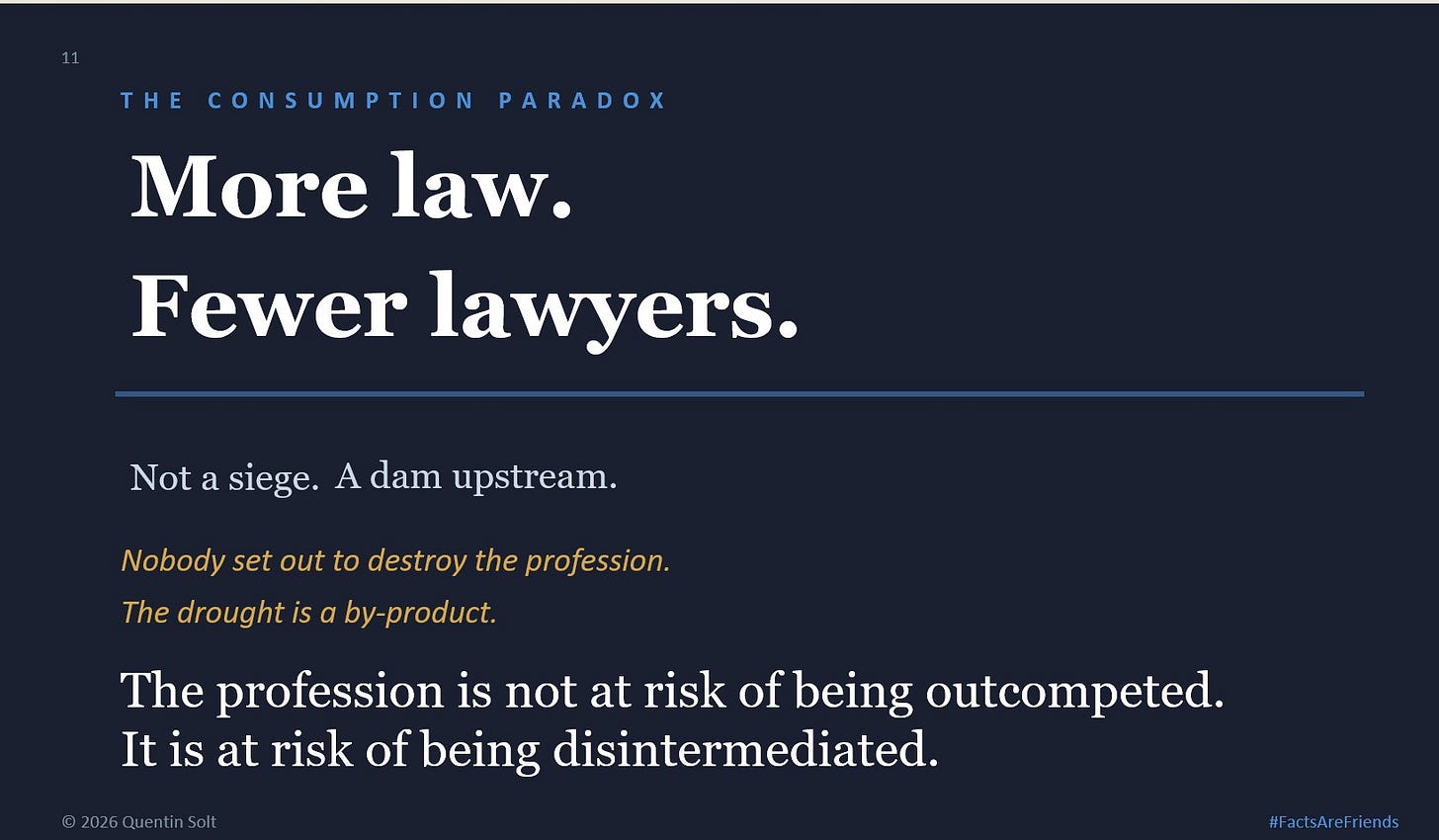
I call this the Consumption Paradox. More legal work is being done than ever before, and much of it can be done without lawyers. More law, fewer lawyers.
This is not a siege. Nobody set out to destroy the legal profession. Anthropic built Claude for its own market. Microsoft built Copilot for its own customers. The conventional supply-side narrative says AI simply makes lawyers faster - a due diligence that took six associates three weeks now takes two associates four days; a privacy policy that took an afternoon now takes ninety seconds.
The royalty of the profession even helped to build the dam. They so believed in the benefits that they paid for the technology to be brought inside the castle. They welcomed the gift horses - Legora, Harvey, Clio, CoCounsel and countless others - through the gates. They trained them, refined them, cherished them.
And it is true that these systems create huge savings and efficiencies. But the swords these knights wield have two edges. The dangerous edge - the one they did not see - is the demand side. If general counsel can use AI to triage their own contracts, what happens to the instruction? The law firm does not get to do it more efficiently. The law firm does not get to do it at all.
The foundation models never set out to attack the castle. They built their own dams to feed and water their own customers. The drought now spreading through the castle is no more than a by-product.
Claude Cowork, Claude for Word, Microsoft Copilot, ChatGPT for legal work - these are the bread and butter of commercial practice, available to anyone with a subscription to a technology company, not a law firm. The tools making lawyers faster today will make many lawyers unnecessary tomorrow. The profession will not be outcompeted. It is at risk of being disintermediated - the clients will simply have no need of it once the AI solution is sold as a utility to their desktops.
The Trojan Horse and the valuations
So, a moment on the Trojan Horse. The law firms wheeled it inside themselves. They bought subscriptions to Legora, Harvey and CoCounsel. In doing so, they gave those tools access to their workflows. They educated the machines. They used the technology to train their own clients to trust AI-generated output. And their subscriptions funded the very companies now poised to compete with them.
Many lawyers comfort themselves that their proprietary workflows are their secret sauce. Yet only yesterday Harvey announced that it is developing open-source tools to encode workflows. Good news? I suspect not. A client who understands that development has much of what they need to ask the next law firm - or the next AI platform - to replicate the workflow. Eventually, some will simply build it themselves.
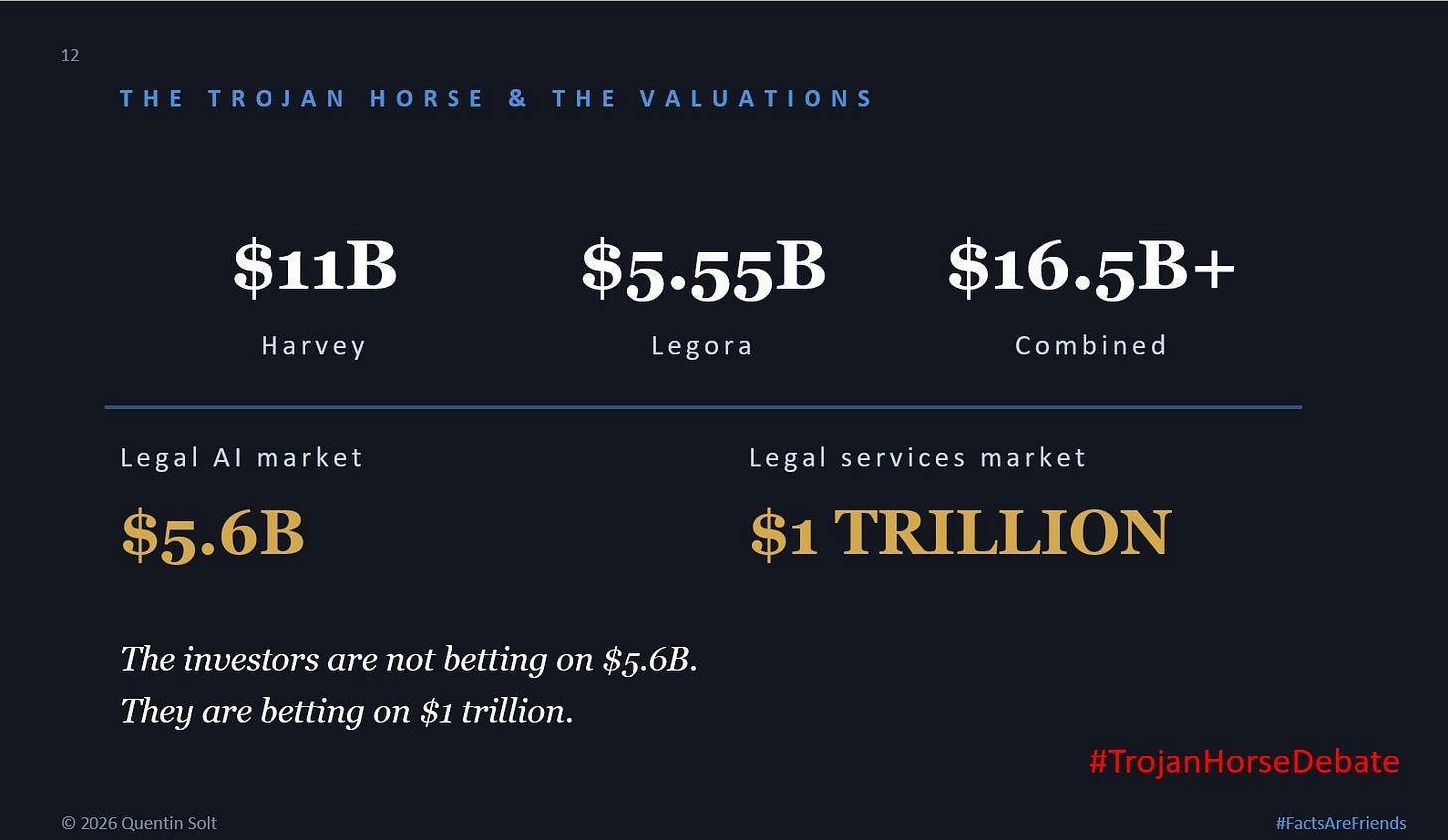
So why is Legora doing this, and why is it teaming up with Ironclad? Look at the numbers. The legal AI software market is estimated, generously, at $5.6 billion. Legora alone is valued at roughly that. Harvey is valued at nearly twice it. Together, those two companies are worth around three times the entire legal AI software market - and there are dozens more besides.
But the legal services market is worth $1 trillion - about the same as Anthropic itself. That is a great deal of money. The investors are not fools. They are not betting on the $5.6 billion software market. They are betting on the $1 trillion services market - the market that law firms have historically owned. If AI captures even a fraction of it, the addressable prize runs to hundreds of billions. Disintermediation may shrink the total spent on legal work, but the technology companies’ slice of it grows enormously.
(I have been debating much of this publicly on LinkedIn with Lev Loukhton - search for the #TrojanHorseDebate.)
Risk and regulation
Two further dimensions deserve attention, because they are the defences lawyers reach for once the others fall away: risk and regulation.
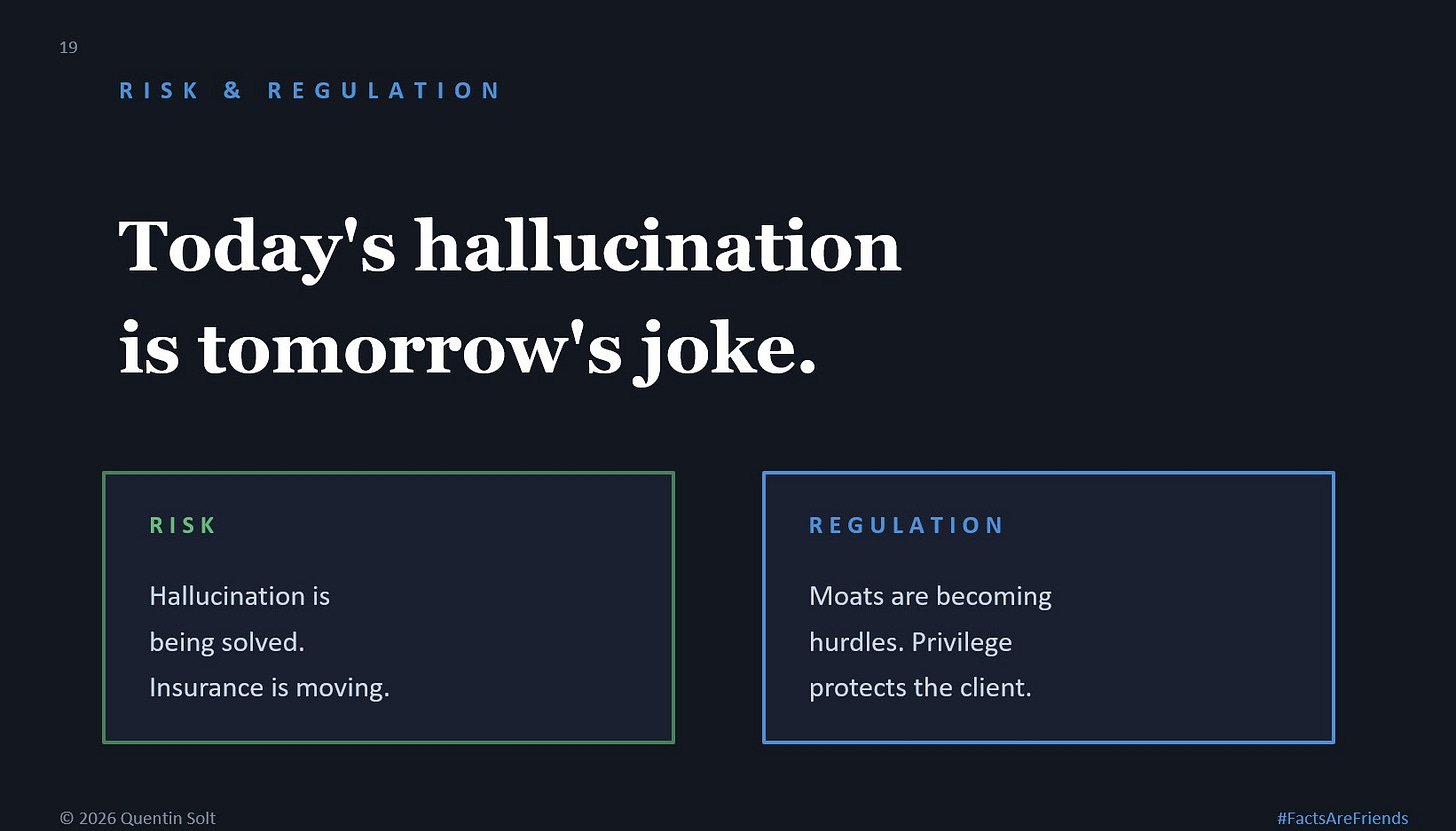
Risk. Lawyers comfort themselves that they are the insured, risk-free solution. The objection clung to most tightly is hallucination - AI makes things up, it cannot be trusted, the stakes are too high. For now, the lawyer as gatekeeper has some validity. But that role has a limited shelf life. Today’s hallucination is tomorrow’s joke; the engineering challenge is being solved, by deterministic models and by the major legal publishers wiring curated data directly into the systems. And humans regularly misinterpret the law too - that is precisely why the hierarchy of junior to senior to counsel exists. Every referral up the chain is an admission that the person below may have got it wrong. AI now sits at the top of that chain.
Neither lawyers nor AI can give certainty. What matters is informed decision-making. Who is better placed to surface the relevant risks in proportion - a lawyer who has seen fifty transactions, or an AI that has analysed fifty thousand? The insurance market is already moving. Specialist insurers are offering AI liability cover, and Verisk released new endorsements specifically addressing AI-generated risk in January 2026. The moment that pricing becomes viable at scale, the profession’s last structural defence falls away.
Regulation. The profession’s regulatory moats - Know Your Client, anti-money laundering, engagement letters, privilege - were valuable when clients had no alternative. But clients are increasingly willing to accept unregulated AI advice. When that happens, the moats become hurdles. The onboarding that once signalled professionalism now signals only delay and cost. And privilege is not there to protect the lawyer - it is there to protect the client. If lawyers use it as a competitive barrier, they are misusing the tools in the gymnasium, and the regulators should change the rules. This is a problem of the moment. It will pass.
What comes next: the living contract
Let me pause. I have painted a bleak picture, and you may not want to believe it. You have seen how vulnerable the legal fortress is to forces its builders never contemplated. Now I want to turn to what comes next - and then to where the hope lies.
I do not go to my doctor for a chat. I go because I want to be healthy. I do not take medicine because I like the taste. And I do not implement contracts for enjoyment. I implement them to maintain sustainable business relationships.
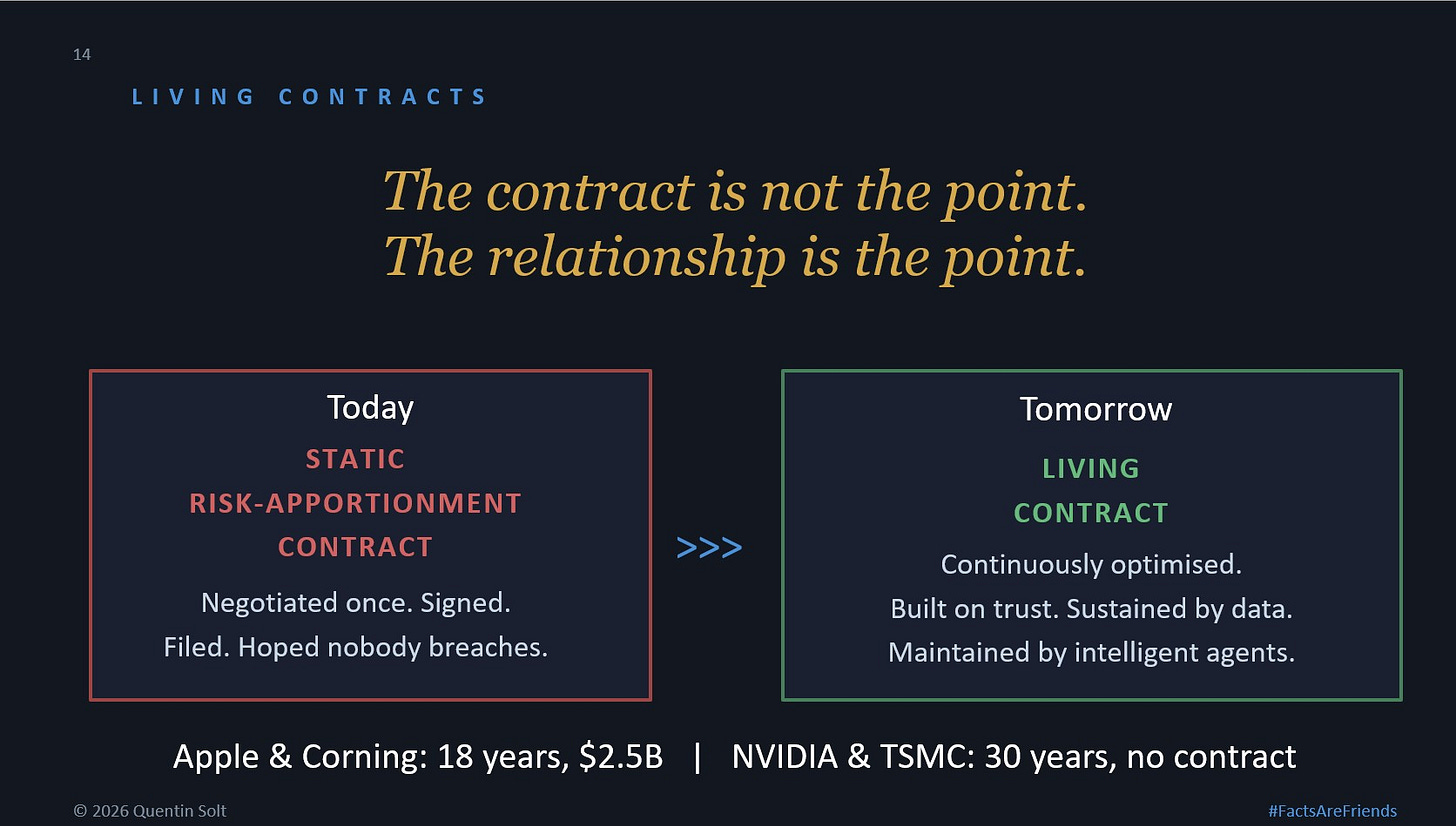
The contract is not the point. The relationship is the point.
The static contract was the tool we adopted because we had no other choice - a means to identify obligations and apportion risk. A lawyer from the 1700s would recognise exactly what we do today. We have swapped the quill for a keyboard and the parchment for a screen, but the basic concept is unchanged.
That is about to change. Trust, data and technology are converging. Consider Apple and Corning: eighteen years, $2.5 billion invested, a relationship in which the boundary between customer and supplier has all but disappeared. Or NVIDIA and TSMC: Jensen Huang has said that over thirty years the two companies have done perhaps a trillion dollars of business - without a contract. “Sometimes I got a better deal. Sometimes I got a worse deal. But we have no contract.”
These are living relationships. Imagine both parties deploying intelligent agents with complete visibility of their own side. The agents negotiate continuously and transparently - not trying to win, but to optimise. If a deal becomes too good to be true for one side, the agents renegotiate. The remaining risk comes from bad actors; but where both parties are genuinely motivated by the long term, you have a winning formula. Enterprise systems, blockchain and the Internet of Things provide the infrastructure. The static risk-apportionment contract eventually disappears, and legal correctness becomes a property of the system rather than a service you buy from a professional.
The siege is quiet
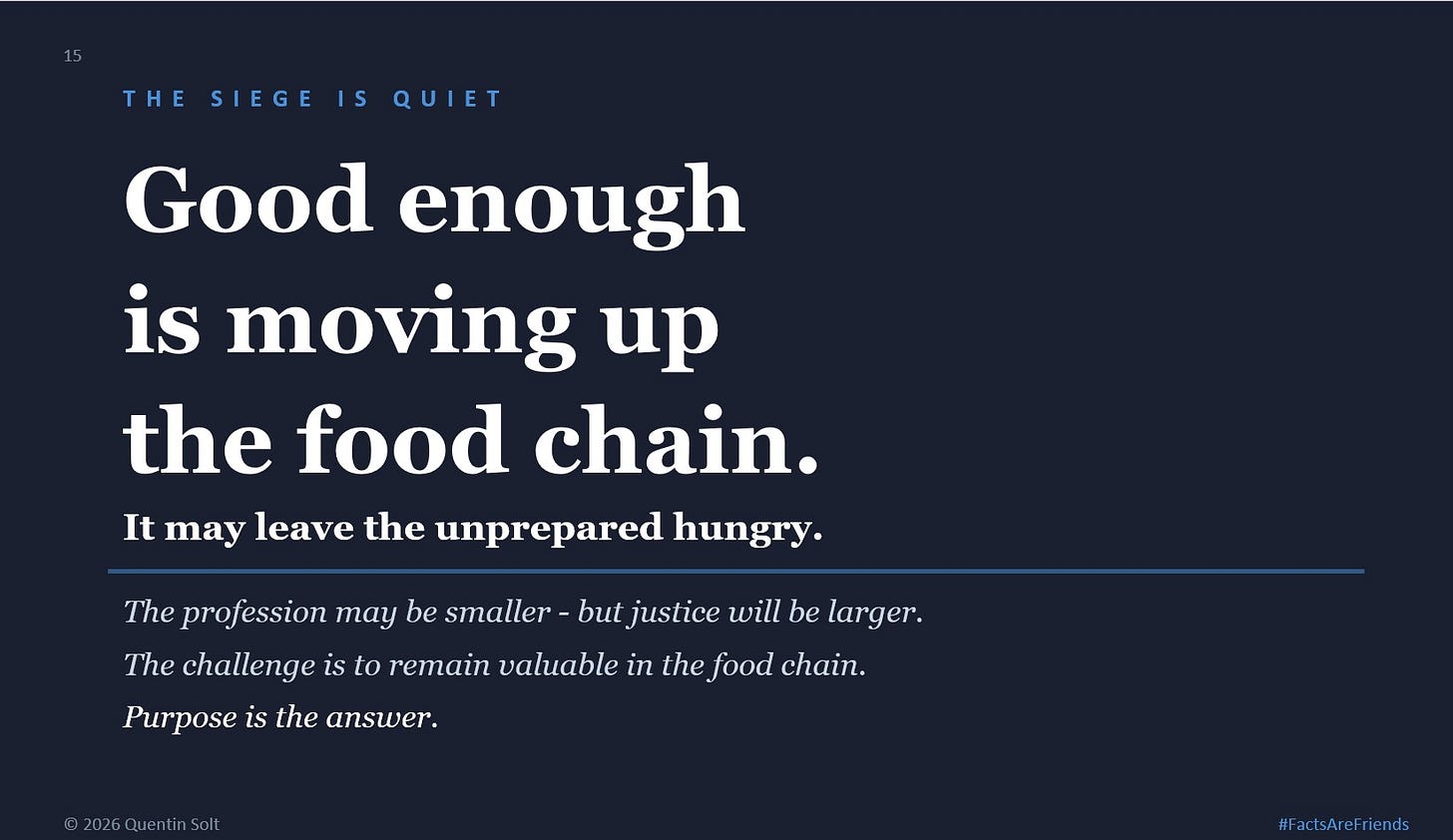
Back to the fortress. Nobody is storming the walls. Nobody needs to. Good enough is moving up the food chain.
You will hear people say - and I hear it at every conference - “learn to use AI, because you will not be replaced by AI, but by someone who knows how to use it.” I think that is misguided. When motorcars were introduced, the original chauffeur was a mechanic who could crank the engine and change the spark plugs. Today, anyone with a driving licence is a chauffeur, and my new car does not even have a spark plug. The same will happen with AI - not over a hundred years, but a handful. The people on the cutting edge of the large language models are certainly not lawyers.
The profession may be smaller. But that does not mean those who have flourished before will cease to be valuable. To continue, though, they must find their purpose.
What do we do?
I do not want to end on the fall of the fortress, because there is hope - and it is real.
There is a widely held view, argued forcefully by some of the most thoughtful people in technology, that I am too gloomy. The argument runs like this: every wave of technology has automated tasks and, in doing so, created entirely new categories of work nobody could have predicted. The spreadsheet did not end accountancy; it created financial modelling on a scale never seen before. The cash machine did not empty the banks; for a time it multiplied the branches. On this view, each thing AI automates frees human beings to do something new, and human relevance rises rather than falls. There are serious voices arguing that AI will create more work, not less, and that we will look back on today’s anxiety as we now look back on the Luddites.
It is a genuinely optimistic case, and it may well prove right for the economy as a whole. I hope it does. But I would gently sound one note of caution. Even if the optimists are right about the economy, that does not mean they are right about this profession. The work may not vanish - but it may migrate. The honest position, I think, is this: there is every reason for hope for the individual, and rather less comfort for the institution.
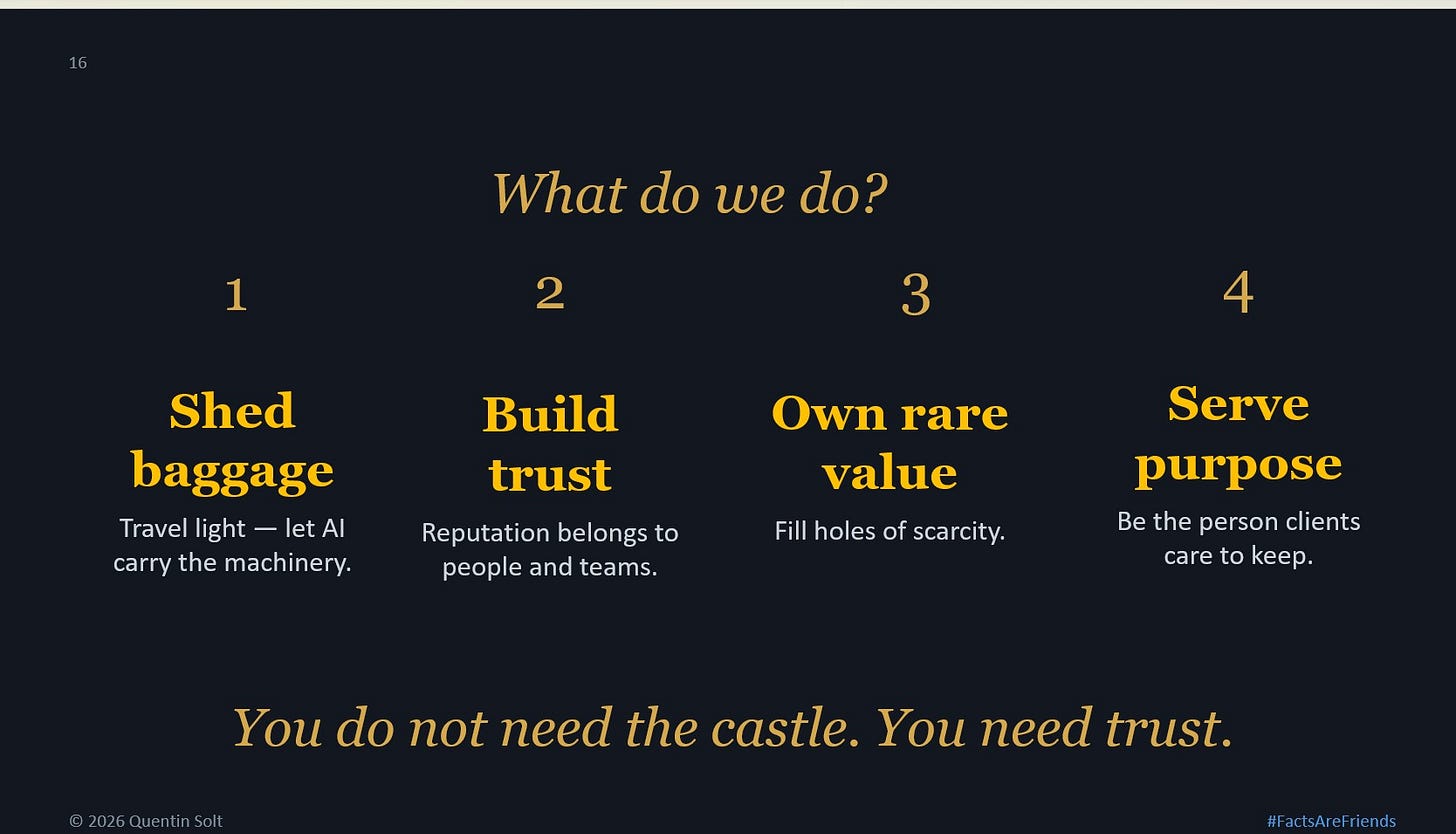
Which brings me to what I would actually advise. Four things.
First, shed the baggage. Remember the senior partner spending 40% of his time on administration and 20% on office politics. AI can carry much of that machinery. The lawyer who succeeds will travel light: the lawyer, the client, and far less in between. For support staff this matters just as much - the work of the future is unlikely to be endless process for its own sake; it will be making the technology, the matter, the client relationship and the firm’s systems work together cleanly. The technology that threatens the old model is the same technology that can liberate people from much of what made practice exhausting.
Second, build trust. Others may use the word “brand”, but trust is the better word - trust is what underpins a brand. For lawyers, that means turning up, being present, demonstrating expertise and earning a reputation people will rely on. For support staff, it means becoming the people who make the whole system reliable - those who know the client, the matter, the process, the risk, the deadlines, the data and the rhythm of the practice. Trust attaches to individuals and teams, not just to institutions.
Third, specialise. General legal knowledge is precisely what AI has commoditised - that was the moat drained first. But deep specialisation will remain differentiated for some time to come. The person who has seen the unusual cases, who understands the commercial context, who knows where the bodies are buried, and whose judgement was formed in an area too sparse for meaningful training data - that person retains real value. Good enough wins where the work is common; it struggles where the work is rare. So go where the work is rare. And this applies well beyond technical law - to legal operations, knowledge management, data handling, client onboarding, AI supervision, compliance, billing intelligence and matter management.
Fourth, understand your purpose - and be authentic to it. Clients rarely want merely legal documents. They want confidence, permission, protection, speed, leverage, closure or peace of mind. The winners will be the people with a real relationship with their clients, invited to the table from the outset not simply for the legal work they can produce, but for the value they bring beyond the law. A client may be able to subscribe to intelligence by the token; they are far less likely to be able to subscribe to someone who genuinely cares about their success. We may come to call these people deal mediators - people who bring law, judgement, commercial sense, human understanding and technology together around the client’s real objective.
You do not need the castle. You need trust.
And this is not just a message for partners. In a world of AI, the trusted PA, the experienced paralegal, the operations lead, the knowledge lawyer, the IT specialist, the finance manager and the business-development professional may all become more important, not less - because they help turn legal knowledge into a trusted service.
One last thought, and it matters more than anything else I have said. Suppose I have the long term exactly right. Even then, we do not get to live in that future today. We live in the transition - and the transition may run for years. We cannot leap to the endpoint. The endpoint I have described is, in part, speculation; treat it as such. What is not speculation is the transition. That is here. That is now. So we are far better served preparing for the immediate than chasing a distant horizon. Deal with today. Then deal with tomorrow when it becomes today.
And none of this needs to be driven by fear. Fear makes you defensive, and defensiveness is the wrong posture for what is coming. The same forces that threaten the old model are handing us an extraordinary opportunity. The lawyers and support teams who thrive will be the ones who saw the tide coming and learned how to ride it. So do not meet this moment with fear. Meet it by grasping the opportunity directly in front of you - today.
Shed that what does not matter. Deepen what you know. Build trust. Understand why you do it, and be authentic to what interests you and what you care about. Throw off fear, authorise yourself and step out bravely. There is a future for everybody, as my friend Lev Loukhin says, lawyers can have agency. You do. Exercise it when it is most valuable: now.
If you want to discuss any of the points arising from this article, please feel free to reach out to me on Quentin@FactsAreFriends.com.
Exploring how AI reshapes society, work, politics and human connection - from my forthcoming book. #FactsAreFriends
Sources and evidence
The Next Paradigm in the Legal Profession - Quentin Solt - JUVE LOK 2026
A definitive, long-form list of every source relied on in the talk and the accompanying essay. Each entry gives the full citation and a short note on what it establishes. Numbering follows the master script.
HISTORICAL
St George’s Castle became the royal residence when Lisbon was made capital of Portugal in 1255 under Afonso III, and remained so until the early 1500s when the court moved to the Ribeira Palace.
HUMAN INCONSISTENCY AND THE LIMITS OF JUDGEMENT
Eren, O. & Mocan, N. (2018), ‘Emotional Judges and Unlucky Juveniles’, American Economic Journal: Applied Economics, Vol. 10, No. 3, pp. 171-205.
What it establishes. Peer-reviewed evidence that experienced judges gave harsher sentences after an unexpected local football defeat - the basis for the line that AI does not care who won the football match yesterday.
Cambridge Judge Business School (2025), research on algorithmic vs human expert performance in professional judgment tasks.
What it establishes. Supports the broader claim that formulas and algorithms tend to outperform human experts, partly because they are more consistent.
AI MATCHING OR EXCEEDING LAWYERS
Martin, L., Whitehouse, N., Yiu, S. et al. (2024), ‘Better Call GPT: Comparing Large Language Models Against Lawyers’, Onit AI Centre of Excellence. Published on arXiv (2401.16212).
What it establishes. Commercial-domain benchmarking: LLMs matched or exceeded junior lawyers on contract review, in seconds rather than hours, at 99.97% less cost.
LawNext / Bob Ambrogi (September 2025), ‘AI Tools Match Or Exceed Human Lawyers in Contract Drafting Benchmark Study’.
What it establishes. Extends the point from review into drafting - the more skilled task the profession regards as more defensible.
Vals AI (October 2025), VLAIR - Legal Research benchmark. AI products outperformed lawyer baseline on 15 of 21 question types, by an average margin of 31 percentage points where AI outperformed.
What it establishes. Independent benchmark across legal research tasks. Cut from the spoken talk for time, but available to support the judgement section.
Menezes-Neto, E.J. & Clementino, M.B.M. (2022), ‘Using deep learning to predict outcomes of legal appeals better than human experts’, PLOS ONE, 17(7), e0272287. Trained on 612,961 appeals, compared against 22 experts.
What it establishes. Large-scale peer-reviewed study in which AI out-predicted human legal experts roughly threefold - evidence that judgement is substantially pattern recognition.
Published accuracy ranges from 78-92% depending on practice area, with strongest results in contract disputes and employment law. See Clio (2026), ‘Legal AI Case Outcome Prediction’. Lawyer predictions typically range 60-75%.
What it establishes. Supports the case-outcome prediction figures (AI 85-92% vs lawyers 60-75%).
THE PROFESSION ADOPTING AND THE MARKET REACTING
Paul Griggs, PwC US Senior Partner. Reported in the Financial Times, March 2026.
What it establishes. Source for the “adopt AI or leave” line and PwC One offering services without a PwC person in the loop.
VALUATIONS AND MARKET SIZE
Research and Markets, ‘Artificial Intelligence (AI) in Legal Market Global Report 2026’. Estimated $5.59 billion in 2026.
What it establishes. The headline legal-AI software market figure (~$5.6bn) used to frame the valuation argument. This is the most generous published estimate - see [12].
Published market analyses consistently place the global legal AI software market well below $5.6 billion. MarketsandMarkets estimates $3.11 billion in 2025. Research and Markets reports a 2025 valuation of $2.77 billion, rising to $3.32 billion in 2026. Market Research Future places the 2025 market at $654.95 million. Business Research Insights estimates $1.61 billion for 2026. Fortune Business Insights reports a 2026 valuation of $1.035 billion.
Legora $550M Series D at $5.55 billion valuation, March 2026. Reported by TechCrunch.
Harvey $200M raise at $11 billion valuation, March 2026. Reported by Bloomberg.
Aggregate valuation of leading legal-AI vendors (Harvey ~$11bn; Legora ~$5.5-5.6bn; plus Everlaw, LegalOn, Luminance, CoCounsel within Thomson Reuters) understood to total roughly $25-35 billion. Sources: TechCrunch; Research and Markets; AI2Work (all 2024-2026).
Global legal services market estimated at $1.05 trillion in 2025, $1.08 trillion in 2026. Sources: Grand View Research; Precedence Research; Mordor Intelligence.
What it establishes. The $1 trillion prize the investors are really pursuing - the market law firms have historically owned.
INSURANCE AND RISK
Verisk CG 40 47 and CG 40 48 endorsements, January 2026, specifically addressing AI-generated risk. Testudo, Armilla and CoverYourAI offer dedicated AI liability coverage.
What it establishes. Evidence that the mainstream insurance market is actively pricing AI-generated legal risk - undermining the “we are the insured option” defence.
LIVING CONTRACTS: TRUST OVER PAPER
Apple has invested over $2.5 billion in Corning’s manufacturing facility in Harrodsburg, Kentucky since 2017. Partnership began with the first iPhone in 2007.
What it establishes. A documented deeply integrated relationship where sustained mutual investment, not the contract, holds the parties together.
Jensen Huang, Lex Fridman Podcast, Episode 494, March 2026. Huang stated NVIDIA and TSMC have conducted ‘hundreds of billions - even over a trillion dollars’ of business over 30 years without a formal contract.
What it establishes. Illustration of the living-relationship model: two giants running their most critical relationship on trust, not contract.
TSPA Semiconductor Substack (31 March 2026), ‘No Contracts, No Problem: The Trust Behind NVIDIA and TSMC’.
Legora-Ironclad partnership (announced June 2026); Harvey open-sourcing workflow playbooks (announced June 2026); Legora embedding project-management tools. Reported via company announcements and conference coverage.
Salinas et al., Stanford Law School (27 May 2026), blind study in which law professors preferred AI answers to legal questions over those of their peers roughly three-quarters of the time.