 Facts are friends
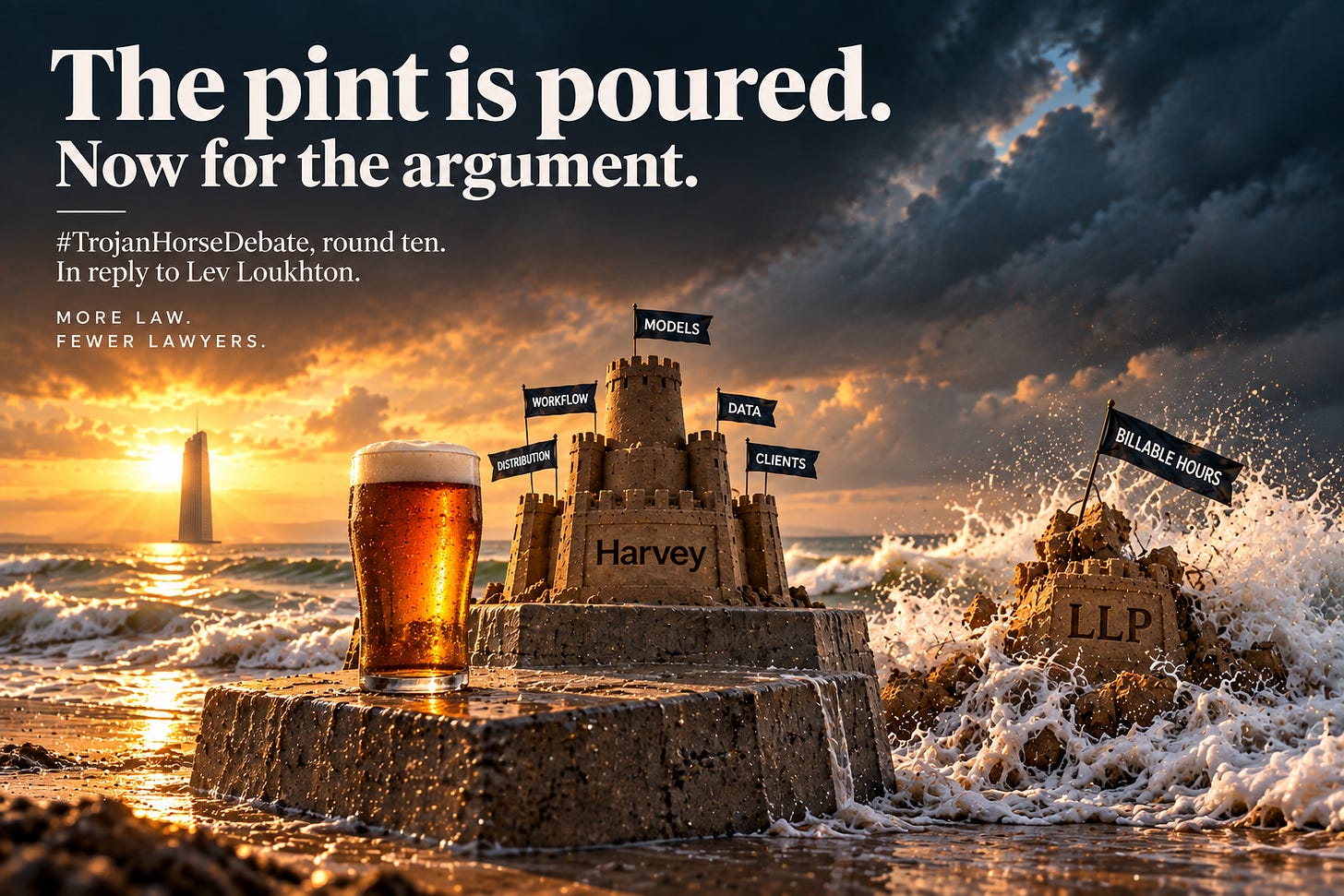
Lev Loukhton has replied to my last essay, “The landlords cut the rent as Harvey started moving out”, in a LinkedIn article titled “The Pint and the Corgi”. It is a valuable advance in the #TrojanHorseDebate and I reproduce it in full below, because it deserves to be read in context, but most of you will have read it already, so I give my response first.
My reply
First, Lev, thank you. You say this debate has shaped your thinking and GrayHair’s investment thesis. That is generous, and I appreciate it. Whatever the profession does with these arguments, they are better for having been tested. The half pint stands. So does the disagreement - and it may even have widened.
Why Harvey did it and what it got are different things
You say Harvey built its own model because the bills were too high. I suggested it may have been about control. Actually, we are both less interested in the “why” than in the “what” - what Harvey ended up with. It may have been a pricing decision or it may have been strategic - I have no ability to second-guess what influenced the people in the driving seat (or the pressures and opportunities that they were responding to), but the outcome is what matters.
What Harvey ended up with is a model of its own. It can change the model, decide where it runs and it can now stop depending on the suppliers’ price list. Other platforms will not have this flexibility. How Harvey got there (and why) it now has control, and that control will last longer than the token discount.
Fixing costs buys time, making suppliers replaceable buys choices. Bit as we shall see, it may also have the unexpected consequence of increasing the risk of unwelcome competition. The price cuts by OpenAI and Anthropic showed how fast a cost advantage can appear or vanish when somebody else sets the price.
A business built on the suppliers’ price list has a shaky foundation whichever way the price moves. I think Harvey has on this one - by design or luck - done well (at least for now, but we should not - no pun intended - discount the reaction that Harvey going its own way may provoke on the foundation models which will see deprecation in token utilisation).
I suspect Harvey got here by design, and in any event recognise the old truth of “the harder I work the luckier I get” - which I have found to be truer still when combined with my personal mantra of “work smarter, not harder” (and it is in the chase of that which drove me to automation in the legal market almost three decades ago).
So, as I see it having your own model is worth it - if you can afford it. Harvey raised $550 million this month, so it can afford it. Your own advice, that firms must never stop watching the technology is fair - but what to do with what you see is less clear. It may assume that the watcher has choice when it spots trouble. If you don’t have the big budgets such as those deployed by Harvey and Kirkland, your choices are curtailed. A model of your own is not cheap, and well advised firms need to focus on what they can own which will distinguish them from the other suppliers. That means anticipating what the other suppliers will look like - starting with whom your competition is, and why: I return that later in this essay.
Owning the stack is owning the plug sockets
You say (in parentheses) that owning the stack is a “bit of a red herring”, and point out that Kirkland is still buying tools from other people while it builds its own. To me that says more about Kirkland’s strategy, which looks like $500 million spread across a table of bets, rather than saying about whether owning things is a good idea.

Picture your own home. I guess you control the wiring and the plug sockets and buy electricity from whichever supplier offers best value (and you retain the ability to switch suppliers). But you do not let the electricity company control the sockets - if your supplier owned the sockets then it could switch them off and control your appliances - perhaps only allowing you to use the tariff the supplier wants you to use or refusing you the ability to use your appliance at a time of high demand. That may be a bargain that as a consumer you are willing to make, but even then you would want to retain the ability to swap to another supplier in case you did not like the decisions being imposed on you.
A firm which owns its data, its workflow, its evaluation of the machine’s output and the layer through which models are called can swap Opus for Sol, or Sol for Kimi as prices move. The firm which locks in to a single provider is, well, locked in. It can only switch when its supplier allows it to do so, and the firm which has tied itself to a single supplier is exposed - one morning it finds that the supplier has turned off the entire infrastructure, not only killing its ability to service your clients but the erstwhile supplier has directly approached the firm’s clients , offering the same service as it provided to the firm, but disintermediated. The supplier offers a cheaper, faster and at least Good Enough alternative. The only tool the firm has to call on is the historic relationship - but that is scant value when the very tools it relied on are no longer available (or, more likely, deprecated from those that the supplier offers and only available to the firm at a price which is higher than the supplier is charging the consumer). In those circumstances the value of the relationship will be tested, and in many cases will quickly wither. And then we see the Trojan Horse has entered the race - but at its own timing and without letting the competition know that there was a a race at all, let alone that it was even entering.
The good news is that the sockets are cheap. Building a power station is expensive, and you rent that. Owning the wiring is within reach of firms with a fraction of Kirkland’s money.
Sometimes owning the whole thing really does pay. That is where LawFairy has arrived. It has built a rules engine for UK immigration law. It applies the written rules across more than fifty visa routes, and language models work inside that structure rather than making the decisions. It is one of only two technology-only law firms the SRA has authorised. It is ahead of the pack, and it is building something sustainable,
In areas of law with fixed tests, thresholds and deadlines, a purpose-built system gives you something a general AI model cannot: the same answer every time from the same facts, with a reasoning trail you can audit, delivered by a regulated firm.
The SRA’s authorisation is permission to operate, not a guarantee that every answer is right. So the firm remains responsible - just like a traditional firm, and here is the obvious point: the AI tool can be honed, refined and taught. Think of it as teaching a junior associate, the difference is that this one learns every time and does not have memory aberrations, relationship issues, time off sick or uncontrolled biases impacting it. And you only need teach it once, no new intake every we months. It is climbing the ladder, and pulling the rungs up behind it. Yes, others may create technology to compete but its value is in its embedded knowledge.
LawFairy demonstrates that “Data is the new oil” and law firms should start by looking for what oil they can drill, and get ahead of the crowd. Wise firms will want to partner with businesses like LawFairy to learn to commoditise their narrow domain value.
The next piece it to place a probabilistic model above the deterministic model, which will optimise the likelihood of securing the information needed to give the best, tailored advice that any lawyer might offer.
These areas for exploitation may appear to be narrow for now - but specialisation will be the edge advantage beating even the foundation models in the next iteration of the growth of the legal profession. I anticipate that GrayHair Ventures is ahead of this curve already.
Standing still is a strategy - if you know when to jump
Our conversation is light. In historic Britain’s palaces fools were left to make the points others could not articulate. They knew that in comedy, timing is everything. The same is true in the professions. Those arguing about Trojan Horses and theoretical paradoxes may be taken as fools, but the underlying texts are important and valuable.
You say that “standing still is the one strategy guaranteed to fail”. I understand what you say, but offer a caveat. Waiting, if your current business still pays, can be sensible - provided (as you say) you keep the ability to move.
Many firms are stuck because they lack information rather than because they lack courage. Some of them may turn out to be well placed: when the winning model becomes clear, they may be able to swap to the cutting edge, dodging the bleeding edge, and will be well positioned to adopt it.
As we look back we shall see that some firms spent too much too soon preparing for a contest they could never win. They will be exposed as having wasted the money, the effort, the opportunity and the years. They will have run in the wrong direction and invested poorly; and they shall be exposes as not having invested in the advantage they intrinsically had, but in trying to out compete the specialist developer in an arena where only the specialists would win. They will be the ones who strived to develop a technology that is, as you suggest, Good Enough for their practice today but which will wither quickly - you suggest that a platform offering value today will wane over 18 months. That timeline appears plausible, and looking at it that way, perhaps it is better to “rent” until the market stabilises rather than build without knowing where the end will settle.
Every partnership should be battling the “when question”. Too soon, and the firm risks bleeding or heading in the wrong direction, too late and it is consigned to history of “also rans”.
The wise will see their specialisms and take a sideways step into something that the engineers at the platforms are not building but which (at least some of their) clients will still want even after the generic “Good Enough” is universally available. They will nurture and develop their true sustainable advantage.
Insurance: agreed - and the labs can retain more of the risk
We agree that AI work can be insured. Since 2024 Orbital Witness has offered its customers optional cover from First Title for mistakes in its AI residential property product. You note that Corgi now sells liability cover for autonomous AI products. Crosby says it is working with insurers, regulators and auditors so that some of its agents’ outputs can eventually go out without a lawyer checking each line; for now its lawyers still check every output.
Here is where I draw a different conclusion from yours.
A foundation-model company with the money of OpenAI or Anthropic could simply carry the risk on its own books, without an insurer. Carrying the risk is not the same as satisfying a rule that says you must have insurance, and it would not remove the rules on who may do reserved legal work, or professional duties, or questions of privilege and confidentiality, or an SRA firm’s duty to hold proper indemnity cover. But if - as in the UK - the regulator permits the work and the client accepts the arrangement, it removes one more reason to put a human reviewer between the client and the answer.
There is a difference between innovation being insurable, which you celebrate, and the supplier retaining the risk itself, which changes the economics again. On top of that, insurers are driven by mathematics and evidence. If, as I anticipate, we see AI making fewer mistakes, it will actually be favoured by the insurers and at that point the entire argument moves. I suspect that we shall see this in the insurance of autonomous vehicles first, but that the legal profession will at the front of the queue that that will trigger.
4K, 8K and the frontier that moves
Your Legal Capability Frontier is an interesting argument , and I still hold to the television. Early ChatGPT was black and white television. Today’s frontier models are 8K. From the sofa most of us cannot tell 8K from 4K, and we will not pay double for it. Open-weight models are now 4K. For most legal work, 4K is all anybody needs. So, I believe that only lawyers would believe that an argument that legal capability has no fixed ceiling could save the profession - leaving aside whether or not there is even a ceiling, the better question is whether clients will care. My assertion is that clients simply want advice that is Good Enough, delivered in a timely and cost-efficient way and that the 4k TV gives them exactly that.
I do not believe there is an endless appetite for enhanced legal logic in the way we practise law today. The frontier you describe may be real: company brains, predictive analytics on judicial philosophy at OurFirm.ai and Lewis Liu’s Twin-1 capturing a senior partner’s judgement for asynchronous access. I endorse the shout-outs, but that does not mean that there is no ceiling (whether theoretical or - as really matters - practical).
But let’s take a look at what OurFirm.ai and Twin-1 actually do. Each takes a human’s expertise and bottles it so that fewer humans are needed to serve it. I understand you to suggest that that is not making what already exists more efficient (perhaps that is a misunderstanding?). I say that that is exactly what they do. They accelerate steps in a process and that acceleration removes lawyer’s time (and perhaps the need for lawyers at all ) from the loop.
In this we describe the machinery of the Consumption Paradox and I think you call it a bigger pie (“The pie is not being redivided among fewer players. It is expanding, and the expansion is the opportunity”) - surely this is attempting to have the Consumption Paradox pie and eating Jevons’ Paradox cake at the same time? As I see it this is a dangerous cocktail leading at the very least to indigestion.
So I part company with you here, and this is I think at the heart of everything we have discussed. As the technology improves, more clients get served by it, and fewer lawyers are needed to serve them. Clients do not want lawyers. They want outcomes.
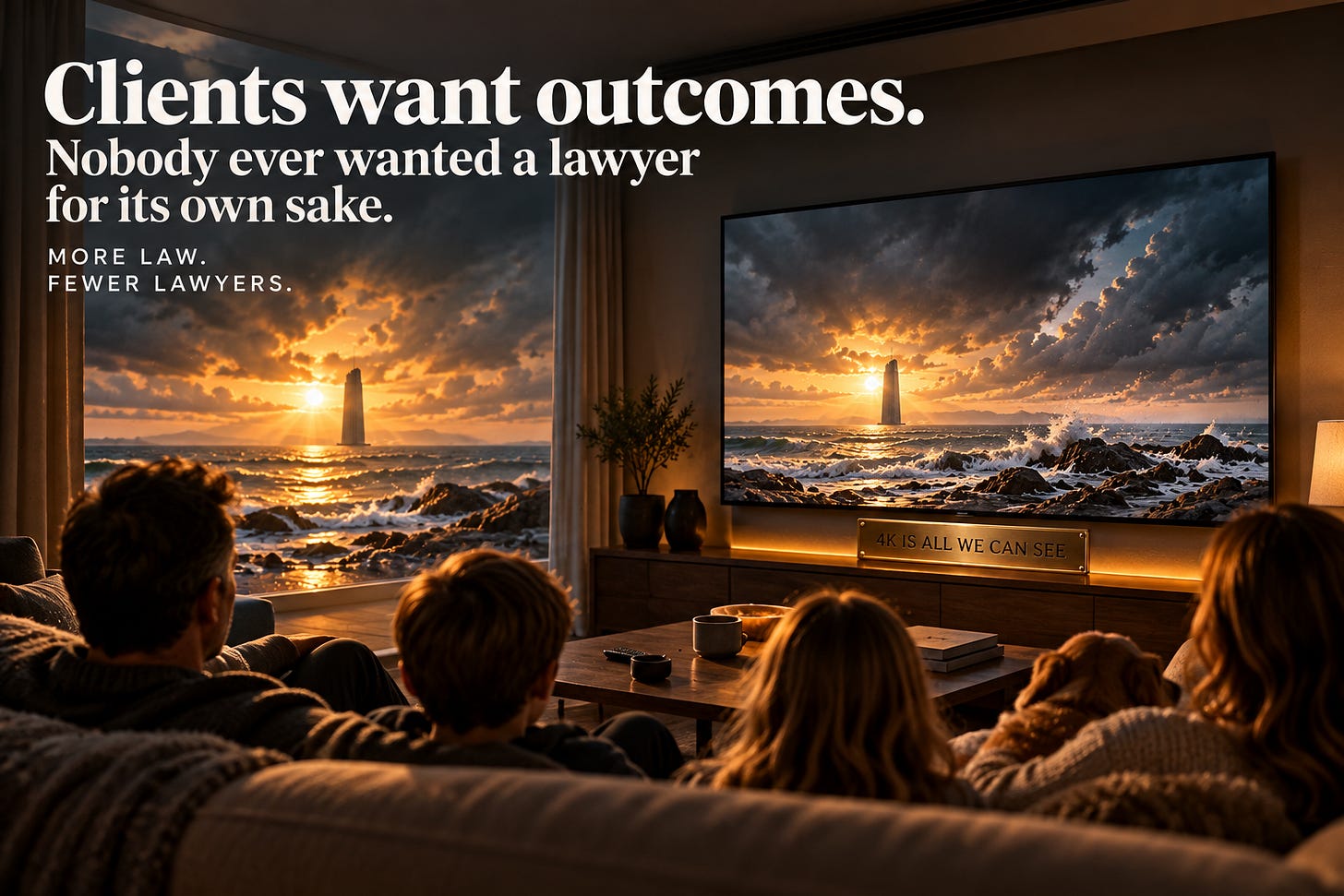
Nobody has ever wanted a solicitor or attorney for its own sake; they want the house, the deal, the visa, the dispute closed, the risk carried. I don’t go to the doctor because I want the doctor - I want better health. That may require a diagnosis, prescription and changes in my daily life. But these are not why I went to the doctor. I went because I wanted the outcome of being healthier. People go to lawyers because they want the outcome, not the process. In fact, the don’t want the process at all - they tolerate it because it is the route to get to the outcome.
Can you imagine consulting an AI for many medical requirements? You might get more people having medical appointments and getting better prescriptions and service faster and cheaper than could ever have been achieved by human consultations. It may even accelerate the process delivering the desired outcome faster - and that may of itself enhance the outcome. In the same way the frontier in law can keep moving - more people getting better legal service, faster and cheaper and at the same time the number of jobs requiring serious input from a human lawyer can shrink, because the client decides what is Good Enough and that bar rises with every release.
As lawyers we look at this from our perspective, the supply side. As you suggested I urge that we should follow Harry Houdini , I am encouraging law firms to swap hats to look at this all from the buy side. See that, and then decide what you will do as the profession transitions.
Many successful frontier products when tweaked will leave the client better placed to do more without the firm, which will be welcomed by the client. That is seeing this from the buy side. It is of course very different from the way the firms seem to see things today. We have already started to learn this lesson, as the efficiencies have encouraged clients to demand lower pricing. The next stage is for the client to demand direct access to the Good Enough technology.
Far from the profession becoming bigger and more valuable for the people who work in it, in this scenario it looks sets to shrivel with only the exceptional specialist services surviving - until they, too, are put through the commodization process.
A comment beneath your article made a point which I may summarise in one sentence: the frontier can expand while every company on it loses the power to charge more. Those are separate points, and I extend the second: not just the ability to charge more, but the ability to charge at all.
What I see changing next is the recipe itself. The static contract, drafted once and fought over later, gives way to the living contract, a relationship maintained by trusted agents which adjust as the world does. Once every action is recorded and can be traced to whoever did it, and agreements are watched continuously rather than dusted off when something goes wrong, cheating gets expensive and trust becomes worth money.
Parties who can rely on each other stop paying a premium to protect themselves against the future, and a large part of what lawyers currently sell is protection against the future. The living contract changes that perspective, and there will be plenty or roles for lawyers as we evolve to the next paradigm, but (as ever) timing is the key. There is a clear path to get there, but that is secret sauce which I am (frankly) not yet willing to disclose.
Freshfields, and the question you answered instead
You say Freshfields signed a deal with Anthropic because Anthropic needed domain expertise and distribution. That is an interesting observation, and explains why Anthropic signed. Why Freshfields signed is less clear. I suspect the answer is that it anticipated that it may secure an advantage over the firms that did not partner with a foundation model. Your point about the landlord needing its tenants to build the building is true - as far as it goes. You anticipated my reply, so I will give it: the operative word is “yet”. A landlord who learns a trade from its tenants is then able to decide whether it wants to retain the tenant or replace it (perhaps to learn a new trade). They will retain the tenant if the tenant gives better value than the alternative. That is worth pondering on.
The FT’s report says the tools Freshfields helps to build could later be sold to rival firms. If that is the case, it amplifies the uncertainty of the firm’s strategy that led to this partnership. One hopes (and suspects) that there is more to it than we can see from outside. I would be fascinated to learn more.
Jevons: agreement
You accept that consumption expands as intelligence gets cheaper. You look at the impact on the foundation models and their pricing. I see that as a simple distraction and want to draw out what it means, because it is the largest point in this whole debate.
Two suppliers cutting prices while customers are exploring their own supply is what a fiercely competitive, increasingly commodity-like market can look like. We cannot prove that the price cuts were aimed at Harvey or companies like it. But the result will be commodity intelligence at commodity prices. Applied to the law, many more people will secure the benefit of legal help while fewer lawyer-hours are needed to serve them. That is the Consumption Paradox. The suppliers chasing the price down will need to monetise their investment - they may move in to the Big Law space and maintain the costs and reap the enhanced margins, but that is only sustainable while the competition accedes to this approach. But when the model providers themselves start competing, the race to the bottom will be to sell utility to consumers. And every business decision is made by a consumer - hence the brilliance of the Harvey pro bono strategy, if it means is wins hearts and minds of the person on the street - because as I see it the CEO and chief legal officers are, in other guises, just such a person on the street.
Lawyers understanding what is to come may anticipate seeing their clients increasingly buy the capability directly while the underlying price of intelligence continues to fall rapidly.
Pyramids and pro bono
I have mentioned pro bono above, but look forward to your reserved pyramid and pro bono responses with interest. I have put my positions on both.
As you know, I expect that the foundation models - notwithstanding their private assurances that they want to facilitate rather than disrupt the specialist platforms - will increasingly to sell the same capability. Harvey’s reduction in the use to foundation models’ tokens may actually provoke those models into the alternative sale. That would be the ultimate unexpected consequence of what otherwise looks like a wise strategy. The big difference I see is that the foundation models will have the ability to sell law as a utility. And then the trust that Harvey is building today by piggybacking on the lawyers will be vulnerable. That trust may then transfer to the foundation models, since the consumer (client) will understand the benefits of the AI legal solution and their loyalty to the legal firm or to the platform brand will be trumped by the fiduciary duty demanding acceptance of the pricing, speed and perceived enhanced quality of the foundation models’ service. If I am wrong and the client does not attach value to the brand, the foundation model will simply buy the brand, its embedded client base and sweat that asset - indeed, they may do this anyway in order to retain the existing value proposition that clients already accept. .
Plurality, for now
Your close is that plurality of business models is the answer, and that the experiment is the point. I agree but only to the extent that this is an interim answer. We are back to the “yet”.

Markets experiment and often converge around a smaller number of dominant architectures, while niches remain.
Cooley GO shows that productised and premium delivery can coexist; it does not establish that plurality is permanent. I expect the profession to settle around fewer dominant models again.
My prediction is that those models will employ fewer lawyers than the models being tried on the way, because client-led convergence rewards outcomes delivered with less scarce human input.
The next pint
So the next pint is waiting on the bar, and the questions I would like to mull on with you as we enjoy the beer are:
if there is room for multiple business models for now, how long until the old models start to seize up
what is the longevity of even today’s emerging models, and
how many of today’s lawyers will be needed as the new business models emerge and after they have been implemented.
Asked with a light step, but these are profound moments in the evolution of the legal profession.
Exploring how AI reshapes society, work, politics and human connection - from my forthcoming book.
#FactsAreFriends #TrojanHorseDebate
Sources
Lev Loukhton, LinkedIn, 24 September 2026, “The Pint and the Corgi”
Quentin Solt, Substack, “The landlords cut the rent as Harvey started moving out - Built on Sand: the #TrojanHorseDebate evolves” - https://factsarefriends.substack.com/p/the-landlords-cut-the-rent-cut-as
LawFairy launch, GlobeNewswire via National Law Review, 2 April 2026 - https://natlawreview.com/press-releases/lawfairy-goes-live-launching-deterministic-legal-intelligence-platform-uk
The Global Legal Post, “SRA authorises new AI-powered law firm LawFairy” (Raj Panasar on language models operating inside the deterministic structure) - https://www.globallegalpost.com/news/sra-authorises-new-ai-powered-law-firm-lawfairy-590898458
Artificial Lawyer, 25 June 2024, “Orbital Witness to Offer GenAI Accuracy Insurance in Legal Tech World First” - https://www.artificiallawyer.com/2024/06/25/orbital-witness-to-offer-genai-accuracy-insurance-in-legal-tech-world-first/
Bloomberg, 21 September 2026, “Startups Like Harvey Embrace Open Models to Cut Reliance on Anthropic, OpenAI” - https://www.bloomberg.com/news/articles/2026-09-21/startups-like-harvey-embrace-open-models-to-cut-reliance-on-anthropic-openai
Decrypt, 22 September 2026, “OpenAI Launches GPT-6 Sol and Luna Minutes After Anthropic Drops Claude Opus 5.5” - https://decrypt.co/378986/openai-launches-gpt-6-sol-luna-anthropic-claude-opus-5-5
Business Wire, 23 April 2026, “Freshfields and Anthropic Team Up to Co-Build AI Legal Workflows” - https://www.businesswire.com/news/home/20260423837690/en/Freshfields-and-Anthropic-Team-Up-to-Co-Build-AI-Legal-Workflows-Deploying-Claude-Across-the-Firm-Globally
Resultsense, 3 September 2026, summarising Financial Times reporting on the Freshfields tools-for-resale point - https://www.resultsense.com/news/2026-09-03-law-firms-build-own-legal-ai/
Reuters, 28 May 2026, “Law firm Kirkland to spend $500 million developing its own AI platform” - https://finance.yahoo.com/sectors/technology/articles/law-firm-kirkland-spend-500-215908453.html
Lev’s post, to which this is a reply, in fullThe Pint and the Corgi
Lev Loukhton, LinkedIn, 24 September 2026I will take that pint, Quentin Solt. Next round is on me, regardless of where any of this lands. I will happily admit that our #TrojanHorseDebate has sharpened my personal thinking on legal tech and refined our investment thesis at Grayhair Venture Partners, and that is obviously worth a lot more than a couple of pints.
On Tenet: cost, not control
You have reached for control because control is the more flattering explanation, and because it survives longer as an argument than a spreadsheet does. But look at what actually happened. Harvey’s margins (allegedly) went negative because token consumption rose twenty-fold and every one of those tokens was purchased at retail from someone with more pricing power than Harvey has. Sovereignty is not at issue here, we are faced with unit economics that require improvement.
Now, we at GrayHair have been backing companies with superior architecture (better accuracy per dollar, not just better accuracy) since we started writing checks in this space, precisely because it was obvious that renting frontier intelligence at frontier prices for commodity tasks was not necessarily the soundest business model. But, equally, we knew that you can fund an unsustainable cost structure indefinitely if the capital keeps flowing. What you cannot do is call the moment the capital gets nervous a “strategic pivot.” Bloomberg’s article is the invoice; nothing more, nothing less.
Call it control over your own destiny if you like the phrase (I won’t begrudge you the flourish, and I do admire your writing style), but it is still a pricing decision, not governance.
On building your own stack
I have said this before and Tenet does not change it: there is nothing fundamentally wrong with a hybrid approach, building some and renting some. Where I would beg to differ (slightly) is on the shape of the contest you have drawn. No law firm is competing with Anthropic or OpenAI, and none should be foolish enough to try - the people keeping that particular genie on some kind of leash are not the people Kirkland is going to out-hire, and that is not the layer at which Kirkland is trying to compete. Kirkland is trying to out-build Harvey (if that; we have it on reliable authority that Kirkland is buying/renting a lot of solutions, so the whole notion of “owning the stack” is a bit of a red herring).
For everyone without Kirkland’s revenues, the answer is - categorically, absolutely and resoundingly - not to own the stack. It is to never stop watching it. That is the actual significance of firms appointing so many Heads of AI alongside KM Managers (as recently pointed out by Ted Theodoropoulos). From where I sit, this is an admission that horizon-scanning has become a permanent function, not a project with an end date. Even a firm that can afford the best off-the-shelf platform today will find it stops being Good Enough in eighteen months, because the practice underneath it is being rebuilt in real time. Standing still is the one strategy guaranteed to fail.
On insurance
Orbital already has AI outputs underwritten for residential property transactions in the UK - a live policy, not a promise. Corgi is doing something similar more generally. And Crosby has announced it will insure its agents’ outputs, moving toward autonomous work its lawyers no longer review line by line, though the carrier and the evals underpinning it are still being worked out with regulators. That is not evidence the human backstop is quietly becoming unaffordable, as you would have it. It does, however, offer some evidence that genuine service-delivery innovation is already insurable, in at least one case, and getting there in others - which is exactly the kind of structural advantage worth backing rather than an ambient risk worth fearing.
On the frontier
Your 4K/8K metaphor is elegant, but I cannot fully agree with it. It assumes legal capability has a fixed ceiling, and the only question is how cheaply you can rent your way up to it. That may have been true when Harvey showed up, and the whole proposition was “better chatbot than the associate had.” It stopped being true roughly the moment we started underwriting company brains, real data-driven business and legal insights (shout out to Andrew Mancilla at OurFirm.ai for their predictive analytics relating to judicial philosophy) and digital twins (another shout-out to Lewis Z. Liu, whose Twin-1 captures a senior partner’s judgment for asynchronous access). This is not compression of existing capability - it opens the door to a head-spinning potential of what is possible, an expansion of what is for sale in the first place. The Legal Capability Frontier is not a fixed resolution you are metering access to. It is a boundary that keeps moving, and it is moving (in part) because investors like us are underwriting the startups moving it, going beyond LegalTech 2.0 (which, by the way, does not cease to be valuable simply because the next wave has appeared).
That is also my answer to your best question - what does a firm sell once the client can buy the advice, the insurance and the regulatory comfort without the firm? Whatever currently sits past the frontier, because the frontier relocates faster than commoditization can catch it. The pie is not being redivided among fewer players. It is expanding, and the expansion is the opportunity.
It is also why I remain adamant that “landlords need tenants”. Freshfields did not sign with Anthropic because Anthropic had run out of things to do. It signed because Anthropic needed domain expertise and distribution it does not have, and a law firm was the fastest way to acquire both (remember that part in the early installments of our #TrojanHorseDebate, where I mentioned that some firms are bound to break ranks and provide access to frontier models, even if some firms decide to stonewall?) A landlord that needs its tenants to help build the building is not yet ready to evict them (and I appreciate that you will feel that the operational word here is “yet”).
On Jevons - turn it back upstairs
You are right that consumption expands as intelligence gets cheaper, and I do not believe that this was ever in dispute. But, as you pointed out: Harvey’s tokens went up (allegedly) twenty-fold and it responded by going and building its own supply. The labs’ response, roughly ninety minutes apart, was to cut prices on exactly the tier Harvey had just fled to. That is not the behaviour of an entrenched landlord calmly collecting rent. That is two competitors racing one another down a cost curve because neither trusts the other to hold the line - which is precisely the treadmill Harvey was trying to get off. “Confirmed dependency,” as you put it, cuts in both directions. Nobody upstairs is as comfortable as the rent cut makes them look. Not sure there are any “landlords” in this market that are sitting there looking pretty, certainly not at some companies that are currently raising money at an eye-watering valuation well north of $1 trillion...
Two things I am not answering here
The pyramid point deserves more than a paragraph tacked onto the end of someone else’s argument, so I’m not going to try. How judgment gets built when the repetitions that used to build it disappear is a real question and I don’t think either of us has an honest answer yet.
Same with pro bono - I have a different view on the announcement (I do think that Harvey is enabling more pro bono capacity, not renting the firms’ reputations to build one, and - while I certainly like the strategy to get closer to certain portions of the market, I am not yet confident that it makes sense given the value proposition), but that is a debate on its own terms and deserves its own round rather than a rebuttal squeezed in here.
Where that leaves us
I do not think the market settles into one story any more than it settled into one law firm business model a generation ago. Some firms will sell volume, some will sell judgment, some will do both under different letterhead (Cooley GO exists precisely because commoditizing your own expertise and defending the premium version of it are not mutually exclusive strategies). That plurality is not a sign that the profession has not figured out its answer. The process of experimenting with business models is the answer.
What do you think?