 Facts are friends

The new Engels’ pause: AI creates wealth but makes workers poorer
On 28 December 2025 Geoffrey Hinton delivered a warning on CNN:
We’re going to see it having the capabilities to replace many, many jobs.
Not augment. Not assist. Replace.
In October 2025 Hinton explained the commercial logic. It is not rocket science. You don’t need AI to work it out. And that, of course, is the point - when it gets hard, AI can get there faster and more reliably. Big companies are betting on job replacement because that is where the big money sits. For firms that have already committed billions to AI infrastructure, labour substitution stops being a productivity upgrade and becomes the simplest route to protecting margins.
AI is becoming faster, more reliable and cheaper than people. Why, driven by economics, would you employ a person rather than deploy and AI?
This sits behind a more awkward reality for professional services. Lawyers, accountants, consultants and analysts do not become competent by reading textbooks. They become competent through repetition. Their early work looks mundane to the outside world because it is training disguised as output. For years many of us have recognised the “inappropriateness” of clients being charged for the time recorded (often wasted) by juniors learning the craft. With AI the client no longer has to it up with what many have (rightly in my view) seen as a con.
The Bank of England has been circling the same concern for years. In 2018, Mark Carney used the language of Engels’ Pause to warn that technological returns often flow first to the owners of capital rather than the workers who use it. In December 2025, Andrew Bailey made the parallel explicit again, comparing AI-driven disruption to earlier waves of displacement. Bailey speaks of displacement. This is not language of supplementing or facilitating, it is displacement and replacement.
Optimists still argue that new jobs will appear, as they did after previous technological shocks. That remains possible. It is also unknowable. History has a habit of surprising us - and it may surprise me again with new forms of work. But for us to rely on that would be a triumph of hope over solid policy preparation.
A profession that trains competence through junior work cannot run its future capability on optimism.
The historical pattern: the new Engels’ Pause
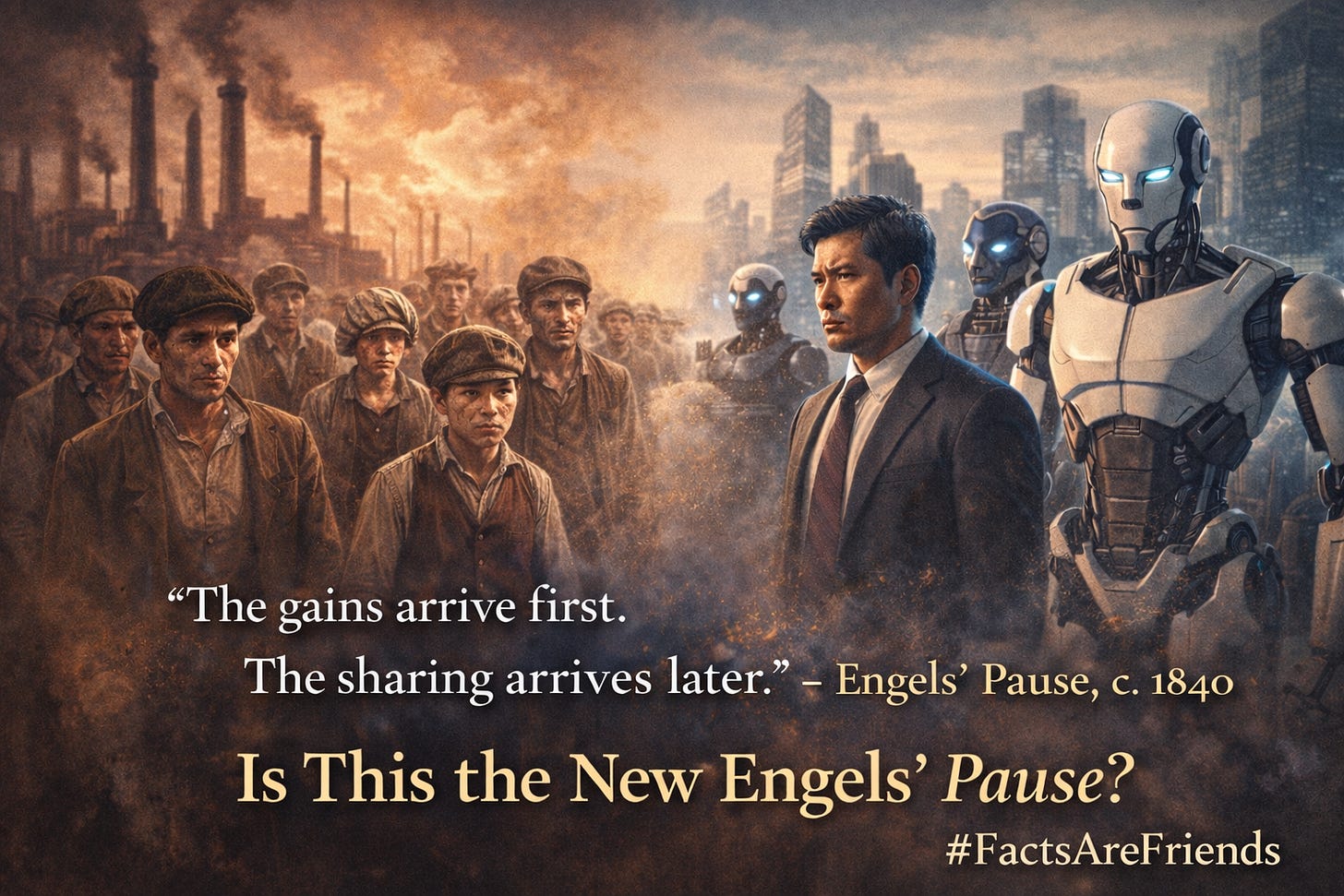
Engels’ Pause describes a long period during Britain’s early Industrial Revolution when productivity rose strongly while wages lagged badly. The country got richer. Ordinary workers waited.
For over half a century - more than most peoples’ working lives - between 1780 and 1840, Britain’s output per worker rose sharply whilst real wages for the working class barely moved. Workers were displaced by machines, often tended by children with minimal bargaining power. The gains from technological progress flowed overwhelmingly to capital owners who reinvested profits in factories and machinery rather than wages.
The divergence was not accidental. Early technologies tended to replace labour rather than augment it. The Combination Acts of 1799 and 1800 prohibited unions entirely, leaving workers exposed to pure market forces. Real wages did not rise consistently until after the Corn Laws were abolished in 1846.
Policy choices drove outcomes. The decision to suppress unions and protect domestic grain prices was not inevitable - it was chosen. Those choices determined who captured the gains from technological transformation.
For AI that sequence should be writ large as a warning label with a Lord Denning style red hand pointing at it. If the gains arrive first and the sharing arrives later, the social fabric stretches. Some stretch is elastic, some snaps.
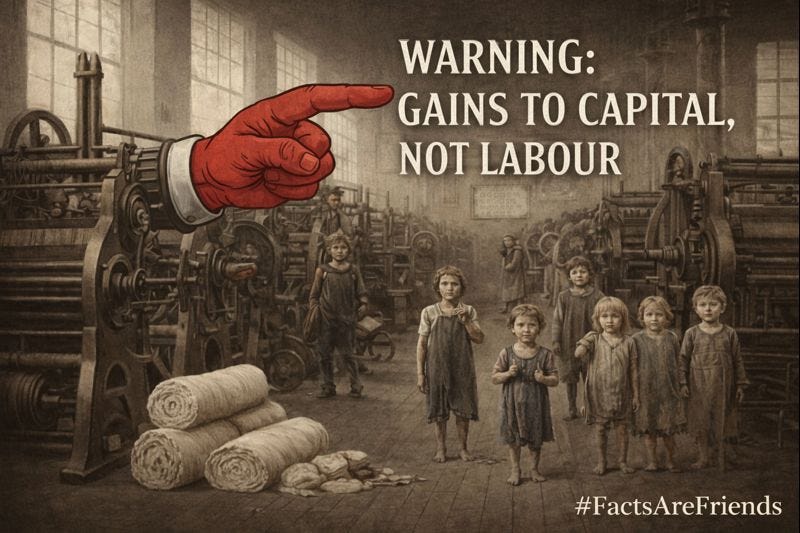
Engel’s warning is starkThe modern parallel: the bottom rung dries up first
AI compresses decades into quarters. Looking today I see that the most important early signal is not wages collapsing, but entry points shrinking.
Stanford’s Digital Economy Lab documented the employment effects in its August 2025 study. The Lab found a 13% relative decline in employment for workers aged 22-25 in AI-exposed occupations since late 2022.
Many exhort young people to study to develop computer systems “that is where the future is”. Yes, but … that does not mean that there will be more jobs there. In fact, since 2022 jobs for software developers aged 22-25 in the US have fallen approximately 20%. The stats show that customer service workers in the same age group experienced an 11% decline. What are the facts here, and what are they telling us?
The implication is straightforward. The bottom rung becomes thinner before the top rung feels anything. That is how talent pipelines constrict. If AI removes the entry-level work that creates competence, the professional ladder does not simply get shorter. It becomes harder to climb at all.
Law as the leading indicator
Law is a particularly clear case study because it combines three features:
A large share of junior work is text-heavy and repeatable.
Training relies on apprenticeship and repetition.
Risk tolerance is low, because errors trigger cost consequences, regulatory consequences and court consequences.
In late 2025, those pressures started to show up in decisions, not just strategy decks.
In September 2025 Freshfields Bruckhaus Deringer announced redundancies affecting up to 19 paralegal positions at its Manchester hub - approximately half of junior paralegals there. The firm cited “a fast-changing legal market” and “investing in technology” language widely interpreted as AI-driven workload substitution. Again, “only” paralegals, again once they are trimmed it does not take a genius to see where next commercial logic drives to.
Then in November Clifford Chance cut 50 London business services roles and explicitly cited “greater use of AI and reduced demand for some business services” among the drivers. This marked the first time a Magic Circle firm directly linked job cuts to artificial intelligence. The firm recorded revenue of £2.4bn for FY2025 (a 9% increase) and equity partner profits of £2.1m each, suggesting the cuts are strategic rather than defensive. Sure they were (again) “only” support staff, but these are real people, real jobs and - importantly for lawyers reading this - they are just the start. You do not need much imagination to guess at what happens next.
Training contract numbers across 67 leading City firms have dipped 8% from their 2024 peak.
More striking are voices from within the profession. Junior associate Zach Couger at McDermott Will & Schulte told MIT Technology Review in December 2025: “I’m worried that I’m not getting the same reps that senior attorneys got”. He added ominously:
“I may be the last plane out”.
This is the double bind in practice. Firms gain short-term efficiency. They can keep pricing structures largely intact whilst doing more work with fewer people. Partners bill the same rates whilst deploying fewer associates. Profitability improves. But the efficiency is purchased by starving the very experiences that produce future judgement. But perhaps with the speed of AI’s development, that makes sense?
The Law Society Gazette articulated it on the basis that if a model can perform document review, research, extract precedents and draft initial documents in seconds, who does the foundational training? Without training in basic legal skills, how will the profession produce competent senior lawyers who can judge whether an automated product is right or wrong? But I wonder whether, perhaps, this is the wrong question? Is the better question based on the assumption that AI will replace most of the lawyers and we should instead explore how we develop systems that will monitor AI and it frameworks to protect from black box logic going awry?
Sure, AI today is fallible. But everyday it gets better. Just like the junior associates learning on the job - only AI has a magnitude winder and faster learning trajectory. Those relying on AI not being good enough, ride alongside those who believed that the speed at which trains travelled would destroy bodies.
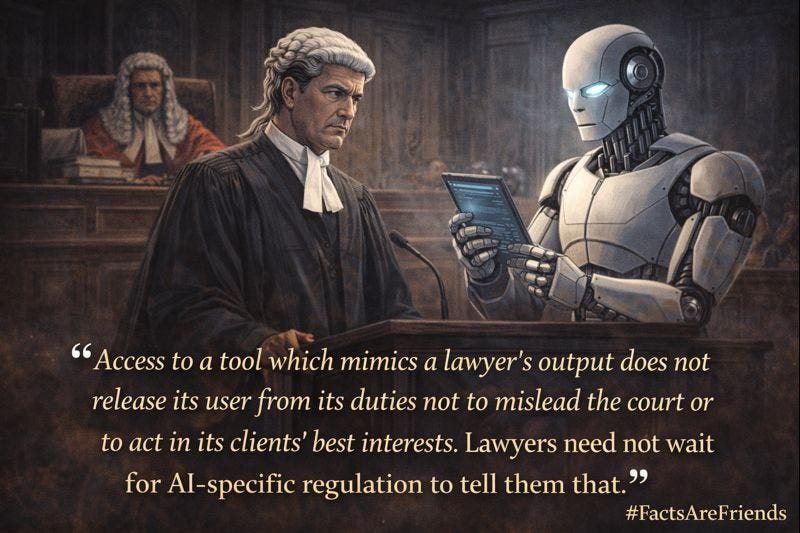
The courts and regulators have tightened the screw at the same time. In Ayinde v Haringey & Al-Haroun v Qatar National Bank ([2025] EWHC 1383 Admin, June 2025), the Divisional Court confronted barristers and solicitors who submitted AI-generated fake case citations. The court stated unambiguously:
“Access to a tool which mimics a lawyer’s output does not release its user from its duties not to mislead the court or to act in its clients’ best interests. Lawyers need not wait for AI-specific regulation to tell them that”.
The Lady Chief Justice followed in July 2025, linking responsible AI use to robust oversight, training and support, particularly for trainees and early-career lawyers.
Meanwhile, professional indemnity insurers are responding with increasing caution. Berkley Insurance introduced one of the broadest AI exclusions for professional liability policies in 2025, characterised by Above the Law as “not a scalpel; it’s a sledgehammer”.
Major insurers including AIG and WR Berkley have filed with regulators for approval to restrict liability for AI-related claims. New general liability endorsements allowing carriers to exclude generative AI exposures are expected to become effective this month (January 2026).
This is exactly what we should expect - insurers moving faster than regulators (who in turn move faster than the - even with global warming - glacially slow legislators), but still moving too slowly? The insurers are responding to last year’s data - next year (I predict) the insurance pendulum will catch up: AI will be seen to be quicker and cheaper but - and this is critical - less accident prone and more reliable than humans. When that happens it is the insurers who will lead and drive the industry to adoption of AI. I foresee in the near future insurers withholding insurance if AI is not deployed (in the same way that they withhold insurance if you fail to apply locks to your home).
It is clear that the profession faces a structural problem. Junior work is thinning. Accountability remains personal. Risk tolerance stays low. Insurance coverage is contracting. That combination creates pressure for new delivery models that do not rely on the traditional pyramid. Oh, wait a moment - others spotted this a long time ago …
The competitive landscape shifts
The regulatory boundaries are being tested by new entrants. The SRA made history in May 2025 by authorising Garfield.Law Ltd as the first AI-driven law firm in England and Wales, using an LLM to guide clients through small claims debt recovery with automated letters starting at £2. I have written about this in my LinkedIn posts and recommend those who are not familiar with it to check it out. Consider how long until even a part of what you do is automated.
More dramatically, Norm Law LLP launched in November 2025 backed by a $50 million investment from Blackstone, deploying lawyers trained as “Legal Engineers” who convert legal workflows into AI agents. This is the way the next generation “AI First” law firms will evolve and - for some time - dominate. In the same way as Henry Ford developed his cars to look like horse drawn carriages and Musk developed his electric cars to look like the successors to Ford’s cars, AI first law firms will initially look like conventional firms but (as Ford and then Musk changed the internal workings) they will perform in a totally different way. As clients become used to AI law, the providers will start to look quite different.
Legal AI platform Harvey reached an $8 billion valuation in December 2025, up from $3 billion in February—serving 700 clients including the majority of top 10 US law firms. Clio’s $1 billion acquisition of vLex in November 2025 represented the largest M&A transaction in legal technology history. The funders can smell blood - although (as explained in my previous Substack series on valuations), I believe that they are backing the wrong horse: in fact talking of horses I see theses tools as Trojan Horses which law firms are paying for but which will ultimately be no more than an aggregation service for a “foundational” AI model (probably controlled by Microsoft) which will swallow them whole.
For now the billable hour proves surprisingly resilient. The ACC/Everlaw survey in September 2025 found nearly 60% of in-house counsel reported “no noticeable savings yet” from outside counsel’s AI use. Only 13% pointed to fewer billable hours. T he expectations-reality gap is stark: in 2024, 39% of law firm attorneys expected AI to accelerate alternative fee arrangement adoption; by 2025, only 9% reported actual increases. However, I believe that this disparity can be attributed the market inertia and dominance of major law firms. As clients become more sophisticated and, indeed, law firms expose the powers of AI by paying for systems such as Legora, Harvey and Cleo, so they will demand more for less.
For now, this double bind - immediate gains traded for long-term capability loss - represents a period of transition. The deeper competitive threat that lurks is not from the legal AI platforms but from technology companies and consulting firms with sufficient scale and capital to absorb regulatory barriers and influence insurers. When Big Tech or major consulting firms decide the legal services market justifies investment, they will influence and build the regulatory infrastructure required.
The policy vacuum: scaffolding, not reassurance
Engels’ Pause was not an automatic law of steam power. It was a political economy sequence. It took time for institutions to catch up. That time imposed costs on ordinary people. Today we are at the start of that curve: Some efficiencies are being seen, few of the real costs are yet being felt. We would, however, be kidding ourselves if we failed to recognise the reality of risk.
Today’s policy debate is slowly pivoting from whether AI raises productivity to how tax, welfare and labour market structures adapt when human labour time decouples from economic value.
Sami Mahroum argued in Project Syndicate on 30 December 2025 that policymakers are:
“overlooking the deeper problem: the accelerating decoupling of human labour time from economic value”.
Robot taxes and AI usage taxes are entering mainstream discussion partly because governments can see the fiscal problem forming as labour-based tax receipts weaken.
Those proposals may help. They do not solve the underlying pipeline question. They do not go far enough, but they indicate a direction of travel.
Simple redistribution of basic income matters, but it is not sufficient. The core requirement is scaffolding for an economy in which paid work no longer functions as the universal distribution mechanism for dignity, income and belonging.
That scaffolding has three legs.
First, investment in human capabilities that remain hard to mechanise at scale: empathy, creativity, judgment and complex interpersonal dynamics. These remain distinctly human capabilities, though the boundary moves constantly.
Second, new systems like Universal Income, funded by the immense wealth that AI will generate, to provide a foundation for citizens to build lives of purpose beyond traditional paid employment. this will transform people's lives so that they no longer work to live, but are able to live to work.
Third, democratic governance of AI capabilities themselves. If AI platforms become the dominant infrastructure for professional services- including legal work - who controls access and on what terms? These are not merely technical questions but fundamental questions about power, accountability and the distribution of economic opportunity.
The choice before us
Policy choices during the Industrial Revolution were not inevitable. The decisions to suppress unions through the Combination Acts, to protect grain prices through the Corn Laws, to allow productivity gains to flow entirely to capital owners were political decisions that determined who benefited from technological transformation.
Today’s policy choices around AI adoption, worker protection and wealth distribution are equally consequential.
Bailey is right that AI will displace workers just as the Industrial Revolution did.
Hinton is right that the economic incentives for replacement are overwhelming.
But Engels’ Pause was not predetermined by steam power and textile machinery. It resulted from specific policy choices about who would bear the costs and capture the benefits of transformation.
For the legal profession, the immediate question is stark: when AI eliminates the work that trains junior lawyers, do we worry about the next generation of senior partners - will they ever be needed? Firms optimising for today’s profitability may be systematically destroying their own future capability: and that may be the inevitable consequence of AI.
The broader question applies across all professional services: will we repeat Engels’ Pause - allowing technology to enrich capital whilst impoverishing labour for a generation - or will we build the scaffolding for an economy where AI’s productivity gains are shared rather than concentrated?
History suggests the default outcome is concentration. Changing that outcome requires deliberate choice.
We need people like you and me to be talking to policy makers ensuring that we do not admit civil unrest to society for lack of forethought.
Sources
Geoffrey Hinton CNN State of the Union interview, 28 December 2025: Hinton’s warning about AI capabilities to replace jobs and the seven-month doubling cycle.
https://fortune.com/2025/12/28/geoffrey-hinton-godfather-of-ai-2026-prediction-human-worker-replacement/ and warning warning that AI is moving from augmentation to large-scale job replacement, with capabilities accelerating rapidly https://fortune.com/2025/12/28/geoffrey-hinton-godfather-of-ai-2026-prediction-human-worker-replacement
Geoffrey Hinton Bloomberg TV interview, October 2025: The economic logic quote about companies betting on job replacement “because that’s where the big money is going to be”
https://finance.yahoo.com/news/godfather-ai-says-tech-giants-184357806.html
Mark Carney speech “The Future of Work”, 14 September 2018: The Bank of England’s earlier use of “Engels’ Pause” terminology and warning about returns flowing to capital owners.
https://www.bankofengland.co.uk/-/media/boe/files/speech/2018/the-future-of-work-speech-by-mark-carney
Andrew Bailey BBC Radio 4 interview, 19 December 2025: Mr Bailey’s Industrial Revolution comparison and displacement warnings.
https://www.insurancejournal.com/news/international/2025/12/19/851754.htm
Robert C. Allen, “Engels’ pause: Technical change, capital accumulation, and inequality in the british industrial revolution”: historical statistics on output vs wages 1780-1840.
https://www.nuff.ox.ac.uk/Users/Allen/engelspause.pdf
Stanford Digital Economy Lab, “Canaries in the Coal Mine?”, August 2025: 13% employment decline for workers aged 22-25 in AI-exposed occupations and specific figures for software developers and customer service workers.
https://digitaleconomy.stanford.edu/publications/canaries-in-the-coal-mine/
Clifford Chance redundancies, November 2025:
https://www.cityam.com/clifford-chance-ai-driven-redundancies-hit-london-business-service-roles/
Freshfields Manchester paralegal redundancies, September 2025:
https://solicitornews.co.uk/freshfields-manchester-paralegal-redundancies/
Training contract numbers decline: The 8% decline from 2024 peak across 67 leading City firms.
https://www.lawcareers.net/Explore/News/Training-contract-numbers-remain-stable-new-research-reveals-07112025
Zach Couger MIT Technology Review interview, December 2025:
https://www.technologyreview.com/2025/12/15/1129181/ai-might-not-be-coming-for-lawyers-jobs-anytime-soon/
Law Society Gazette commentary, August 2025: Training pipeline question about producing competent senior lawyers.
https://www.lawgazette.co.uk/commentary-and-opinion/everything-will-change-including-training/5124203.article
Ayinde v Haringey & Al-Haroun judgment, June 2025:
https://www.judiciary.uk/wp-content/uploads/2025/06/Ayinde-v-London-Borough-of-Haringey-and-Al-Haroun-v-Qatar-National-Bank.pdf
Lady Chief Justice comments, July 2025: Emphasis on oversight and support for early-career lawyers.
https://www.judiciary.uk/mansion-house-speech-by-the-lady-chief-justice-2/
Berkley Insurance AI exclusions, 2025: Broad AI exclusion characterisation.
https://www.datamation.com/artificial-intelligence/insurers-ai-liability-coverage/
Garfield.Law SRA authorisation, May 2025: First AI-driven law firm SRA approval:
https://www.sra.org.uk/news/news/press/garfield-ai-authorised/
Norm Law LLP launch with Blackstone backing, November 2025: Verifies $50 million investment and “Legal Engineers” approach.
https://www.prnewswire.com/news-releases/norm-ai-announces-50-million-blackstone-investment-launch-of-new-ai-native-law-firm-norm-law-302621622.html
Harvey AI $8 billion valuation, December 2025: valuation and client base:
https://techcrunch.com/2025/12/04/legal-ai-startup-harvey-confirms-8b-valuation/
Clio vLex acquisition, November 2025: $1 billion transaction:
https://www.prnewswire.com/news-releases/clio-completes-landmark-1b-vlex-acquisition-and-announces-500m-series-g-funding-round-at-5b-valuation-302609582.html
ACC/Everlaw billable hour survey, September 2025: 60% report no savings and low alternative pricing adoption:
https://www.attorneyatwork.com/the-ai-adoption-divide-dominates-the-2025-future-of-professionals-report/
Sami Mahroum, “How to Tax AI”, Project Syndicate, 30 December 2025:
https://www.project-syndicate.org/commentary/ai-hours-level-tax-computational-time-usage-by-sami-mahroum-2025-12