 Facts are friends
In brief
AI will make legal services cheaper to produce. The legal profession has barely begun to think about a more dangerous problem: what happens when the people and businesses who need lawyers no longer need them - or can no longer afford them?
This essay argues that the demand side offers a threat to legal practice as we know it today. While most focus on the supply side (AI doing legal work) the demand side (AI eliminating the need, the jobs and therefore the income of those who buy legal services) is at least as serious a threat.
I call this the consumption paradox: AI makes law cheaper to deliver while simultaneously destroying the demand that pays for it.
The two effects do not cancel out. They compound. And they affect every category of legal client - corporations, transactional individuals and people in crisis - in different but equally damaging ways.
The numbers
In the LegalTech space, headlines focus on what AI can do:
Draft contracts.
Summarise cases.
Review documents.
Give technical advice.
Advise on strategy (in case you haven’t seen that yet, it’s coming)
And yes, it does these things well, and cheaply. Research drawing on studies by MIT economists suggests AI cuts the cost of automatable tasks by roughly a quarter.[1]
AI is not distracted by personal relationships, it does not demand pay rise, it does not grow tired, it is not distracted by office politics and as it develops it will learn not to to hallucinate, not to repeat mistakes (unlike people who take time to learn) and how to improve and emulate EQ as well as IQ. It will be quick and thorough, and for a majority of people for a majority of the time, it will be good enough.
But step back from the technology and look at the people.
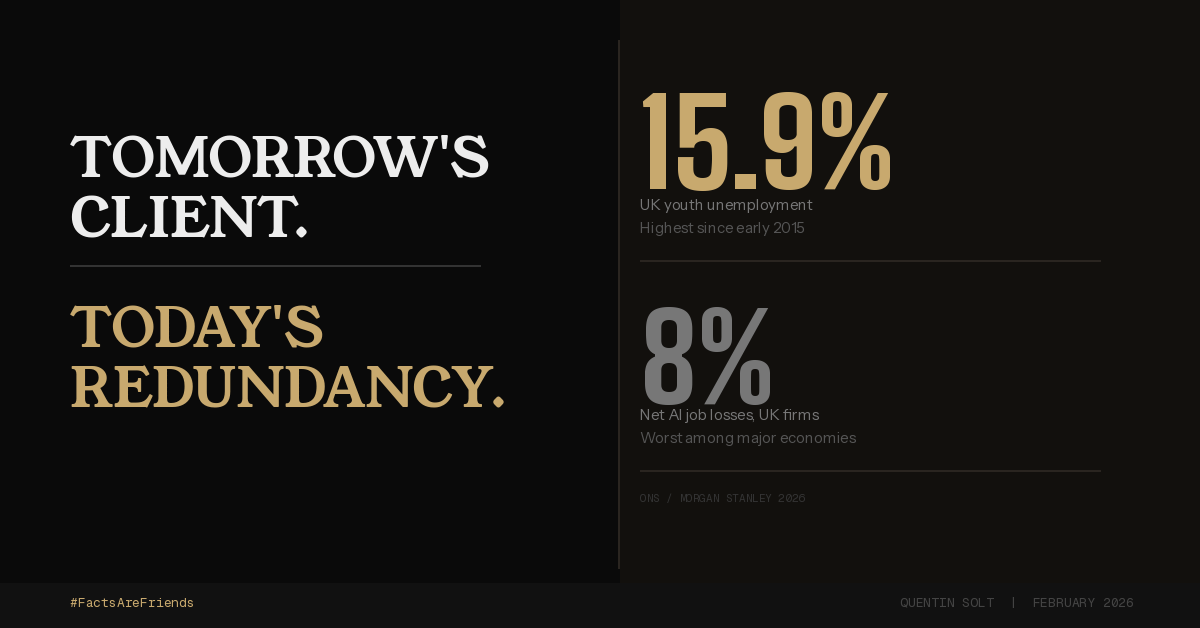
In the UK, youth unemployment reached 15.9% in late 2025 - its highest since early 2015.[2]
Morgan Stanley found that British firms reported 8% net job losses from AI adoption over the past year - the worst among major economies and double the international average.[3]
The CIPD found that one in six UK employers expects AI to shrink their workforce in 2026, with junior, clerical and administrative roles bearing the brunt.[4]
In the US, the pattern is the same but clearer: underemployment among young graduates last year reached 42.5% - meaning nearly half are working in jobs that do not require a degree.[5]
Challenger, Gray & Christmas tracked nearly 55,000 US layoffs directly attributed to AI in 2025 alone.[6]
These are stories of people’s lives. People who would expect to buy houses, start businesses, get divorced, write wills and instruct solicitors.
The paradox
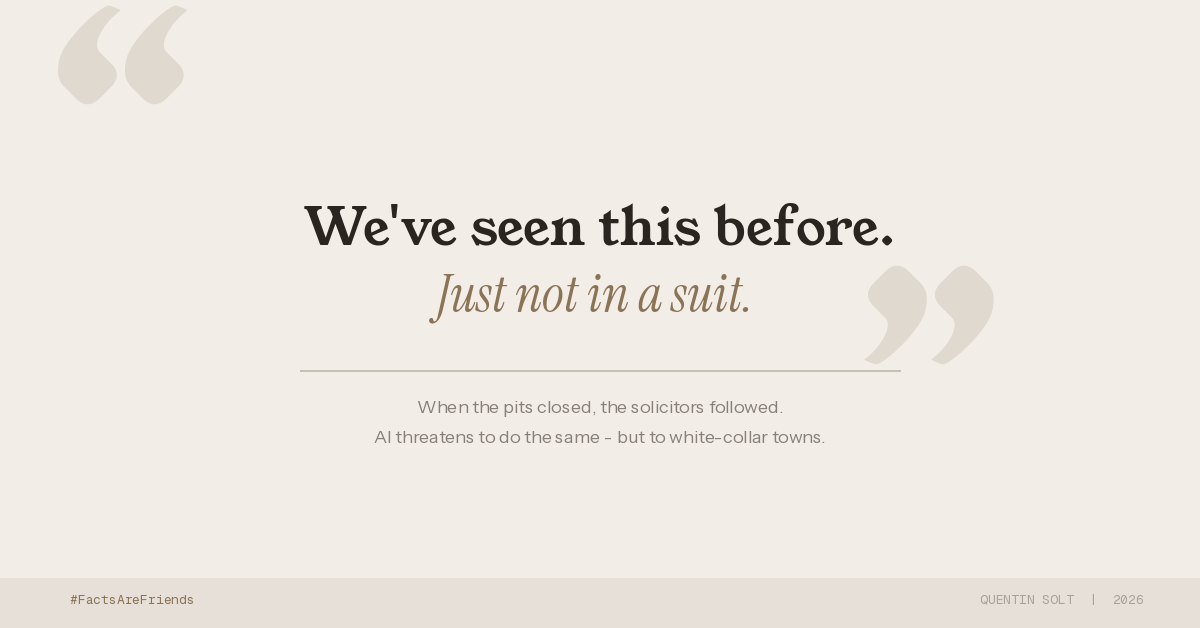
Anyone who remembers what happened to high street solicitors in Britain’s former mining and steel towns already knows what demand destruction looks like. When the pits closed, the conveyancers, the family lawyers and the will-writers followed within a generation. Not because their work got worse, but because the community that sustained them lost its income.
AI threatens to do the same thing - but to white-collar towns.
Harvard economist David Deming does not pull his punches: that the tasks AI replaces best are exactly the things young graduates have traditionally done - reading, synthesising, producing reports and presentations.[7]
Anthropic’s CEO Dario Amodei has warned of unemployment reaching 10-20% within five years.[8] As the head of a company whose business depends on AI adoption, Amodei might be expected to overstate AI’s capabilities - yet even moderate versions of his prediction would reshape the legal market. If anything close to that materialises, the consequences reach every part of the legal market. But they reach each part differently.
Three client types, three threats
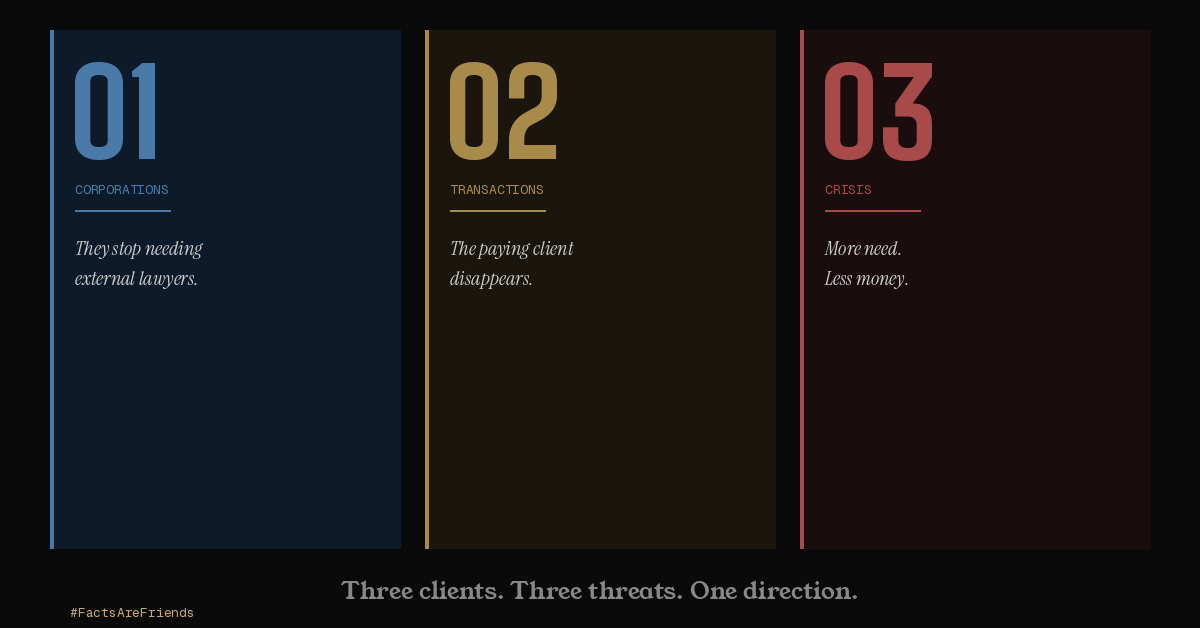
Corporations are not going to go bankrupt because of AI. But the likelihood is that they are going to stop needing (most, and perhaps all, of) their external lawyers.
The general counsel of a FTSE 250 company can already use AI to draft standard contracts, review supplier terms, monitor regulatory changes and flag compliance risks. Work that was routinely outsourced to City or regional firms - due diligence, document review, first-pass contract drafting - is migrating in-house at speed. As confidence in AI increases, the need for lawyers decreases. It is a confidence and trust game.
As familiarity with and trust in AI (and the tools to check its outputs) grows stronger, so the “make or buy” decision will shift faster and more decisively toward “make”.
Corporate legal departments will not disappear, but their external spend will shrink.
The law firms that survive longest in this space will be the ones retained for genuinely complex, high-stakes, judgment-intensive work - the kind that clients do not expect to trust AI to handle reliably. That is a much smaller market than the one that currently sustains the corporate legal sector, and even it will contract.
There may be one partial exception: institutional clients - banks, funds, infrastructure lenders - those organisations who pass legal costs through to borrowers or product buyers. When someone else is paying, the incentive to compress fees is weaker, and in-house teams act as intermediaries rather than cost centres. Until the competitors in the market do just that. Then the argument is beyond compelling, it is likely to become existential. This segment may prove more resilient for some time. But it is a narrow slice of the corporate market, and procurement pressure and regulatory scrutiny of passed-through costs will all move in the same direction.
Individuals and small businesses doing transactions - buying a house, forming a company, drafting a will, reviewing a lease - are the backbone of high street and regional practice. This work is highly standardised and, increasingly, highly automatable. AI conveyancing tools, automated will-drafters and contract review platforms are increasingly available to consumers who are willing to trust them. For now, most people still want a human solicitor for peace of mind but “peace of mind” is a luxury purchase, and luxury purchases are the first thing to go when income falls.
If unemployment amongst the so-called “professional” group rises significantly, the pool of people willing to pay £1,500 for a conveyance - rather than £150 for an AI-assisted platform - will contract sharply. The work does not disappear; but the client paying a traditional lawyer does. And for those who remain, a more insidious dynamic is emerging: firms using AI to chase volume and compress fees, claiming lawyer review on the output. Whether that review is meaningful is another question. What starts as efficiency risks becoming a race to the bottom with a professional wrapper - and the client who cannot distinguish quality from cost is the one left exposed.
Individuals in crisis - facing redundancy, divorce, eviction, criminal charges, immigration proceedings - need lawyers the most and can afford them the least. Legal aid in England and Wales has been starved of budget over the past decades. The people most likely to be displaced by AI are also the people most likely to need legal protection as a result - unfair dismissal claims, debt proceedings, housing disputes. If unemployment rises, demand for this kind of legal help increases while the ability to pay for it collapses. This is where the consumption paradox cuts deepest: more need, less money, and an already broken funding model.
Three different clients. Three different mechanisms. One shared outcome: the demand for paid legal services declines across the board.
The structural trap
Those three client categories do not exist in isolation. They are symptoms of a deeper structural problem. The legal profession is caught in a bind. It is simultaneously doing three things that cannot coexist for long:
Eliminating jobs - both its own junior positions and, by adopting AI, contributing to the broader displacement of the professional class it serves. Fewer employed professionals means fewer clients.
Concentrating profits - AI productivity gains flow to equity partners and legal tech investors, not to the wider workforce. MIT’s Acemoglu calls this the divergence between average and marginal productivity: the firm’s output rises but the share going to labour shrinks.[9] Today’s partners prosper. The profession hollows out.
Depending on solvent clients - whether corporate or individual - to sustain demand at any price, however deflated.
The Industrial Revolution offers a sobering precedent. Handloom weavers did not just lose their jobs to power looms. They also lost the income that sustained local economies of shopkeepers, landlords and tradespeople who depended on their custom.[10]
The legal profession risks becoming the shopkeeper in this analogy - not the weaver.
It is not the one being directly automated. It is the one whose customers are.

What comes next
Governments will face enormous pressure to respond. Universal basic income became a national reality in November 2025 when the Marshall Islands launched the first country-wide UBI - $200 per quarter to every resident citizen, funded through a sovereign wealth fund.[11]
The Marshall Islands is a nation of 33,000 people backed by a US compact, which makes it a poor template for the UK or the US. But as I have argued elsewhere, the UK is substantially already supporting a majority of it people on welfare state (UBI by another name?).
It is the direction that matters. Pilot schemes and political pressure for some form of income support are already building across developed economies. If something along those lines reaches the UK, the question for lawyers is blunt: does a person on £12,000 a year instruct a solicitor, or use a free AI tool? The honest answer is the AI tool.
And financing any meaningful income support requires taxing the sectors that make money. Legal services - high value, early adopters, already cutting headcount - will be a prime target.
I think three markets will emerge.
Elite corporate law will thrive for a time - smaller, more profitable, more technologically sophisticated - serving businesses that still need human judgment for complex, high-stakes work. This market will be lucrative but narrow, entry to it will be fiercely competitive and it will be under constant threat for so long as it survives.
Mass-market legal services will become a publicly funded or subsidised function - legal aid reimagined for the AI age, delivered through a combination of AI platforms and human oversight. The economics of private practice at this level will simply cease to work.
And the middle - regional firms charging mid-range fees for competent but unremarkable work - will be squeezed out of existence from above and below. The thousands of solicitors currently in that band face the hardest question. Some will move up into specialist, judgment-intensive work. Some will move into publicly funded roles. Many will find that the career they trained for no longer exists in a form they recognise.
The deeper question
Evidence of the consumption paradox is accumulating. And now is the time for honest engagement.
For many people - lawyers included - professional identity is not just a source of income. It is a source of meaning, status, community and purpose. When the work disappears, the salary is not the only thing that goes with it. AI forces a question that the legal profession has barely begun to engage with honestly:
What am I for, if not this?
#FactsAreFriends
Notes and sources
[1] The 27% figure comes from studies by Brynjolfsson et al. (2023) and Noy & Zhang (2023), cited by Nobel laureate Daron Acemoglu in his paper The Simple Macroeconomics of AI (MIT, 2024). Acemoglu emphasises that this cost saving applies only to “exposed” tasks - roughly 20% of all labour tasks - and that only around 23% of those can be profitably automated near-term. His net estimate of AI’s contribution to productivity growth is a modest 0.5-0.7% over a decade, far below the 1.5-3.4% projected by Goldman Sachs and McKinsey.
Acemoglu paper - https://economics.mit.edu/sites/default/files/2024-04/The%20Simple%20Macroeconomics%20of%20AI.pdf
MIT interview - https://economics.mit.edu/news/daron-acemoglu-what-do-we-know-about-economics-ai
AEI analysis of Goldman response - https://www.aei.org/articles/ais-economic-potential-goldman-sachs-responds-to-daron-acemoglu/
[2] House of Commons Library, Youth unemployment statistics, 20 January 2026. In September-November 2025, 729,000 young people aged 16-24 were unemployed (up 103,000 year-on-year) and the youth unemployment rate was 15.9%, its highest since early 2015. UK overall unemployment reached 5.1%, its highest since 2021.
https://commonslibrary.parliament.uk/research-briefings/sn05871/
ONS employment data - https://www.ons.gov.uk/employmentandlabourmarket/peopleinwork/employmentandemployeetypes/bulletins/employmentintheuk/december2025
[3] Morgan Stanley research (January 2026), reported by Bloomberg. UK firms using AI for at least one year reported 8% net job losses - the highest among the US, Germany, Japan and Australia, and twice the international average. UK productivity gains from AI averaged 11.5%, similar to peers, but the employment outcome was markedly worse.
E&T Magazine - https://eandt.theiet.org/2026/01/27/ai-driven-job-losses-hitting-uk-harder-other-big-economies
eWeek summary - https://www.eweek.com/news/ai-job-losses-uk-morgan-stanley-report/
People Management - https://www.peoplemanagement.co.uk/article/1948375/ai-washing-tech-really-blame-job-losses
[4] CIPD Labour Market Outlook (November 2025). 17% of 2,000 UK employers surveyed expect AI to shrink their workforce in the next 12 months. Among those, 62% said clerical, junior managerial and administrative roles are most at risk. Large private sector firms were worst affected (26%).
https://www.digit.fyi/one-in-six-uk-employers-plan-ai-layoffs-in-2026/
People Management - https://www.peoplemanagement.co.uk/article/1939164/one-six-employers-expect-job-losses-ai-cipd-finds
[5] NY Fed, The Labor Market for Recent College Graduates (Q4 2025). Graduate unemployment climbed to 5.7% in Q4 2025 (ages 22-27). Underemployment hit 42.5%, the highest since 2020. The Cleveland Fed separately found that young graduates now exit unemployment more slowly than peers without degrees - a reversal of a decades-long pattern. For context, UK recent graduate unemployment stands at approximately 6% (HESA Graduate Outcomes 2023/24), with competition for graduate roles at record highs: an estimated 1.2 million applications for 17,000 graduate vacancies.
NY Fed - https://www.newyorkfed.org/research/college-labor-market
Cleveland Fed - https://www.clevelandfed.org/publications/economic-commentary/2025/ec-202514-are-young-college-graduates-losing-their-edge-in-the-job-market
UK graduate data - https://www.universitiesuk.ac.uk/latest/insights-and-analysis/graduate-outcomes-what-latest-data
The Boar on UK graduate crisis - https://theboar.org/2025/09/uni-leavers-face-unemployment-crisis-as-graduate-jobs-in-the-uk-fall-by-a-third/
[6] Challenger, Gray & Christmas 2025 year-end report. AI was cited in 54,836 announced US layoff plans in 2025. Since tracking began in 2023, AI has been cited in 71,825 cumulative job cut announcements. Total US layoffs in 2025 reached 1.2 million - the highest since 2020. An independent analysis estimated total AI-attributable displacement (including “silent” attrition - roles not backfilled when people left) at 200,000-300,000.
Challenger year-end - https://www.challengergray.com/blog/2025-year-end-challenger-report-highest-q4-layoffs-since-2008-lowest-ytd-hiring-since-2010/
CNBC - https://www.cnbc.com/2025/12/21/ai-job-cuts-amazon-microsoft-and-more-cite-ai-for-2025-layoffs.html
Shap analysis - https://daveshap.substack.com/p/ai-destroyed-200k-to-300k-jobs-in
[7] David Deming, economist at Harvard, quoted in The Atlantic, February 2026. The Atlantic - https://www.theatlantic.com/magazine/2026/03/ai-economy-labor-market-transformation/685731/
[8] Dario Amodei, CEO of Anthropic, told Axios in May 2025 that AI could eliminate 50% of entry-level white-collar jobs and spike unemployment to 10-20% within five years.
Axios - https://www.axios.com/2025/05/28/ai-jobs-white-collar-unemployment-anthropic
CNN - https://www.cnn.com/2025/05/29/tech/ai-anthropic-ceo-dario-amodei-unemployment
Fortune - https://fortune.com/2025/05/28/anthropic-ceo-warning-ai-job-loss/
[9] Acemoglu & Restrepo, Automation and New Tasks: How Technology Displaces and Reinstates Labor, Journal of Economic Perspectives, 2019. The key insight: automation “always reduces the labour share in value added and may reduce labour demand even as it raises productivity.”
https://www.aeaweb.org/articles?id=10.1257/jep.33.2.3
[10] The handloom weavers illustration draws on Acemoglu & Johnson, Power and Progress (2023), which traces how Ricardo himself changed his mind about whether machinery benefits workers - concluding that if it simply replaced labour without creating new tasks, it could be actively harmful.
Acemoglu MIT interview - https://economics.mit.edu/news/daron-acemoglu-what-do-we-know-about-economics-ai
[11] Marshall Islands UBI (Enra programme), launched 26 November 2025. $200/quarter ($800/year) to every resident citizen including children. Over 33,000 enrolled. Funded through a sovereign wealth fund capitalised under the Compact of Free Association with the US. The IMF has engaged seriously but warned about fiscal sustainability.
Lowy Institute - https://www.lowyinstitute.org/the-interpreter/marshall-islands-experiment-universal-basic-income
East Asia Forum - https://eastasiaforum.org/2026/01/07/the-price-of-the-marshall-islands-universal-basic-income/
Scott Santens analysis - https://www.scottsantens.com/the-marshall-islands-just-quietly-implemented-the-first-national-universal-basic-income-ubi/