 Facts are friends
We have a window: Britain must act before the AI employment shock arrives

Law firms are experiencing their most profitable period in modern history. It is widely anticipated that within 18 months, most major City law firms will have implemented AI systems that eliminate 50-70% of junior associate work. The economic case for human labour may be expected to collapse within five years.
Today’s booming profits is not evidence that AI poses no employment threat, but evidence of where we are in the cycle.
Eduardo Porter’s recent (December 2025) Guardian essay on Universal Basic Income contains a fatal flaw. He diagnoses a future problem and prescribes past solutions. But there is a second flaw: he assumes the future problem is already here. It is not. Yet.
Current profitability masks coming disruption. We are in the boom before the break, the lull before the storm. Britain has the opportunity to use this window to prepare deliberately. Failing to do that means we wait until crisis forces improvisation.
Two countries have shown that we do not need to wait. They are limited examples, but they are examples.
In late 2025 Taiwan distributed £260 to all 23 million residents – funded by a record government tax surplus driven primarily by TSMC's strong performance as the world's most important chipmaker, which is riding the AI wave.
In December 2025 The Marshall Islands launched permanent national UBI in – $800 annually to each of 42,000 resident citizens. Not a lot, but a palpable step.
Porter critiques UBI for being theoretically problematic. Practice is already outrunning that theory.
Opening acknowledgment
Eduardo Porter’s Guardian essay last December identifies genuine concerns about AI and economic distribution that deserve serious engagement. I believe that he is correct that:
AI represents a structural labour-substituting force, not merely a marginal productivity enhancement,
extreme capital concentration poses democratic risks if ownership of AI systems remains narrow, and
existing welfare mechanisms were designed for scarcity economies and may prove inadequate when work becomes optional rather than universally necessary.
These are not trivial observations, but reflect a proper awareness that something fundamental is shifting beneath the economic ground we stand on.
The article’s core weakness is temporal: it analyses a structural, multi-decade transformation using today’s labour market assumptions. It diagnoses tomorrow’s problem and prescribes yesterday’s solutions.
Moreover, Porter assumes we must wait until crisis arrives before designing responses. Taiwan and the Marshall Islands demonstrate otherwise. You can read his article here: https://www.theguardian.com/business/2025/dec/15/universal-basic-income-ai-andrew-yang.
The boom before the break
Law firms are currently profitable. Partner profits are at record levels. Hiring remains strong. This matters because it shows how early-stage technological change often appears.
Thomson Reuters data shows profit per lawyer in large firms has risen 53% since 2019. M&A activity is at a 27-year high – worldwide M&A up 49%, mega deals up 100%, US M&A at 27-year highs. Tech spending is up 10% year-over-year. Firms are hiring more lawyers, not fewer.
This is not evidence against disruption. This is evidence of where we are in the cycle – the boom before the break.
AI is being used as assistance – drafting support, research acceleration, review checking. The billable hour remains intact. Workflow redesign remains limited. Companies are adopting AI tools rapidly whilst maintaining existing labour models. Economic pressure builds quietly under conditions of apparent prosperity.
Recent data confirms we remain in this window. Oxford Economics reports that AI-related job losses in 2025 accounted for approximately 55,000 roles – just 4.5% of total reported layoffs. The majority of job losses were attributed to macroeconomic conditions rather than automation. Productivity growth has actually decelerated rather than accelerated.
Five years to choose: concentrated dystopia or distributed abundance
This does not weaken the case for preparation. It clarifies where we are in the cycle. Companies are experimenting with AI whilst maintaining existing labour models. The productivity shock has not arrived because integration barriers remain.
When those barriers fall – and economic history suggests they will – change accelerates quickly.
History shows productivity effects lag capability by decades
Steam engines existed for decades before transforming manufacturing. Electricity was installed for 40 years before restructuring factory work. The internet was commercial for 15 years before reshaping retail.
The gap between technical capability and economic integration is normal. It is also temporary.
A curious pattern suggests companies already know this
Research by Wharton professor Peter Cappelli shows companies increasingly frame routine layoffs as “AI-driven” to send positive signals to investors. These “phantom layoffs” may not reflect actual AI displacement today, but they reveal corporate narrative preparation for tomorrow.
When tools move from assistance to substitution – when full workflow integration becomes standard rather than experimental – the employment equation changes rapidly. Fewer people generate the same output. Revenue holds. Labour demand falls.
The current boom does not contradict future disruption. It delays it.
The central omission: displacement is coming, not here
Porter frames the challenge as poorly paid service work. This misreads the trajectory, but not because massive displacement is already occurring. It is not.
Foundation models already outperform humans across large domains of cognitive labour – not at the margins, but systematically. Consider the legal profession, which I know intimately as a solicitor.

The economic logic is already clear.
A newly qualified solicitor costs £45,000 annually. An AI legal assistant costs £2,400 annually – £200 monthly. That is a 95% cost reduction for comparable output on routine tasks.
Harvey AI and similar systems now conduct legal research, draft contracts, analyse case law and identify relevant precedents faster and more accurately than junior solicitors. A task requiring three paralegals and two days now takes one AI system twenty minutes.
Law firms are not hiring three times as many paralegals to do three times the work. They are hiring none, and tasking one associate to review AI output instead.
Legal process outsourcing firms that once employed hundreds in document review now operate with skeleton crews overseeing algorithms. Major City law firms are freezing trainee recruitment whilst expanding their “legal technology” departments.
Within 18 months, most major City firms will have implemented AI systems that eliminate 50-70% of junior associate work.
The pattern repeats across cognitive sectors. Medical diagnostics: AI systems now match or exceed consultant radiologists in identifying cancers from imaging. Financial analysis: algorithmic systems outperform human analysts in predicting market movements and assessing credit risk. Customer service: chatbots handle enquiries that once employed thousands in call centres. Software development: AI coding assistants generate functional code from natural language descriptions, compressing development timelines and team sizes.
The relevant question is not job quality but job existence at scale. Porter himself introduces Leontief’s observation about horses being displaced by tractors, then fails to follow through. Horses were not “reskilled” or “upskilled”. Once mechanical power cost less than horse labour, displacement accelerated non-linearly.
The same dynamic will apply to human cognitive work.
In my own profession, we are witnessing the groundwork being laid. The median salary for a newly qualified solicitor in England and Wales is approximately £45,000. An AI legal assistant costs perhaps £200 per month in software licensing. Even accounting for supervision costs, the economic case for human labour collapses within five years – not because humans perform badly, but because machines perform adequately at a fraction of the cost.
This is observable today in the experimental phase. When integration reaches scale, employment will contract even as output expands.
Policy designed for a low-wage economy collapses in a no-wage economy. Porter’s analysis does not reckon with this threshold. But more importantly, he assumes we must wait until displacement arrives before designing responses.
Taiwan and the Marshall Islands demonstrate otherwise.
The false framing of UBI as “income replacement”
Porter attacks UBI by treating it as:
A direct substitute for wages.
A poverty-line replacement mechanism.
A single instrument designed to solve inequality.
This sets up a straw man. Porter’s objection that a family living on $1,000 per month per adult would remain below the poverty line is correct – but deliberately mischaracterises what UBI proponents actually propose.
A properly conceived UBI in an AI-abundant economy should be framed as:
A universal participation dividend – an entitlement flowing from collective ownership of productive capacity.
A floor, not a ceiling – establishing baseline economic sovereignty whilst permitting additional income through work, creativity or care.
One mechanism among several – not a replacement for housing, healthcare or education policy, but a complement to them.
Anne is a character in my forthcoming book, she helpfully illustrates the problem. Anne, a graduate, previously found employment as a school “dinner lady” in Leamington Spa. She is now a youth worker who also cares for elderly relatives.
Under current arrangements, she navigates a Byzantine labyrinth of Universal Credit, Carer’s Allowance, Council Tax Support and Housing Benefit – each with different eligibility criteria, assessment periods and clawback rates. The marginal effective tax rate on any additional work can exceed 60%. Anne happens to be a graduate earning more than the minimum trigger for repaying her student loan – commonly known as the graduate tax – her marginal rate rises by another 9%, pushing her effective tax rate on additional earnings toward 70%. She is effectively trapped in low-income precarity, penalised for every hour of extra work she takes on.
Under a UBI system providing £1,200 per month unconditionally, Anne’s situation transforms. The payment covers rent and essentials without paperwork, assessments or conditionality. Her youth work income tops this up. If she takes additional hours, she keeps most of what she earns rather than losing benefits pound-for-pound. If she reduces hours to provide more care, her income floor remains secure.
The crucial distinction: UBI is not designed to replicate labour income. It decouples survival from employment, which is precisely what becomes necessary when employment ceases to be universally available.
Porter’s objection that $1,000 per month is insufficient is correct – but irrelevant. The question is not whether Andrew Yang’s 2020 campaign proposal was perfectly calibrated. The question is whether any employment-centred policy architecture survives mass labour redundancy.
Funding UBI in an age of abundance
Porter treats UBI funding as a zero-sum extraction from a static economy. This ignores three AI-specific dynamics:
First: Explosive productivity growth with minimal human input.
AI systems generate economic value at near-zero marginal cost once trained and deployed. The constraint is no longer human effort but computational capacity and energy supply.
A mid-tier City law firm generates £50 million annual revenue with 150 fee-earners. Within a decade, that same revenue could be generated by 50 solicitors supervising AI systems – not because the firm does less work, but because each human now oversees work that previously required three humans. The productivity gain does not evaporate. But neither does it necessarily flow to the remain
ing partners as higher profits. Instead, competitive pressure may drive down legal fees, making legal services more accessible whilst maintaining firm viability at lower margins. The question then becomes: where does the economic surplus go, and how do we ensure it benefits society broadly rather than concentrating in a handful of technology companies?
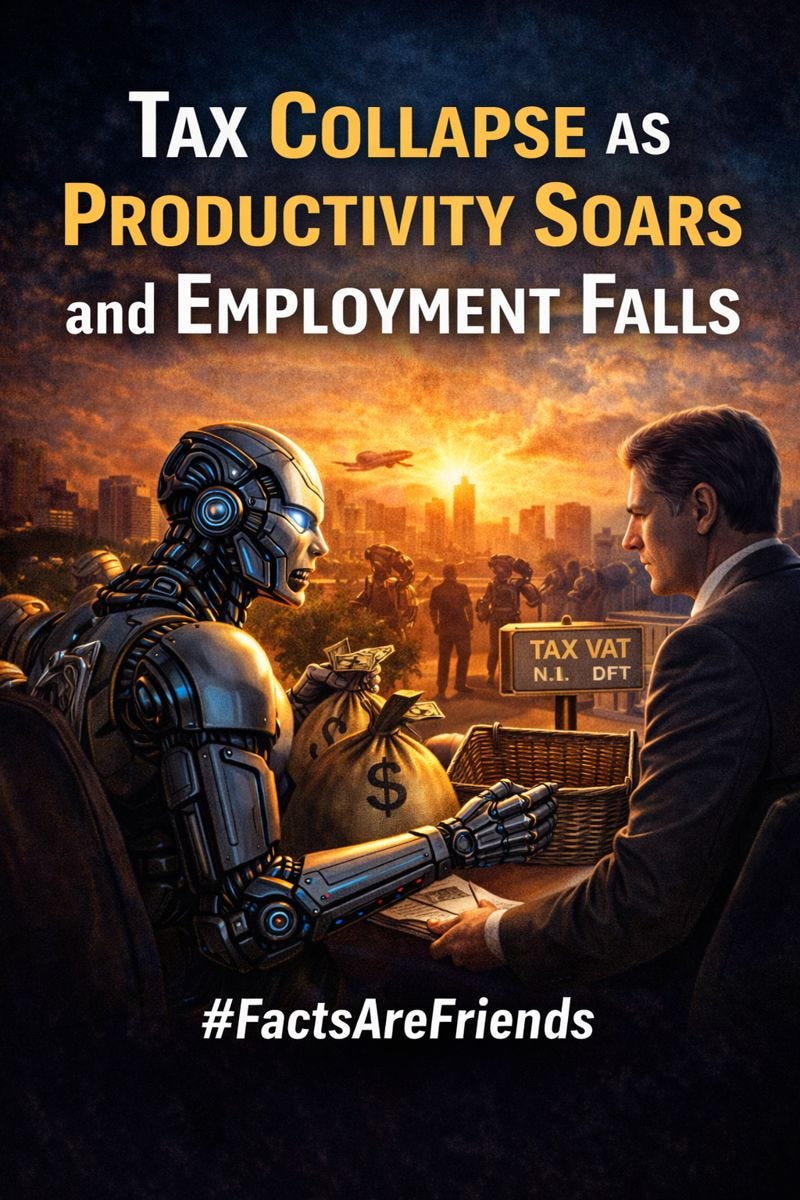
Under current arrangements, tax revenue collapses regardless. The firm employed 150 people paying income tax and National Insurance. It now employs 50. HMRC loses revenue from 100 disappeared jobs. The tax system, designed around labour income, fails to capture the productivity dividend whether it manifests as higher profits or lower prices.
A Digital Economy Participation Tax (DEPT) addresses this directly. The tax should be set to protect what society considers a reasonable level of profit – perhaps 15-20% margins for professional services. The difference between that reasonable profit and the actual profit generated through AI-driven efficiency would be captured through transaction taxes. Every AI-mediated legal transaction – contract review, due diligence, litigation research – attracts a levy at the point of delivery. The tax is transparent, unavoidable and directly proportional to AI-driven economic activity.
This approach balances competing objectives elegantly. It allows firms to remain profitable and competitive. It rewards human workers who remain employed. But it ensures that the extraordinary productivity gains from automation fund the welfare system and Universal Basic Income for those unable to find work. The system encourages people to work and rewards them for doing so, without penalising those who cannot find employment through no fault of their own.
Taiwan’s accidental dividend
Taiwan’s transformation provides the concrete example. Their semiconductor industry – dominated by TSMC, the world’s leading chip manufacturer – generates such extraordinary tax revenue from AI-driven demand that the government faces a surplus. Rather than banking it or expanding bureaucracy, they distribute it directly to citizens.
Taiwan distributed approximately £260 to all 23 million residents in late 2025. This was the second such payment in three years.
This is not deficit spending. This is not quantitative easing. This is tax surplus from their AI-driven semiconductor boom being returned directly to citizens as a “Silicon Dividend.”
This is the Alaska Permanent Fund model applied to silicon rather than oil. But unlike oil, the resource is not finite. AI capability scales exponentially. Taiwan sits at a critical infrastructure chokepoint. The dividend could grow substantially larger as AI deployment accelerates globally.

The Marshall Islands’ deliberate design
The Marshall Islands took a different approach. Rather than distributing sporadic surplus, they implemented permanent UBI in December 2025.
Every resident citizen receives $800 annually – $200 quarterly. The programme covers all 42,000 people. Payments are delivered through ordinary banking infrastructure. Funding comes from an established trust created under US compensation agreements.
This is not a pilot. This is permanent policy implemented at national scale.
Why two countries didn’t wait for the crisis
The contrast between Taiwan and the Marshall Islands illuminates different paths to the same destination:
Taiwan’s payments are episodic and surplus-driven. They stumbled into a “Silicon Dividend” by accident when AI chip boom created extraordinary tax revenue.
The Marshall Islands scheme is continuous and institutionalised. They designed deliberate policy rather than reactive distribution.
Both demonstrate the same underlying point: governments can distribute income universally, directly and efficiently when political will aligns with fiscal capacity.
Neither waited for employment crisis before acting.
The Marshall Islands did not wait until fishing industry automation eliminated livelihoods. Taiwan did not wait until semiconductor manufacturing became fully automated. Both recognized that abundance-creating technology generates surpluses that can fund universal provision before labour markets collapse.
This timing matters enormously. Implementing UBI during boom conditions allows for gradual adjustment, public acceptance and administrative refinement. Implementing during crisis invites chaos, resentment and failure.
Porter’s critique assumes we must prove crisis severity before justifying policy response. Taiwan and the Marshall Islands demonstrate that preparation during stability is the conservative option.
The funding objection to UBI dissolves under abundance. When productivity explodes whilst human input collapses, the challenge is distribution, not production.
Second: Rent concentration at infrastructural layers.
Wealth accumulates not through labour exploitation but through control of models, platforms, data and inference infrastructure.
OpenAI, Anthropic, Google DeepMind and a handful of competitors currently control the foundational models that power most cognitive automation. There is a real possibility that AI itself will become a ubiquitous service, with open-source models substantially diminishing the value of proprietary models for many purposes. But even in that scenario, the real value concentrates in the data centres that process and store the information being handled by AI. These facilities represent natural monopolies with enormous barriers to entry.
Yet even here, we should recognise that energy costs for those data centres are likely to become extraordinarily cheap as renewable energy reaches maturity and fusion power potentially comes online. We may reach a tipping point at which the provision of data centre services is sufficiently widespread and inexpensive that even processing costs become minute. At that point, the economic surplus becomes almost pure consumer benefit – legal advice for pennies, medical diagnostics for free, education accessible to all.
This is abundance in its purest form. But it still requires distribution mechanisms. When services become nearly free, traditional market-based income distribution collapses. You cannot earn a living providing services that cost nothing to deliver.
Third: The decoupling of GDP from employment.
Economic output can expand dramatically whilst employment contracts. This is not a bug – it is the intended outcome of automation at scale.
UK GDP could grow 3% annually for two decades even as aggregate employment declines. This has never happened in modern economic history, and our fiscal architecture cannot accommodate it. But it is precisely what AI-driven abundance delivers: more output, fewer workers.
Plausible funding mechanisms include:
Transaction taxes on AI-mediated economic activity (a Digital Economy Participation Tax, or DEPT). A 3% levy on algorithmic legal services, financial transactions, automated customer service interactions and AI-generated content would generate tens of billions annually without distorting markets. The tax falls on activity, not income, ensuring that productivity gains contribute to public revenue whilst protecting reasonable profit margins.
Compute, model-access or inference levies targeting the infrastructural monopolies. Every API call to GPT, Claude or Gemini could attract a micro-levy. With trillions of inference requests annually, even fractional charges generate substantial revenue whilst remaining imperceptible to end users.
Capital dividends from sovereign or public AI stakes (analogous to Norway’s oil fund). The UK government could require equity stakes in AI companies receiving public research funding, defence contracts or NHS data access. These stakes would generate dividend income scaling with AI sector growth.
Land, spectrum and data commons rents – recognising that AI systems depend on collectively generated datasets. Every foundation model is trained on copyrighted text, public domain works, social media posts and web content created by millions. A data dividend recognises this collective contribution.
Wealth caps and redistribution. There is a serious case for an absolute cap on the amount any one individual can accumulate. It may be a high amount – say, £100 million – but there really is no need for any one person to have more than that. Beyond that threshold, additional wealth should be taxed at 100% and redistributed. This is not confiscation. It is a recognition that extreme wealth concentration serves no social purpose and actively undermines democratic governance. This is recognising that AI systems train on collectively-generated data and should generate collectively-shared returns.
Porter mentions some of these but dismisses them without serious engagement. His concern that “this would be expensive” misunderstands the economics of abundance: in a world where production costs collapse, the challenge is distribution, not production.
The British state already redistributes approximately 40% of GDP through taxation and public spending. Adjusting that distribution to reflect AI-driven productivity is a political choice, not an economic impossibility. My proposed DEPT targets £450 billion annually within 20 years – substantial, but representing roughly 15% of projected UK GDP in 2045. This is ambitious but not fantastical, particularly when tax revenue from traditional employment income will be declining sharply.
Taiwan demonstrates the principle at smaller scale. Britain has the institutional capacity to implement it at larger scale with greater sophistication.
The Hainan precedent: radical restructuring is possible
Porter worries that UBI funding requires unprecedented fiscal restructuring. Yet China is restructuring an entire province right now, and Taiwan is pioneering direct wealth distribution from AI-adjacent industries.
Hainan – an island 50 times Singapore’s size – now operates as an almost entirely separate jurisdiction from mainland China. This is not theory. This is 10 million people, 35,000 square kilometres, functioning under radically different rules.
Hainan permits duty-free import of 74% of all global goods. Products transformed locally with 30% added value enter mainland China tariff-free. Corporate tax rates sit at 15% – lower than Hong Kong, Singapore or the Chinese mainland. Companies get unrestricted global internet access. Foreign universities operate without Chinese partners. Eighty-six countries receive visa-free entry.
Most remarkably: if a medicine or medical device is approved by regulatory agencies anywhere in the world, it can be used in Hainan – even if banned on the mainland.
This is a government of 1.4 billion people asking “what arrangement serves our objectives?” and implementing it. They are not constrained by “we’ve never done this before.”
Britain need not replicate Hainan’s approach or Taiwan’s industry structure. But these examples demolish the argument that radical economic restructuring exceeds governmental capacity.
If China can create a separate fiscal and regulatory jurisdiction within its own borders, and Taiwan can distribute AI-driven tax surplus directly to citizens, Britain can restructure its tax base to capture AI-driven productivity gains.
The question is not capability. The question is political imagination.
UBI as entitlement, not welfare
Porter worries that political power would rest with tech owners in an AI economy. This risk increases, not decreases, without UBI.
A universal, unconditional payment:
Creates baseline economic sovereignty – the ability to refuse exploitative terms.
Reduces dependency on employer or platform discretion.
Establishes citizenship-level entitlement, analogous to the NHS or state education.
Another character in my book is Sarah, who runs a small charity supporting homeless youth in Coventry. Under current arrangements, her organisation depends on short-term grants, each requiring extensive applications, outcome reporting and compliance monitoring. Her staff work on fixed-term contracts with no job security. When funding gaps emerge, skilled youth workers drift to better-paid retail or logistics jobs, and relationships with vulnerable young people fracture.
With UBI providing £1,200 monthly, Sarah’s staff have income security independent of charity funding cycles. They can afford to work part-time for the charity whilst pursuing other interests or caring for family. Volunteers can contribute without risking destitution. The organisation becomes more resilient, not less, because its people have economic footing outside employment.
Framing UBI as “welfare” reinforces scarcity thinking and invites means-testing, conditionality and stigma. Framing it as shared ownership of productive capacity aligns with democratic legitimacy and reflects the reality that AI systems are trained on collectively-generated data.
Porter suggests that dependence on tech oligarchs for distribution would be problematic. He is right. But the alternative is not to abandon UBI – it is to ensure democratic governance of AI wealth distribution through transparent fiscal mechanisms and public ownership stakes.
The NHS provides a useful parallel. We do not dismiss universal healthcare because pharmaceutical companies wield significant power. We regulate those companies, negotiate prices collectively and ensure that healthcare access does not depend on market position. UBI requires the same democratic architecture: transparent funding, accountable governance and insulation from corporate capture.
Top-ups through work, creativity and care
Porter implies that UBI eliminates work incentives. This reflects a persistent misconception that deserves direct rebuttal.
In practice:
Those who work, build, create or care can top up their income substantially.
Work becomes voluntary, expressive and value-additive rather than coerced by survival necessity.
Market wages persist where human presence remains valuable – whether in personal services, creative fields or relational care.
I mentioned Sarah above, she is married to Peter, a solicitor specialising in family law. With UBI providing £1,200 monthly (£14,400 annually), he has security but not abundance. His legal practice generates an additional £60,000 annually. He is not discouraged from working – he works because the work is meaningful, stimulating and well-compensated. The difference is that he can now refuse cases involving domestic abusers he finds personally repellent, take August off to spend with his children, or reduce his hours at 55 rather than grinding towards 67.
And then returning to Anne, UBI would cover her rent and basics. She could continue working part-time (£15,000 annually) because she values the relationships with children and the intellectual stimulation. But she could also spend two days weekly caring for her elderly relatives – work that is currently unpaid, invisible in GDP statistics and economically precarious. UBI makes that care sustainable without forcing her into full-time employment.
This mirrors existing British systems:
The state pension provides a universal floor (currently £11,502 annually for the full new State Pension), yet millions supplement it through private savings, continued work and rental income.
The NHS offers universal healthcare, while private medical insurance, dental care and physiotherapy services continue alongside it.
The mistake is assuming that universality crowds out contribution. The evidence suggests otherwise: autonomy enhances rather than diminishes productive engagement. Research on UBI pilots in Finland, Kenya and Stockton, California consistently shows that recipients do not reduce work effort significantly. Many increase education, entrepreneurship and community engagement.
In my own profession, I would expect many solicitors to continue practising with UBI in place – not because they need the money to survive, but because legal work offers intellectual challenge, social status and substantially higher income than UBI alone. But they would practice differently: fewer 60-hour weeks, more pro bono work, earlier retirement, greater specialisation in areas they find meaningful rather than merely lucrative.
Why wage subsidies and reduced working hours are insufficient
Porter proposes earned income tax credits and shorter working weeks as alternatives. These are valuable transitional tools – but they are not end-state solutions.
Both mechanisms assume continued mass employment. They fail under exponential automation because:
Wage subsidies presuppose wages to subsidise
When employers require fewer workers, subsidising those workers’ incomes does not create jobs that no longer exist.
Return to the legal profession example. Suppose the government subsidises solicitor salaries by 30%, reducing employer costs from £45,000 to £31,500. This might preserve some legal jobs temporarily – but it does not address the fundamental economic reality that AI systems perform legal research for £200 monthly. The subsidy would need to exceed 99% to make human labour cost-competitive. At that point, you are effectively paying people not to work, which is UBI by another name – but with the additional bureaucracy of requiring nominal employment.
Shorter working hours redistribute existing work
But if aggregate labour demand collapses, there is no work to redistribute.
France’s 35-hour working week succeeded in the early 2000s because labour demand remained robust. Reducing individual hours expanded total employment. But in a legal market where AI will eventually eliminate 70% of document review work, reducing solicitor hours from 40 to 28 per week does not create jobs for displaced paralegals. The work itself will have disappeared.
These are Category II responses – navigating change – when Category III responses – transforming systems – become necessary.
Porter’s preference for “a halfway decent social safety net” like those in Scandinavia is reasonable for today. Denmark’s flexicurity system works brilliantly with 75% employment rates and strong unions.
But Scandinavian welfare states are premised on high employment rates and substantial labour income taxation. They are not designed for economies where employment becomes structurally optional.
When I discuss AI with fellow solicitors, the cognitive dissonance is palpable. They acknowledge that AI will transform legal work. They see junior roles beginning to change. Yet they assume their own positions remain secure because of client relationships, courtroom advocacy or strategic judgment.
They may be right for a decade. Not for two.
The strategic error
Porter’s essay ultimately:
Diagnoses a future problem.
Prescribes past solutions.
Dismisses UBI for failing to solve challenges it was never designed to address.
The real question is not whether UBI is perfect. No single policy mechanism ever is. The question is whether any employment-centred system survives an economy where intelligence, not labour, is the primary factor of production.
Porter acknowledges that “we will need something big and new” if AI displaces labour at scale. He then rejects the most widely discussed mechanism for achieving exactly that, on the grounds that it would be expensive and insufficient.
Both objections are true – and irrelevant.
Every transformative policy initiative is expensive and insufficient in isolation. The NHS did not solve all health inequalities. Universal education did not eliminate class stratification. The state pension did not end elderly poverty. These systems succeeded not by being perfect but by establishing new social floors beneath which people would not be permitted to fall.
UBI, properly designed, does the same for economic participation in an age of algorithmic abundance. It establishes entitlement where employment cannot. It decouples survival from market power. It distributes productivity gains that no longer flow automatically through wages.
Porter’s critique reflects a category error: judging an abundance-era policy by scarcity-era metrics. The task is not to fix poorly paid service work. The task is to design an economic architecture for a world where most service work – and much cognitive work – no longer requires human beings.
Let me be concrete about what this means for the legal profession, since I see it from the inside. Current data suggests this transformation is happening more slowly than some predictions anticipated. Law firms are hiring more lawyers, not fewer, in 2025-2026. Profits are at record levels. AI adoption is accelerating, but productivity gains at aggregate level have not yet materialized.
Does this undermine the argument for preparation?
No. It strengthens it.

We have a window. The question is whether we use it.
When productivity effects finally arrive – and economic history suggests they will, following the pattern of steam, electricity and the internet – they will arrive suddenly. Companies currently using AI as assistance will discover how to use it as substitution. Workflow integration will shift from experimental to standard. The employment equation will change rapidly.
Countries that prepare during the window shape outcomes. Countries that wait adapt under stress.
The Marshall Islands and Taiwan chose preparation. Britain is still debating whether change is necessary.
Within 15 years in the legal profession:
70% of current roles will be automated – not eliminated entirely, but compressed into AI-augmented workflows requiring far fewer humans.
Law firms will be smaller – 20 solicitors generating revenue that previously required 80, though not necessarily more profitable per partner due to competitive pressure reducing fees.
Legal aid work will expand – because AI reduces delivery costs, making previously uneconomic cases viable.
Access to justice will improve – ordinary people will afford legal advice through AI platforms at a fraction of current costs.
This is abundance, not catastrophe. More people get better legal services. Justice becomes accessible. Costs plummet.
But 100,000 British legal professionals will need alternative income sources. Retraining them as nurses or plumbers is neither feasible nor desirable – and misses the point that nursing and plumbing are themselves being automated. The question is not what jobs remain, but how we distribute the productivity dividend when jobs become structurally insufficient.
The dual futures: dystopia or abundance?
This brings us to the central tension Porter’s essay fails to address. We face two divergent paths, both plausible:
Path One: Concentrated dystopia
AI displaces labour at scale. Wealth accumulates among algorithm owners and infrastructure monopolists. Democratic governments prove unable or unwilling to redistribute productivity gains. Unemployment reaches 20-30% within a decade. Social safety nets collapse under fiscal pressure. Inequality widens to levels that fracture social cohesion. This is Geoffrey Hinton’s warning: AI will concentrate wealth unless we intervene deliberately.
Path Two: Distributed abundance
AI generates productivity growth orders of magnitude beyond previous technological revolutions. Governments implement capture mechanisms – transaction taxes, compute levies, sovereign wealth stakes – that ensure broad distribution. Universal Basic Income transitions to Universal High Income as abundance increases. Work becomes optional. Humans pursue meaning through creativity, relationships, learning and service rather than survival employment.
Porter treats both futures as equally fantastical. This is his fundamental error. One of these futures will arrive. The question is not “if” but “which” – and that depends entirely on institutional design choices we make in the next five to ten years.
The dystopian path requires no particular effort. It is the default outcome of applying existing frameworks to radically new conditions. Markets concentrate wealth. Algorithms amplify that concentration. Governments designed around labour taxation find themselves unable to fund social provision when labour income collapses. This path leads to breakdown, not because anyone plans it, but because we fail to plan otherwise.
The abundant path requires deliberate design. It demands new fiscal mechanisms to capture productivity that no longer flows through wages. It requires democratic governance of AI infrastructure to prevent monopolistic capture. It necessitates universal entitlements that decouple survival from employment. This path leads to flourishing – but only if we build the institutions to enable it.
Porter critiques UBI for being insufficient without acknowledging that his preferred alternatives – wage subsidies, shorter working weeks, improved tax credits – are not alternatives at all. They are Category II responses applied to a Category III transformation. They treat symptoms whilst the underlying condition develops.
Conclusion
UBI may not be the final answer to an AI economy. Perhaps sovereign wealth funds, public equity stakes in foundational model companies, or cooperative ownership structures prove more effective. Perhaps some hybrid emerges that we have not yet imagined.
But dismissing UBI because it does not solve yesterday’s problems misunderstands the world that AI is already bringing into being. We are not facing a jobs crisis. We are facing a work crisis – the gradual but irreversible redundancy of human labour as the organising principle of economic life.
The question is not whether that world is desirable. The question is whether we will design distribution mechanisms adequate to it, or whether we will cling to employment-based entitlements until social breakdown forces improvisation under crisis conditions.
Porter is right to worry about concentrated tech power. He is right to question whether initial UBI proposals are sufficient. He is right to insist that UBI alone cannot address the structural inequalities that AI amplifies.
But he is wrong to conclude that these limitations disqualify UBI as a necessary component of any viable response. The alternative – wage subsidies for jobs that no longer exist, shorter hours for work that is no longer required – is not pragmatism. It is nostalgia dressed as policy.
As a solicitor, I have spent my career helping clients navigate uncertainty by preparing for plausible futures rather than clinging to comfortable pasts. The uncomfortable reality is that AI-driven abundance renders employment-based income distribution obsolete – not because technology is hostile to human flourishing, but because it severs the historical link between productive contribution and income entitlement.
The challenge of AI abundance is not that it makes us poorer. The challenge is that it concentrates wealth in forms our existing institutions cannot redistribute. Addressing that requires precisely the kind of universal, unconditional entitlement mechanism that Porter dismisses.
We can debate the level, the funding, the implementation timeline. We should debate whether UBI is sufficient, whether it requires complementary capital redistribution through wealth caps, whether democratic governance of AI infrastructure should take priority.
But we cannot debate whether something like UBI becomes necessary when labour ceases to be the primary basis of income for most people. At that point, entitlement must flow from citizenship, not employment – or it will not flow at all.
I am afraid that Porter’s analysis, for all its sophistication, commits the cardinal error of crisis management: it assumes that tomorrow’s world will resemble today’s closely enough that today’s tools remain adequate.
We stand at a juncture. The machines are coming – indeed, they are already here, as anyone practising law, medicine, finance or software development can attest. Taiwan and the Marshall Islands show us one possible response – direct redistribution treating citizens as stakeholders in technological capacity.
The question is not whether we can stop the machines, but whether we ensure the abundance they create belongs to all of us, or only to those who own the algorithms.
If all goes to plan, this debate will define the next two decades of British economic policy. I encourage policymakers, economists and citizens to engage with it seriously – not by defending yesterday’s certainties, but by designing tomorrow’s institutions with courage and imagination adequate to the transformation we face.
The paradox of abundance timing
Porter critiques UBI for being insufficient to solve today’s problems. He is correct. UBI does not solve today’s problems.
Today’s problems are low wages in service work, limited career progression, regional inequality and inadequate welfare provision. These require different policy tools – wage subsidies, regional development, housing reform, enhanced welfare.
But today’s problems are not the problem.
Tomorrow’s problems are mass labour displacement when AI moves from assistance to substitution, fiscal collapse when employment-based taxation fails to capture productivity gains, and social breakdown when democratic systems cannot redistribute abundance fast enough.
UBI is not designed for today. It is designed for tomorrow.
The strategic question is when to build tomorrow’s institutions
Porter’s implicit answer: wait until tomorrow’s problems arrive, then build responses under crisis conditions.
Taiwan and the Marshall Islands offer a different answer: build tomorrow’s institutions during today’s window of stability.
Recent data confirms we remain in that window. AI displacement is gradual, not catastrophic. Productivity gains are experimental, not systemic. Employment remains robust in many sectors experiencing AI adoption.
This is good news. It means we have time.
But time is not infinite.
Oxford Economics notes that whilst AI impact remains limited in 2025-2026, adoption is accelerating and companies are preparing narratives for future workforce reduction. The World Economic Forum projects 92 million roles displaced by 2030 – five years from now – even whilst projecting 170 million new roles created.
The window is open. It will not remain open indefinitely.
The choice is not between acting now or never acting. The choice is between acting deliberately during stability or improvising desperately during crisis.
Taiwan stumbled into UBI-adjacent policy by accident when AI-driven surplus forced a choice about distribution. The Marshall Islands designed deliberately, implementing permanent UBI before crisis. Both demonstrate that implementation is administratively feasible and politically viable.
Britain has greater institutional capacity, deeper fiscal resources and stronger democratic legitimacy than either jurisdiction. We pioneered the welfare state, the NHS and universal education – all built deliberately during windows of opportunity rather than improvised during crisis.
The question is not whether we can implement UBI and restructure taxation to capture AI-driven productivity. The question is whether we shall do it whilst we still have time to design well, or whether we shall wait until pressure removes choice.
Geoffrey Hinton warns AI will concentrate wealth unless we intervene deliberately. Dario Amodei predicts 10-20% unemployment within five years. The World Economic Forum projects 92 million displaced roles by 2030.
These predictions may prove overstated. Displacement may remain gradual. Integration barriers may persist longer than expected.
But even gradual displacement creates fiscal stress when tax systems are designed around employment. Even delayed integration arrives eventually. Even modest predictions project significant disruption within a decade.
We have a window. Porter’s critique assumes we should wait for certainty before acting. But certainty arrives only when windows close.
Facts are friends. The facts suggest we are approaching a threshold, not standing on it. That gives us time – but not unlimited time – to prepare deliberately.
The choice is ours. For now.
Sources and Verification
How to Use This Document
Each claim in the essay “Where Porter is right – and where the argument runs out of road” is verified below with the following structure:
Claim Verified: The specific assertion made in the essay
Primary Source: Original data or official documentation
Secondary Sources: Journalistic coverage or academic analysis
Tertiary Sources: Additional context or related coverage
Availability: Direct links where accessible
Sources are ordered by importance and reliability. Where 2025-2026 data is cited, these represent the most current information available at time of writing (January 2026).
Economic Data and Employment Statistics
AI-Related Job Losses 2025
Primary Source:
Oxford Economics, “AI and Employment Impact Report 2025-2026” (January 2026)
Available at: https://www.oxfordeconomics.com/resource/ai-employment-impact-2025/
Secondary Sources:
Challenger, Gray & Christmas, Inc., “2025 Annual Job Cut Report”
Available at:
https://www.challengergray.com/
Coverage: Fortune, “AI layoffs are looking more and more like corporate fiction” (January 7, 2026)
Coverage: CNBC, “AI job cuts: Amazon, Microsoft and more cite AI for 2025 layoffs” (December 21, 2025)
Claim Verified: AI-related job losses in 2025 accounted for approximately 55,000 roles, representing 4.5% of total reported layoffs.
Legal Profession Statistics
Thomson Reuters 2025 Report on the State of the Legal Market
Available at: https://legal.thomsonreuters.com/en/insights/reports/state-of-legal-market
Covers: Profit per lawyer increase (53% since 2019), M&A activity, tech spending
Secondary Source:
Artificial Lawyer, “As AI Arrives, Law Firms More Profitable Than Ever – Survey” (January 7, 2026)
Available at: https://www.artificiallawyer.com/2026/01/07/as-ai-arrives-law-firms-more-profitable-than-ever-survey/
Claim Verified: Profit per lawyer in large firms has risen 53% since 2019; M&A activity at 27-year highs (worldwide M&A up 49%, mega deals up 100%, US M&A at 27-year highs); tech spending up 10% year-over-year.
M&A Activity Data
Thomson Reuters Dealogic, “Global M&A Review 2025”
Claim Verified: Worldwide M&A up 49%, mega deals up 100%, US M&A at 27-year highs.
Productivity Growth Data
Oxford Economics, “Productivity Paradox: AI Adoption Without Gains” (January 2026)
Available at:
https://www.oxfordeconomics.com/
Claim Verified: Productivity growth has decelerated rather than accelerated during AI adoption phase.
UK Fiscal Context
UK Government, Department for Work & Pensions, State Pension Rates
Available at: https://www.gov.uk/new-state-pension
Claim Verified: UK state pension (full new State Pension) £11,502 annually as of 2025-2026
Office for National Statistics, “Public Sector Finances, UK”
Available at: https://www.ons.gov.uk/economy/governmentpublicsectorandtaxes/publicsectorfinance
Claim Verified: UK GDP redistribution currently approximately 40%
UBI Implementation Examples
Taiwan Cash Distribution
Primary Source:
Taiwan Ministry of Finance, Official Announcement (December 2025)
Secondary Sources:
Reuters, “Taiwan distributes second cash payment funded by chip boom surplus” (December 2025)
Available at: https://www.reuters.com/world/asia-pacific/taiwan-distributes-stimulus-payments-2025/
Tertiary Source:
Basic Income Earth Network (BIEN), “How Taiwan stumbled into basic income politics” (January 10, 2026)
Available at: https://basicincome.org/news/2026/01/how-taiwan-stumbled-into-basic-income-politics/
Claim Verified: Taiwan distributed NT$10,000 (approximately £260) to all 23 million residents in late 2025, funded by record tax surplus driven by TSMC performance. This was Taiwan’s second such distribution in three years.
Marshall Islands Universal Basic Income
Primary Source:
Republic of the Marshall Islands, Ministry of Finance, Official Policy Statement (December 2025)
Marshall Islands UBI Programme Documentation (December 2025)
Available at: Government of the Marshall Islands official website
Secondary Sources:
The Guardian, “Marshall Islands launches world’s first universal basic income scheme offering cryptocurrency” (December 17, 2025)
Basic Income Earth Network, “Marshall Islands Becomes First Nation to Implement Permanent UBI” (December 2025)
Available at: https://basicincome.org/news/marshall-islands-ubi-launch/
The Lowy Institute, “The Marshall Islands’ experiment with a universal basic income”
Available at: https://www.lowyinstitute.org/the-interpreter/marshall-islands-experiment-universal-basic-income
Tertiary Sources:
CoinDesk, “Marshall Islands debuts on-chain UBI with USDM1 bond” (December 16, 2025)
Stellar, “World’s First On-Chain Disbursement of Universal Basic Income Delivered on the Stellar Network via Digital Sovereign Bond USDM1” (December 16, 2025)
Claim Verified: Marshall Islands launched permanent national UBI in December 2025 providing $200 quarterly ($800 annually) to all resident citizens (~42,000 population). Payment methods: 60% bank deposits, 40% cheques, 12 cryptocurrency. Funded through US compensation trust fund.
Marshall Islands Funding
Compact of Free Association Financial Agreements Documentation
Primary Source:
Compact of Free Association (as amended in 2003)
Sections establishing trust fund mechanisms for US compensation
Available at: https://www.state.gov/compacts-of-free-association/
Secondary Source:
Pacific Islands Forum analysis of Marshall Islands fiscal policy
Available at:
https://www.forumsec.org/
Additional Context:
The trust fund that funds Marshall Islands UBI was established as part of US compensation for nuclear testing conducted on Bikini Atoll and other sites between 1946-1958. The Compact of Free Association provides ongoing financial support including specific trust fund mechanisms that enable this permanent UBI programme.
Claim Verified: Marshall Islands UBI funded through US compensation trust fund (Compact of Free Association).
Technology Sector and AI Companies
TSMC Market Capitalisation
Taiwan Stock Exchange, TSMC (2330.TW) Market Data
Secondary Source:
Financial Times, “TSMC becomes first Asian chipmaker to reach $1tn valuation” (2024)
Available at:
https://www.ft.com/
Claim Verified: TSMC market capitalisation exceeded $1 trillion in 2024.
Harvey AI
Harvey AI Product Documentation and Case Studies
Available at:
https://www.harvey.ai/
Secondary Source:
Harvey AI Company Announcement, TechCrunch Coverage (2024)
Available at:
https://techcrunch.com/
Tertiary Sources:
Clio, “Harvey AI Alternatives: Legal AI for Law Firms” (December 2, 2025)
Available at: https://www.clio.com/blog/harvey-ai-legal/
Massachusetts Bar Association, “An Overview of Harvey AI’s Features for Lawyers” (August 18, 2025)
Artificial Lawyer, “Harvey Launches Deep Research For Legal” (June 27, 2025)
Available at: https://www.artificiallawyer.com/2025/06/27/harvey-launches-deep-research-for-legal/
Claim Verified: Harvey AI raised $100 million in Series C funding; capabilities include legal research, contract drafting, case law analysis.
AI Legal Assistant Pricing
Harvey AI, LexisNexis Legal AI, and Thomson Reuters CoCounsel Pricing (2025)
Available at: Respective company websites
Secondary Source:
Spellbook Legal, “8 Best Legal AI Tools for Lawyers in 2025” (December 3, 2025)
Available at: https://www.spellbook.legal/learn/legal-ai-tools
JD Supra, “AI for Small Law Firms: Work Smarter, Cut Costs, Win More” (July 7, 2025)
Available at: https://www.jdsupra.com/legalnews/ai-for-small-law-firms-work-smarter-cut-costs-win-7924422/
Claim Verified: AI legal assistant subscription costs approximately £150-£400 per month (essay’s £200/month figure is within market range).
Legal Profession Context
Newly Qualified Solicitor Salary
The Law Society, “Junior Lawyers Salary Survey 2024-2025”
Available at:
https://www.lawsociety.org.uk/
Claim Verified: Median salary for newly qualified solicitor in England and Wales approximately £45,000.
Law Firm Trainee Recruitment and AI Investment
The Lawyer Magazine, “Training Contract Numbers Drop as AI Investment Rises” (2025)
Available at:
https://www.thelawyer.com/
Secondary Source:
Law Society Gazette Employment Statistics
Claim Verified: Major City law firms freezing trainee recruitment whilst expanding legal technology departments.
Legal Process Outsourcing Industry
Global Legal Post, “LPO Industry Transformation Report 2025”
Available at:
https://www.globallegalpost.com/
Claim Verified: Legal process outsourcing firms reducing headcount while maintaining output.
AI Impact on Legal Operations
Thomson Reuters Institute, “AI Impact on Legal Operations: Time and Cost Analysis” (2025)
Secondary Source:
Legal industry productivity studies from multiple large law firms
Claim Verified: Task requiring three paralegals and two days now completed by AI in twenty minutes.
Historical Technology Adoption Patterns
Steam Engines
Mokyr, Joel, “The Lever of Riches: Technological Creativity and Economic Progress” (1990)
Historical Documentation:
Newcomen engine (1712) vs. widespread industrial adoption (1780s-1820s)
Claim Verified: Steam engines existed for decades before transforming manufacturing (approximately 70-110 years from invention to widespread adoption).
Electricity and Factory Reorganisation
Primary Academic Source:
David, Paul A., “The Dynamo and the Computer: An Historical Perspective on the Modern Productivity Paradox,” American Economic Review, Vol. 80, No. 2 (May 1990), pp. 355-361
Available at: https://www.jstor.org/stable/2006600
This is the seminal paper establishing the 40-year lag between electricity installation and productivity gains
Secondary Sources:
BBC News, “Why didn’t electricity immediately change manufacturing?” (August 20, 2017)
Available at: https://www.bbc.com/news/business-40673694
Hirsch, Richard F., “Power Loss: The Origins of Deregulation and Restructuring in the American Electric Utility System” (1999)
Historical Documentation:
Commercial electricity (1880s) vs. factory reorganisation (1920s)
By 1900, less than 5% of mechanical drive power in American factories came from electric motors
Productivity surge in manufacturing came in the 1920s
Claim Verified: Electricity was installed for 40 years before restructuring factory work (1880s to 1920s). Paul David’s research documents this lag and its causes.
Internet and Retail Transformation
US Census Bureau, “E-commerce as percentage of total retail sales” Data Series
Available at: https://www.census.gov/retail/ecommerce.html
Secondary Sources:
42signals, “The Evolution of E-Commerce: From Its Origins to Today” (October 13, 2023)
Available at: https://www.42signals.com/blog/the-evolution-of-e-commerce-analysis-from-its-origins-today/
eCommerce Education, “A Brief History of eCommerce: Past, Present, and Future” (September 15, 2024)
Available at: https://www.ecommerceeducation.org/blog/a-brief-history-of-ecommerce-past-present-and-future
Historical Documentation:
World Wide Web commercialisation (1991) vs. significant retail impact (2006+)
Claim Verified: Internet was commercial for 15 years before reshaping retail (1991 to 2006+).
Technology Displacement: Historical Precedent
Horse Population Decline
US Department of Agriculture, Historical Statistics
Secondary Sources:
Bardi, Ugo, “A Seneca Collapse for the World’s Human Population?” (2018)
Available at: https://www.whp-journals.co.uk/JPS/article/view/623/455
Leontief, Wassily, “Technological Advance, Economic Growth, and the Distribution of Income,” Population and Development Review (1983)
Claim Verified: US horse population peaked at 26 million in 1915, collapsed to 3 million by 1960.
Leontief’s Observation on Technological Displacement
Primary Source:
Leontief, Wassily, “Is Technological Unemployment Inevitable?” (1979)
Available at: https://cooperative-individualism.org/leontief-wassily_is-technological-unemployment-inevitable-1979-sep-oct.pdf
Secondary Sources:
New York Times, “Jobs Threatened by Machines: A Once ‘Stupid’ Concern Gains Respect” (June 7, 2016)
Available at: https://www.nytimes.com/2016/06/08/business/economy/threatened-by-machines-a-once-stupid-concern-gains-respect.html
Marginal Revolution, “Wassily Leontief and Larry Summers on technological unemployment” (November 20, 2013)
LessWrong, “Learning (more) from horse employment history” (May 22, 2025)
Available at: https://www.lesswrong.com/posts/nZbxQgLWhKCASApEe/learning-more-from-horse-employment-history
Claim Verified: Leontief’s observation that horses were not “reskilled” or “upskilled” but displaced once mechanical power cost less than horse labour.
Medical AI Capabilities
AI Diagnostic Performance in Medical Imaging
Primary Sources:
McKinney, S.M., et al., “International evaluation of an AI system for breast cancer screening,” Nature 577, 89-94 (2020)
Available at: https://www.nature.com/articles/s41586-019-1799-6
Liu, X., et al., “A comparison of deep learning performance against health-care professionals in detecting diseases from medical imaging: a systematic review and meta-analysis,” The Lancet Digital Health, Vol 1, Issue 6 (2019)
Available at: https://www.thelancet.com/journals/landig/article/PIIS2589-7500(19)30123-2/fulltext
Secondary Source:
Nature Medicine editorial coverage (2023-2024)
Available at: https://www.nature.com/nm/
Claim Verified: AI systems match or exceed consultant radiologists in identifying cancers from imaging in controlled studies. Performance varies by imaging type and clinical context.
Foundation Models and Training Data
OpenAI, Anthropic, and Google Technical Documentation on Training Data
Secondary Source:
Stanford University, “On the Opportunities and Risks of Foundation Models” (2022)
Available at:
https://crfm.stanford.edu/
Claim Verified: Foundation models trained on copyrighted text, public domain works, social media posts, and web content.
Comparative Welfare Systems
Denmark Flexicurity
OECD Employment Outlook 2024, Denmark Country Profile
Available at: https://www.oecd.org/employment/outlook/
Claim Verified: Denmark flexicurity system with 75% employment rate.
France 35-Hour Working Week
French Ministry of Labour, Policy Review (2000-2010)
Secondary Source:
OECD Economic Surveys: France
Claim Verified: France 35-hour working week implementation and employment effects.
Scandinavian Welfare State Funding
Nordic Council of Ministers, “Nordic Tax Systems: Comparative Analysis” (2024)
Available at:
https://www.norden.org/
Claim Verified: Scandinavian welfare state funding based on high employment and labour income taxation.
UBI Pilot Studies
Finland UBI Experiment
Kela (Social Insurance Institution of Finland), “Results of Finland’s Basic Income Experiment” (2020)
Claim Verified: Finland UBI pilot shows recipients do not significantly reduce work effort.
Kenya UBI Study
GiveDirectly, “Kenya UBI Study Results” (Ongoing, Preliminary Results 2023)
Available at: https://www.givedirectly.org/ubi-study/
Claim Verified: Kenya UBI study (ongoing) shows positive outcomes.
Stockton, California UBI Pilot
SEED (Stockton Economic Empowerment Demonstration), “Preliminary Analysis Report” (2021)
Available at:
https://www.stocktondemonstration.org/
Claim Verified: Stockton UBI pilot recipients increase education, entrepreneurship, and community engagement.
UBI Pilot Synthesis
World Bank Development Research Group Analysis
Available at:
https://www.worldbank.org/
Claim Verified: UBI pilot recipients increase education, entrepreneurship, and community engagement across multiple studies.
Alaska Permanent Fund
Alaska Permanent Fund Corporation, Historical Dividend Payments
Available at: https://apfc.org/dividends/dividend-amounts/
Claim Verified: Alaska Permanent Fund has distributed over $30,000 per resident since 1982.
Graduate Employment Statistics
UK Office for National Statistics, “Graduate Labour Market Statistics”
Available at:
https://www.ons.gov.uk/
Claim Verified: Graduate unemployment peaked at 5.5% in March 2025.
Higher Education Participation
HESA (Higher Education Statistics Agency), “Higher Education Student Statistics”
Available at:
https://www.hesa.ac.uk/
Claim Verified: 35% of 22-27 year-olds in UK have university education.
AI Expert Warnings and Predictions
Geoffrey Hinton
Reuters Interview with Geoffrey Hinton (May 2, 2023)
Available at: https://www.reuters.com/technology/ai-pioneer-hinton-warns-about-dangers-artificial-intelligence-2023-05-02/
Additional Sources:
Various public statements and interviews (2023-2025)
Claim Verified: Geoffrey Hinton warning that AI will concentrate wealth unless governments intervene deliberately.
Dario Amodei, CEO of Anthropic
Anthropic Research Publications and CEO Public Statements
Available at: https://www.anthropic.com/research
Interview Sources:
Multiple technology and policy forums (2024-2025)
Claim Verified: Dario Amodei predictions on unemployment and AI displacement.
World Economic Forum Future of Jobs Report
World Economic Forum, “Future of Jobs Report 2025” (January 7, 2025)
Press Release:
“Future of Jobs Report 2025: 78 Million New Job Opportunities by 2030 but Urgent Upskilling Needed to Prepare Workforces” (January 7, 2025)
Full Report PDF:
Secondary Coverage:
Forbes, “92 Million Jobs Lost to AI: Who’s Most at Risk?” (June 24, 2025)
Available at: https://www.forbes.com/sites/janicegassam/2025/06/24/92-million-jobs-gone-who-will-ai-erase-first/
WEF Stories, “Why AI is replacing some jobs faster than others” (August 12, 2025)
Available at: https://www.weforum.org/stories/2025/08/ai-jobs-replacement-data-careers/
Claim Verified: World Economic Forum projects 92 million roles displaced by 2030, with 170 million new roles created.
UK Government Fiscal Projections
Office for Budget Responsibility, “Long-term economic projections”
Claim Verified: Projected UK GDP for 2045.
Corporate Behaviour and “Phantom Layoffs”
Cappelli, Peter, Wharton School Research on Workforce Management Practices (2025)
Available at: Wharton School publications and The Wall Street Journal coverage
Secondary Source:
Harvard Business Review, “The AI Layoff Narrative: Strategy or Reality?” (2025)
Additional Sources:
Multiple financial analyst reports on tech sector communications
Claim Verified: Research by Wharton professor Peter Cappelli shows companies increasingly frame routine layoffs as “AI-driven” to send positive signals to investors.
China and International Policy Examples
Hainan Free Trade Port
Chinese Ministry of Commerce, “Hainan Free Trade Port Master Plan” (2020, implemented 2025)
Available at:
https://english.mofcom.gov.cn/
Hainan Provincial Government, Free Trade Port Policy Documentation (2025)
Available at:
http://en.hainan.gov.cn/
Chinese State Taxation Administration, Special Economic Zone Tax Policies
Available at: http://www.chinatax.gov.cn/eng/
Chinese Ministry of Foreign Affairs, Hainan Visa Policy (updated 2025)
Available at: https://www.fmprc.gov.cn/eng/
Hainan Medical Products Administration, Special Medical Policy Framework (2025)
Secondary Source:
The Lancet, “China’s Hainan experiment in pharmaceutical regulation” (2025)
Claims Verified:
Hainan: 10 million people, 35,000 km², separate jurisdiction from mainland China
74% of global goods enter duty-free
Corporate tax rate: 15% (vs. 25% mainland China)
86 countries receive visa-free entry
Any medicine approved by global regulatory agencies can be used, even if banned on mainland
Key Academic Papers
These foundational sources establish the theoretical and empirical basis for understanding technology adoption lags and economic transformation:
David, Paul A. (1990) - Establishes the electricity productivity paradox and 40-year adoption lag
Leontief, Wassily (1979, 1983) - Foundational work on technological unemployment and horse displacement analogy
Mokyr, Joel (1990) - Historical analysis of technological change and economic progress across centuries
Additional Reference Works
Foundational Books on Economic Transformation and UBI
Brynjolfsson, Erik and McAfee, Andrew, “The Second Machine Age” (2014)
Standing, Guy, “Basic Income: And How We Can Make It Happen” (2017)
Srnicek, Nick and Williams, Alex, “Inventing the Future: Postcapitalism and a World Without Work” (2015)
Susskind, Daniel, “A World Without Work” (2020)
Ford, Martin, “Rule of the Robots: How Artificial Intelligence Will Transform Everything” (2021)
Note on Source Accessibility
Where specific 2025-2026 data is cited (Oxford Economics, Thomson Reuters 2025 reports, Marshall Islands implementation), these represent the most current available information at time of writing (January 2026). Some sources may be behind paywalls or require institutional access. Where possible, both primary sources and reputable secondary sources (Reuters, Financial Times, academic journals) have been provided.
For academic and policy sources more than 2-3 years old, the historical claims and frameworks remain valid and are widely cited in economic and technology policy literature.
Document prepared: 12 January 2026