 Facts are friends

In part 1 we saw how legal AI valuations rest on untested assumptions.
Harvey and Legora command 80x revenue multiples – unprecedented in legal tech – yet most of their explosive growth hasn’t survived a single renewal cycle.
The fundamental question remains unanswered: do these platforms offer defensible advantages, or are they expensive pilots built on foundational models that any competent prompt engineer could replicate? The arithmetic is sobering, and the first wave of renewals will separate the visionary from the delusional.
The Trojan Horse
There is a deeper problem. Even if the legal AI platforms fail and investors lose their money, lawyers may lose far more.
When a law firm deploys Harvey or Legora it uploads its templates, precedents and playbooks. Its drafting standards. Its accumulated expertise developed over decades. The firm trains its lawyers to use these tools - and trains its clients to expect AI-assisted legal services delivered faster and cheaper.
The knowledge that was once rare and highly prized becomes abundant. The client learns that legal analysis can be commoditised. The mystique evaporates. The black box has been opened.
The legal tech platform may not capture this value - remember, neither Harvey nor Legora trains on firm knowledge. But the damage is done. The client now knows that AI can do much of what they previously paid premium rates for. They will find a way to access that capability, whether through these platforms, through foundational models directly or through the next generation of tools.
Law firms deploying these platforms are accelerating their own demise. They are paying for Trojan Horses to be wheeled through their gates.
The Consulting Parallel: A Warning
The strategy consulting industry offers a cautionary tale - and a contrast.
McKinsey, BCG and Bain recognised early that AI could either enhance or destroy their business models. They chose enhancement - but on their own terms.
McKinsey built “Lilli,” a proprietary AI platform trained on the firm’s own knowledge base. As one McKinsey leader explained: “Lilli was born from the question: ‘How do we help our colleagues at McKinsey access the deepest and broadest array of our best insights?’ And then ChatGPT exploded. And we had this notion of: ‘What if we train it on our own information?’“
Lilli handles over 500,000 monthly inquiries, accelerating the integration of McKinsey’s consulting expertise into AI. Critically, this knowledge stays within McKinsey. The firm controls the platform, the training data and the deployment.
BCG developed its own tool “Navi” that allows its consultants to access firm-specific IP that OpenAI simply doesn’t have; it has transformed from zero to 20% AI revenue - $2.7 billion - in just two years. Bain equipped 13,000 consultants with ChatGPT Enterprise through a partnership with OpenAI, while building an internal OpenAI Centre of Excellence.
There is also a deeper reason why consulting firms may weather the AI storm better than law firms. It comes down to what each profession believes it sells.
Process v Outcome
Lawyers view their product as the Document. The contract. The memorandum. The paperwork. The carefully drafted clause. Decades of legal training and professional culture have reinforced this: the output of legal work is a written artefact, and the lawyer’s value lies in the precision, completeness and defensibility of that artefact. This is not what client want. They want outcomes. And consultants view their products as Outcomes. The successful merger integration. The cost reduction achieved. The regulatory compliance programme implemented. The strategy that actually worked. The document - the PowerPoint deck, the report - is merely the vehicle. No client ever paid McKinsey $5 million for a PDF.
This distinction matters enormously in an AI world.
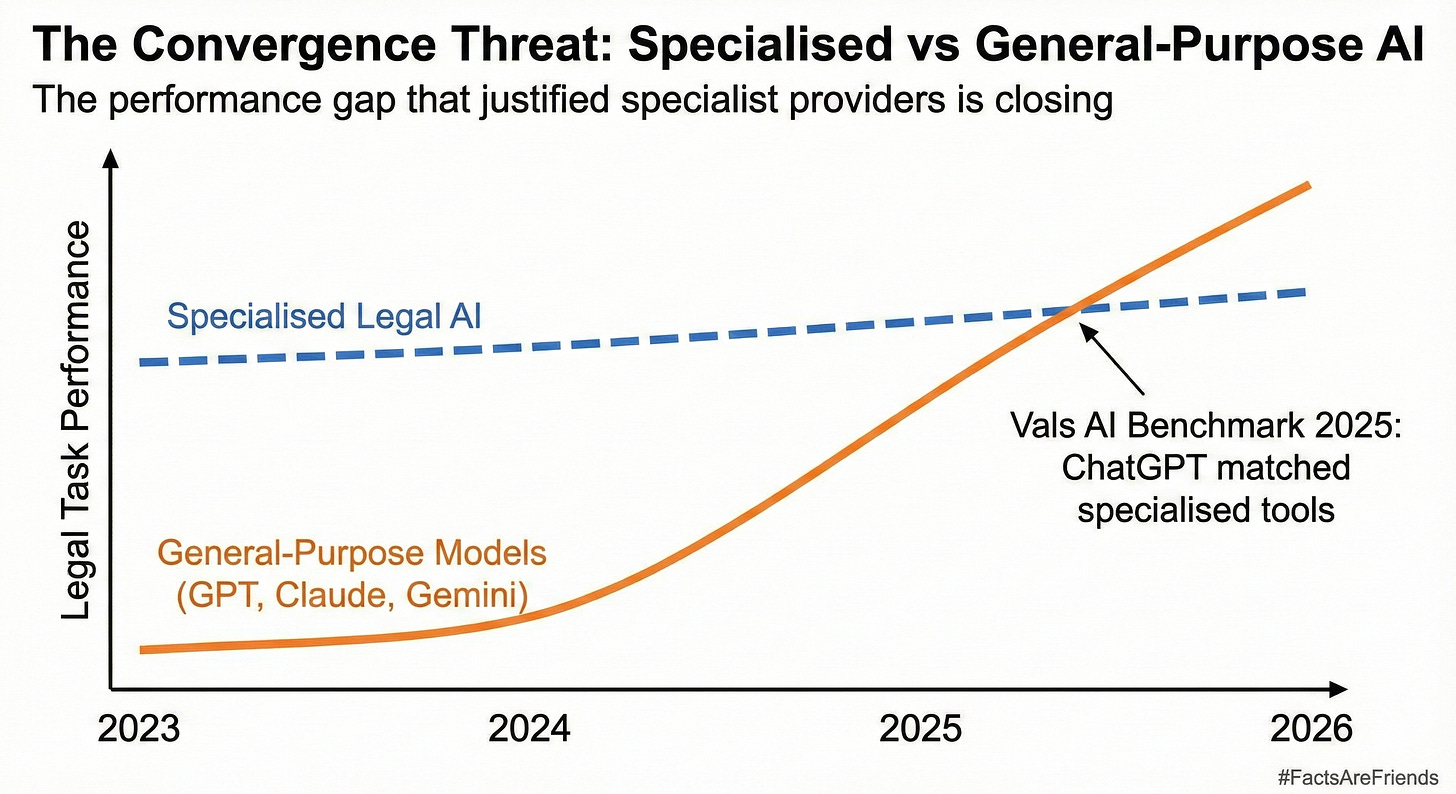
AI makes the document cheap. Large language models can draft contracts, summarise case law, produce memoranda and generate filings with increasing competence. The Vals AI benchmark showed ChatGPT matching specialised legal tools. Every improvement in foundational models compresses the value of document production further.
AI does not make the outcome easy (yet). Integrating two corporate cultures after a merger. Navigating a regulatory investigation. Restructuring a supply chain. Implementing a compliance programme across forty jurisdictions. These require judgment, relationships, persistence and accountability - capabilities that current AI augments but does not replace.
The consulting firms understand this. They are not merely building “Lilli” to answer questions. They are building AI agents to execute workflows - to do the work, not just advise on it, to secure outcomes. They understand something law firms appear to miss: if AI is going to commoditise expert knowledge, you had better control the AI that does it.
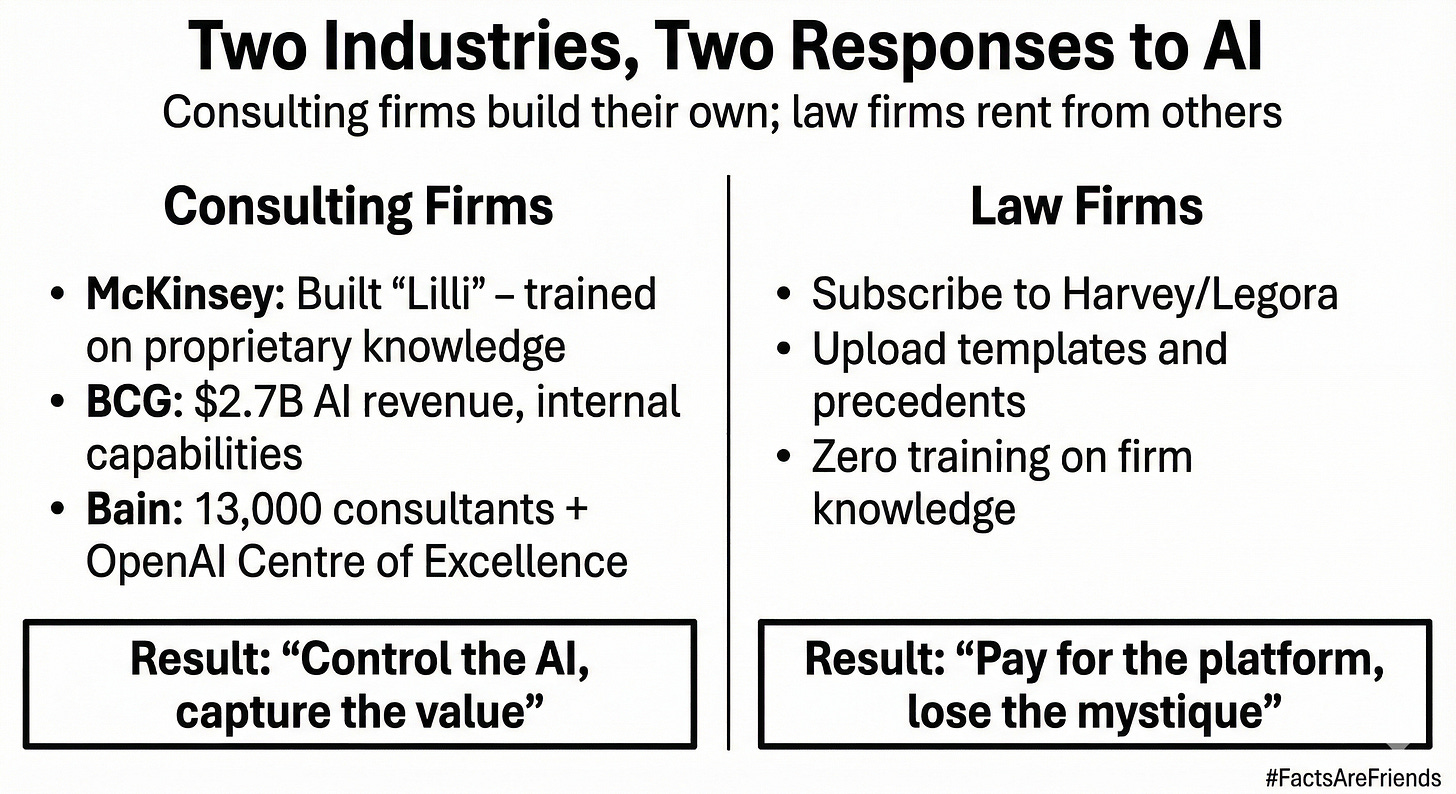
Most law firms are taking the opposite approach (there are some notable exceptions, such as Baker McKenzie which is developing its own generative AI development of internal tools for tasks like data breach notifications and cyber compliance and Linklaters operates its own customised GenAI chatbot Laila embedded in tools such as an AI “Narrative Checker” for time-recording, but even here the real value would be in deep segment knowledge expertise not in automated administration. In September 2025 Linklaters announced a firmwide roll-out of Legora as its generative AI “operating system”, across all 30 offices, alongside Laila, its ReportIQ due-diligence platform and CreateiQ 2.0. The closest thing in Europe to a genuinely law-firm-backed legal LLM appears to be CMS’ tie-up with startup Xayn to form Noxtua which was launched in 2024 as “Europe’s first sovereign legal large language model and legal copilot” aparetly trained on legal material and marketed as avoiding dependence on US hyperscalers. In March 2025, Cleary acquired London-based Springbok AI, bringing a team of data scientists and engineers in-house specifically to build custom AI tools for the firm and its clients. In summary, a small number of firms are building something proprietary, but mostly at the workflow / RAG layer, not at the foundational-model layer.
Most law firms engaging with AI are subscribing to platforms they do not control, uploading their expertise to systems that do not learn from it and training their clients to expect AI-delivered legal services - without capturing any of the resulting value.
Digging or filling moats?
The consulting firms are building moats. The law firms are filling them in.
The consulting firms may find the cartel breaks, but for now they are taking protective action. Law firms are not.
My belief is that the consulting firms are just trying harder to stop the tide from turning and they will secure temporary competitive advantages, but will face ongoing disruption as new entrants and technologies reshape their markets. But instead of just being consumers (as lawyers are), these firms have partnered with the Big AI players. BCG, McKinsey and Accenture have massive alliances with Microsoft, Google, and AWS. They have become “distribution channels“ for enterprise AI. It seems to me that the consulting firms are successfully pivoting to become “Outcome Integrators”. They are no longer just selling “strategy“; they are selling the integration of AI into strategy. The bigger risk to them may not be that AI steals their knowledge, but that pricing pressure from AI efficiency forces them to abandon the lucrative “billable hour” model in favour of outcome-based pricing (e.g. “pay us only if the AI saves you money“). Fairer for the client, but costly for the consultant.
Both consultants and lawyers trade on one other thing. Trust. CEOs often hire McKinsey not just for the answer, but for the “insurance“ of having a top firm validate a risky decision to the Board. It will take time for AI to build a reputational shield. That is the time those working in these professions will feel the calm between storms. But the storm will break.
The Custom Model Illusion
Harvey’s technical achievement is frequently cited as evidence of its moat. The company partnered with OpenAI to create a custom-trained model incorporating 10 billion tokens of US case law.
The October 2025 VLAIR research study found that specialist legal tools and ChatGPT all outperformed a human lawyer baseline on legal research tasks. Legal-specific tools scored 76–78%, ChatGPT scored 74%, and the lawyer control group scored 69%. The margin between the specialist tools and the general model was narrow – just 2-4 percentage points.
This sounds impressive. It is impressive, as a technical accomplishment.
But the technical accomplishment was to absorb all the legal knowledge - every case, every statute, every judicial opinion. And there is the problem: it is all publicly available. The case law that Harvey incorporated into its training is not proprietary. Any competitor with sufficient capital can replicate the training. Thomson Reuters, LexisNexis, Microsoft or any well-funded Big Tech company could pursue the same approach. Look at the numbers being bandied around for developing these frontier models – the cost of training for law becomes a rounding error. There is a caveat to that: on 1 December 2025, Clio’s Fastcase unit sued rival Alexi in US federal court, alleging that Alexi used Fastcase’s licensed legal database to train its AI models in breach of a 2021 licence that expressly barred that use, and seeking destruction of any models trained on that data. They may be successful, but they are attacking a competitor for breaching a contract they are not suggesting that the data was unique. But note what Fastcase is not claiming: that the underlying legal data is unique or proprietary. This is a licensing dispute, not evidence of a defensible data advantage. The very fact that Alexi could access and use this data to train competing models proves the point – legal knowledge is abundant, and barriers to replication are contractual, not technical.
There is, after all, no (usually) proprietary moat in the data itself. The competitor does not need to be another legal firm. Indeed, it is more likely to be another Big Tech business that decides to move into legal services. And then the giants are fighting, and it is the lawyers are running for cover.
And today we see the reality of that risk marching over the horizon in December Elon Musk’s xAI advertised an “AI Legal and Compliance Tutor” to train its Grok model on legal reasoning. The pay rate? $45-100 per hour. Laughable to imagine that somebody on that pay bracket could break the legal machine. Or is it? This may be the moment when specialist legal AI models discover they have a new competitor with deeper pockets and broader ambitions.
We do not know xAI’s strategy, but perhaps it is to hire legal professionals to annotate compliance scenarios, contract analysis and dispute resolution cases, then feed that expertise into Grok. The result would be a general-purpose model with legal capabilities embedded within it – not a standalone legal product, but legal reasoning as a native feature of a platform that already serves hundreds of millions of users.
In testing with ten of the largest law firms, one survey found that lawyers preferred Harvey’s custom model 97% of the time over the base GPT. The 97% preference figure is impressive. However, as Harvey’s co-founder Winston Weinberg explained, lawyers preferred the custom model primarily because it produced “a longer, more complete answer“ that “went into the nuance of what the question was asking and covered more relevant case law”. These are valuable attributes. But they are attributes that foundational models are rapidly developing on their own, without legal-specific training.
Specialist legal AI companies must build distribution, convince law firms to adopt new tools and compete for market share one client at a time. xAI already has distribution through Twitter and enterprise partnerships. If Grok develops credible legal capabilities, it doesn’t need to sell into law firms – it simply becomes the default tool that lawyers already use for everything else.
xAI’s pay rate of $45-75 per hour is telling. It’s low for legal expertise, but sufficient to attract talent at scale. And scale is what general-purpose models do best. Where specialist legal AI companies carefully curate small datasets with expensive expert input, xAI can afford to hire dozens of legal professionals and process vastly more training data. This doesn’t mean specialist legal AI models will disappear. But it does suggest that their competitive advantage – domain expertise encoded in purpose-built systems – may be narrower and shorter-lived than their valuations assume.
The Cost Collapse
The barriers to replicating Harvey’s approach are falling faster than most realise.
In November 2025, the Allen Institute for AI released Olmo 3, a 32B parameter reasoning model that rivals closed-source competitors. The training cost: $2.2 million for the 32B model, approximately $500,000 for the 7B model.
This is not a stripped-down research project. Olmo 3 rivals Qwen’s similar-sized models while training on 6x fewer tokens. In summary, that means that the AI developed at a lower cost, using less energy and with faster iteration - without sacrificing performance.
More significantly, Ai2 released not just the model weights but every training checkpoint, every dataset decision, every line of code. The entire factory, not just the product. And we should not suppose that this is the last or best truly open-source model we shall see. Yes the lawyer may now scramble to build, but the genie is out of the bottle - and it may be just too late to push it back in. The lawyers wanted AI because of the efficiencies it produced: as ever, the old adage applies - be careful what you wish for.
The Magic Circle firms collectively generate billions in revenue. If custom AI training becomes a strategic priority, the technical barriers have essentially evaporated.
A major law firm could train a bespoke legal model for less than a single partner’s annual earnings. And a bespoke legal AI will replace more than one partner.
This does not mean law firms should immediately start training their own models. Most lack the competence, technical expertise and organisational appetite for such projects. But it does mean that Harvey’s technical moat - custom training on legal data - is not a durable competitive advantage. It is a temporary head start that any well-capitalised competitor can close. It also means that the big platforms are leading the way in demonstrating to their successors in the industry what is really valuable, and what is not. I can tell you that the real value is in proprietary data – but for law firms that cannot be the client’s data (which axiomatically belongs to the client), but the firm’s own data. The deep segment specialist knowledge are the new oil wells for lawyers.
The Firm Knowledge Trap
The moat lies not in legal knowledge generally, but in firm-specific knowledge. Harvey and Legora both allow firms to upload their templates, precedents and playbooks to customise outputs. This accumulated institutional wisdom - the drafting preferences, negotiation strategies and risk tolerances that differentiate elite firms - could theoretically become a source of competitive advantage.
The critical point buried in the privacy policies: neither Harvey nor Legora trains its models on firm knowledge.
Harvey maintains a strict “zero training on customer data“ policy for its shared models. As its documentation states: “We don’t use inputs, outputs or uploaded documents to train underlying models”. Legora similarly confirms “zero AI training or data retention“ - customer data is used only for retrieval at runtime.
This constraint is not merely a business decision - it is a regulatory imperative.
Law firms face extraordinary pressure around data privacy and compliance. GDPR in Europe, equivalent frameworks in the UK, Canada, China and specific US states like California impose stringent obligations with severe penalties. Data Protection Impact Assessments are required for systematised processing of personal data and automated decision-making. International data transfer rules add further complexity for global firms.
The consequence is stark: training external models on sensitive client data is virtually impossible from a risk perspective. Firms report that clients have specifically prohibited the use of AI tools on their matters, requiring ethical walls and explicit instructions. This restriction limits not only the platforms’ ability to build moats, but also their ability to achieve the pervasive adoption rates necessary to justify 80x revenue multiples.
The regulatory environment makes creation of a proprietary data moat impossible. The platforms must operate with retrieval-augmented generation rather than true model training. This is not a temporary constraint that clever engineering will overcome - it is a fundamental feature of legal practice. It is not a criticism of their privacy practices. For client confidentiality, these policies are essential. Law firms handling sensitive M&A transactions, litigation strategies and privileged communications cannot permit their data to train models that might influence outputs for competitors.
But the consequence is profound: the accumulated wisdom that makes a firm distinctive never becomes part of the AI’s fundamental capabilities.
The firm’s templates inform outputs at runtime through retrieval-augmented generation - a sophisticated search that finds relevant content and includes it in the prompt. This is valuable, but it is not the same as training. The knowledge stays in workflows and prompt libraries, easily replicated once competitors understand the pattern. And thinking back to the churn – if the competition Platform’s offer is sufficiently attractive the law firms will easily be able to swap from one to the other. The stickiness is only in the interface, and that can be improved for each user.
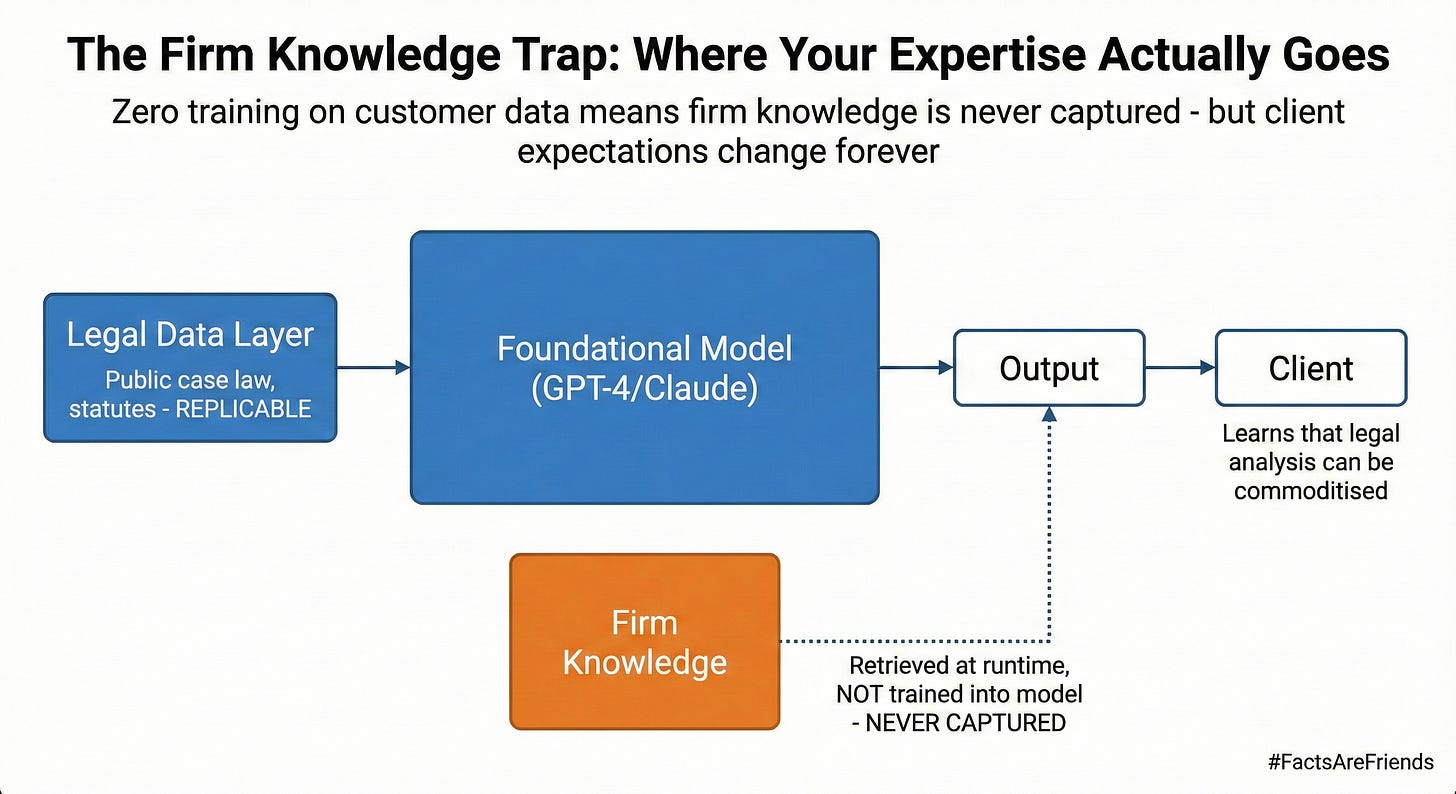
This is where the Trojan Horse becomes visible. Law firms upload their expertise. That expertise does not train the platform’s models. But the firm’s clients learn to expect AI-assisted legal services. The knowledge that was once rare and highly prised becomes abundant.
The legal tech platform may not win. But the lawyers lose anyway.

When firms sign up to these platforms, they are not building proprietary AI. They are renting commodity services with custom configurations - while training their clients to access legal knowledge directly.
Meanwhile, 90% of in-house lawyers already use ChatGPT, Gemini or Claude directly. And if 90% of in-house lawyers already use foundational models directly, and law firms are training their own lawyers (and clients) to expect AI-assisted services via platforms they don’t control, what exactly are firms paying for?
The answer appears to be: temporary convenience wrapped in the illusion of competitive advantage.
Law firms are not buying proprietary AI. They cannot train these models on client data. They are not building moats around their institutional knowledge. What they are purchasing is:
an interface their lawyers are required to use
retrieval systems that search their own documents more efficiently than Google
compliance that satisfies risk committees
the psychological comfort of using a “legal-specific” tool
These are not worthless. User experience matters. Search efficiency has value. Compliance assurance is necessary.
But they are not worth 80x revenue multiples. And they are certainly not worth accelerating the commoditisation of legal expertise.
The brutal arithmetic: firms are paying substantial subscription fees to teach their clients that legal analysis can be automated, whilst their clients’ in-house teams are already using superior foundational models for free.
That the feared disruption is no longer theoretical is demonstrated by recent announcements: in November 2025, Clifford Chance announced it would cut around 10% of its London business-services staff – roughly 50 roles – with AI adoption, reduced demand for some services and offshoring cited as key drivers. The firm is not struggling with poor adoption. It is restructuring because the technology works. Staff at BCLP, and Freshfields have also been impacted. And it is not just the big firms: Irwin Mitchell has made all 56 “Litigation Assistant” roles – non-legally qualified support staff – across its UK offices redundant.
The platforms may fail. The investors may lose billions. But the knowledge has already escaped. The client has already learned that the emperor has no clothes – or at least, that the tailoring can be replicated by a machine.
Law firms are not buying competitive advantage. They are funding their own disruption.