 Facts are friends
If this argument interests you, please consider subscribing. I write about AI, law, professional services and the systems now being built underneath the economy we thought we understood.
This is a long read. The short version is that Musk may lose the model race and still win the infrastructure war. The harder question is whether China, regulation, efficiency gains or the arrival of artificial superintelligence stop him getting there first.
I explain what I believe Elon Musk sees. And when we see it, can you but admire?
Ask most people who is winning the AI model race and they will name the same companies: OpenAI, Anthropic, Google DeepMind. They will talk about benchmarks, model releases, context windows and the breathless commentary that follows each new leaderboard. They will probably not name Elon Musk. Until very recently, even Musk appeared to accept that Grok was behind the frontier. That may be the mistake. The AI war may not be won by the company with the cleverest algorithms this month, but by the person who controls the energy, compute, distribution, data, chips and developer tools on which the whole contest depends. Musk may not have been building the best car. He may have been buying the land, laying the conduits and connecting the utilities. He may be building the infrastructure that the others need to rely on. And as today’s leading foundation models fall to tomorrow’s open models, Musk will still control what his businesses have invested in.
This is not an argument about Grok. Earlier this year Musk said that Grok was not the best model. This essay is an argument about infrastructure, energy and the oldest competitive playbook in the history of capitalism: own the land and connections, and it does not much matter who builds the biggest house - you still own the asset underneath it and access to the utilities it consumes. That was true until yesterday, when the narrative changed - which is what I was waiting for before publishing this essay. xAI released Grok 4.6, and the caveat with which this paragraph opened has narrowed very considerably.
Independent benchmarking from Artificial Analysis puts Grok 4.6 at 61 on its Intelligence Index - tied with OpenAI’s GPT-5.6 Sol, one point behind Claude Fable 5, and two behind Claude Opus 5, which remains the outright leader.
Grok is no longer meaningfully behind the frontier; it is inside it, and at roughly 60% less cost than Opus 5 or GPT-5.6 Sol. And Grok 4.7 is expected within weeks.
Musk’s own claim that Grok is “objectively No. 1 when considering intelligence, speed and cost” may overstate the pure intelligence ranking, but the cost-adjusted case is real. We expect that the Grok 4.7 release will move the dial again. This all strengthens the core argument I am advancing: the entire case was that infrastructure would matter more than model quality even while Musk was conceding the quality gap. He is no longer conceding it.
When I posted the thesis of this essay on LinkedIn, the response was striking. Lawyers, venture capitalists, legal technologists and AI builders across multiple jurisdictions weighed in - and the majority did not push back. They extended my conviction and offered new arguments. Their contributions have enriched what follows, and I am grateful for every one of them.
The debate
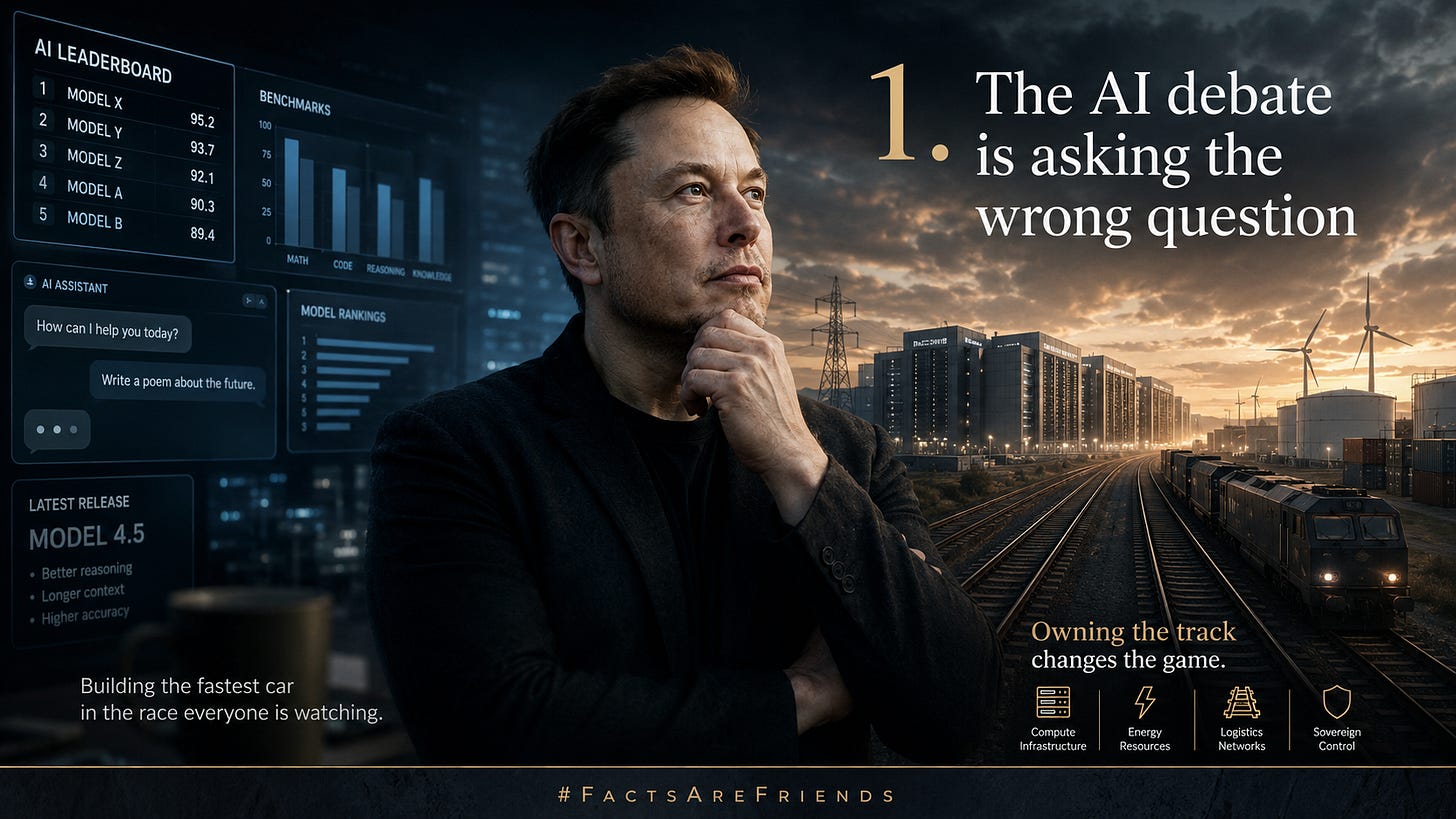
The AI debate is almost entirely consumed by the wrong question. “Which model is best?” is the equivalent of asking, in 1870, which pickaxe technique served the miners best. It misses the point entirely: the people who made the most reliable money in the gold rush were not the miners or even those who taught them how to mine, but the people selling the pickaxes and shovels - and then, when the dust settled, the people who owned the railways.
I had a conversation recently with Tim Davies, founder of Nousica, and he put it with elegant simplicity:
“Musk is not playing the current hand. He is playing for tomorrow”.
That framing explains Musk’s entire approach - while OpenAI and Anthropic race to develop better AI engines and settle governance frameworks, and Google tries to reconcile its search business, having given the crown jewels away and now being held together by Demis, sticking tape and amazingly valuable inertia and footprint, Musk is getting on with building the factory.
Felix Riley, who advises law firms on AI strategy, told me he had been out with a well-informed venture capital friend who said exactly that:
“Watch Elon - he’s building the best stack”.
When the smart money is not looking at models but at infrastructure, that is a signal worth paying attention to.
The energy problem nobody else is solving
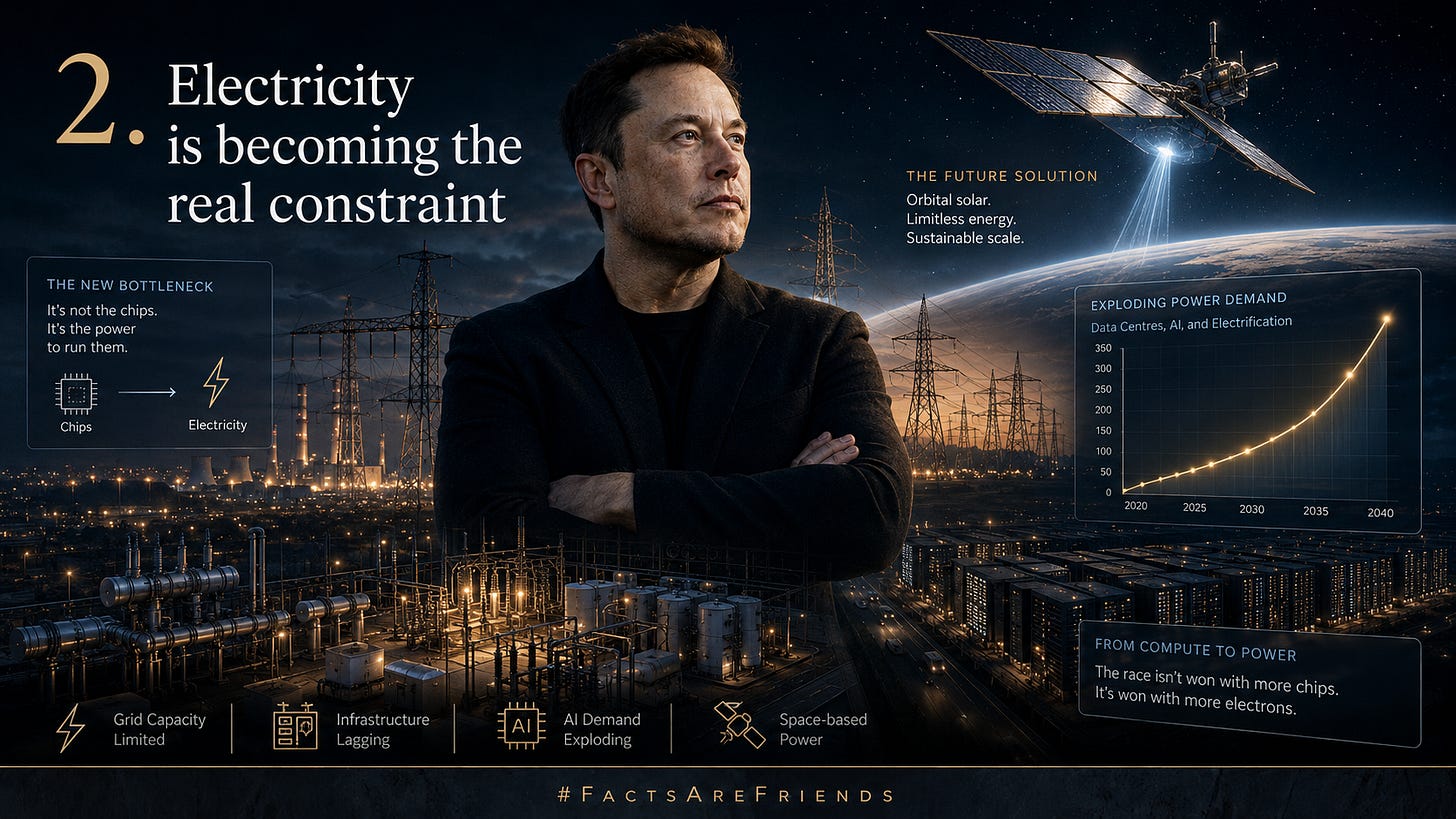
The constraint that will define the next decade of AI is often glossed over - it is not talent, it is not algorithms - it is power (electricity). Talent and algorithms are not unimportant, but there are sufficient pools of them. It is power which has a finite, limiting cap - and it is that cap which will slow down the talent developing the new algorithms.
Musk understands that the primary constraint on AI development is not chip shortages but a fundamental shortage of electricity (and the transformers needed to deliver it). Every major AI laboratory is now competing for the same scarce grid capacity, with a substantial number of planned US data centre builds reportedly delayed or cancelled due to power infrastructure shortages.
Musk made the same point himself in a wide-ranging interview with The Economist in July 2026: “The rate at which AI chips are being made exceeds the rate at which new electricity is coming online,” he said, adding that once space-based power addresses that constraint, the bottleneck outside China “will once again be chips.” It is a rare moment of a tech founder diagnosing his own dependency in public.
Rather than queuing behind everyone else for grid capacity, Musk is vertically integrating into power generation itself. SpaceX filed with the FCC in January 2026 for up to one million orbital data centre satellites, and in June revealed the AI1 satellite design - a 70-metre-wingspan craft carrying 150 kW peak compute, powered by SpaceX-manufactured solar arrays. Musk has told investors that “the cost of deploying AI in space will drop below the cost of terrestrial AI much sooner than most people expect.”
As Matthew Berman, a US class action attorney and AI commentator, noted in response to my LinkedIn post:
“What really matters is the cost of tokens, and tokens are way cheaper in space.”
It is a characteristically direct formulation of the energy-token relationship that sits at the heart of the infrastructure thesis.
The sceptics are not trivial. OpenAI’s Sam Altman has called orbital data centres “ridiculous.” Google’s feasibility study suggests the economics only work once launch costs fall to $200 per kilogram - a target they project may not be met before 2035. Charles Rathmann, an enterprise software commentator, has made a similar point more bluntly: the energy transmission and cooling technology this vision depends on does not yet exist at the necessary scale, and there is no guaranteed pathway to closing that gap on the timeline the optimists assume. SpaceX has unveiled plans for an 11-million-square-foot Gigasat factory in Bastrop, Texas, and expects to begin producing AI satellites by late 2027. Nobody else has the rockets to deploy these at scale. That is the point. If he succeeds - and let’s face it he has failed before (and succeeded, big time) - then he will own the ground and conduits and be able to charge others for occupying it and connecting to what they need.
Ars Technica’s technical analysis, published in July 2026, puts real numbers behind the ambition. Even under an optimistic scenario - full Starship reusability, 200-tonne payloads, $20 million launch costs - deploying and maintaining the full million-satellite constellation would cost an estimated $1.45 trillion; a neutral scenario puts it at $3.45 trillion and a pessimistic one at $9.8 trillion. The optimistic case alone requires roughly ten Starship launches a day; the pessimistic case requires 42. For context, the entire world managed 329 orbital launch attempts in the whole of last year. Musk’s own response to the scale of the challenge is characteristically unbothered: “There’s not some magic that’s necessary that doesn’t exist... we don’t think this is a super hard problem.” Whether that confidence is engineering realism or the same instinct that once dismissed the difficulty of reusable rockets is, at this stage, a matter of record rather than prediction.
The scale of these commitments is now measured in decades and gigawatts rather than quarters and racks. On 6 July 2026, Anthropic signed a 20-year lease with TeraWulf - a former bitcoin miner turned AI landlord - for a purpose-built campus in Hawesville, Kentucky, expected to generate approximately $19 billion in contracted revenue and deliver 401 MW of critical IT load by early 2028. AI companies are no longer simply buying chips. They are reserving towns, power loads and decade-long chunks of the electrical grid. “We need more compute” has moved from the startup pitch deck to something closer to a request to build a small industrial moon base in Kentucky.
The superstructure - how the empire joins up
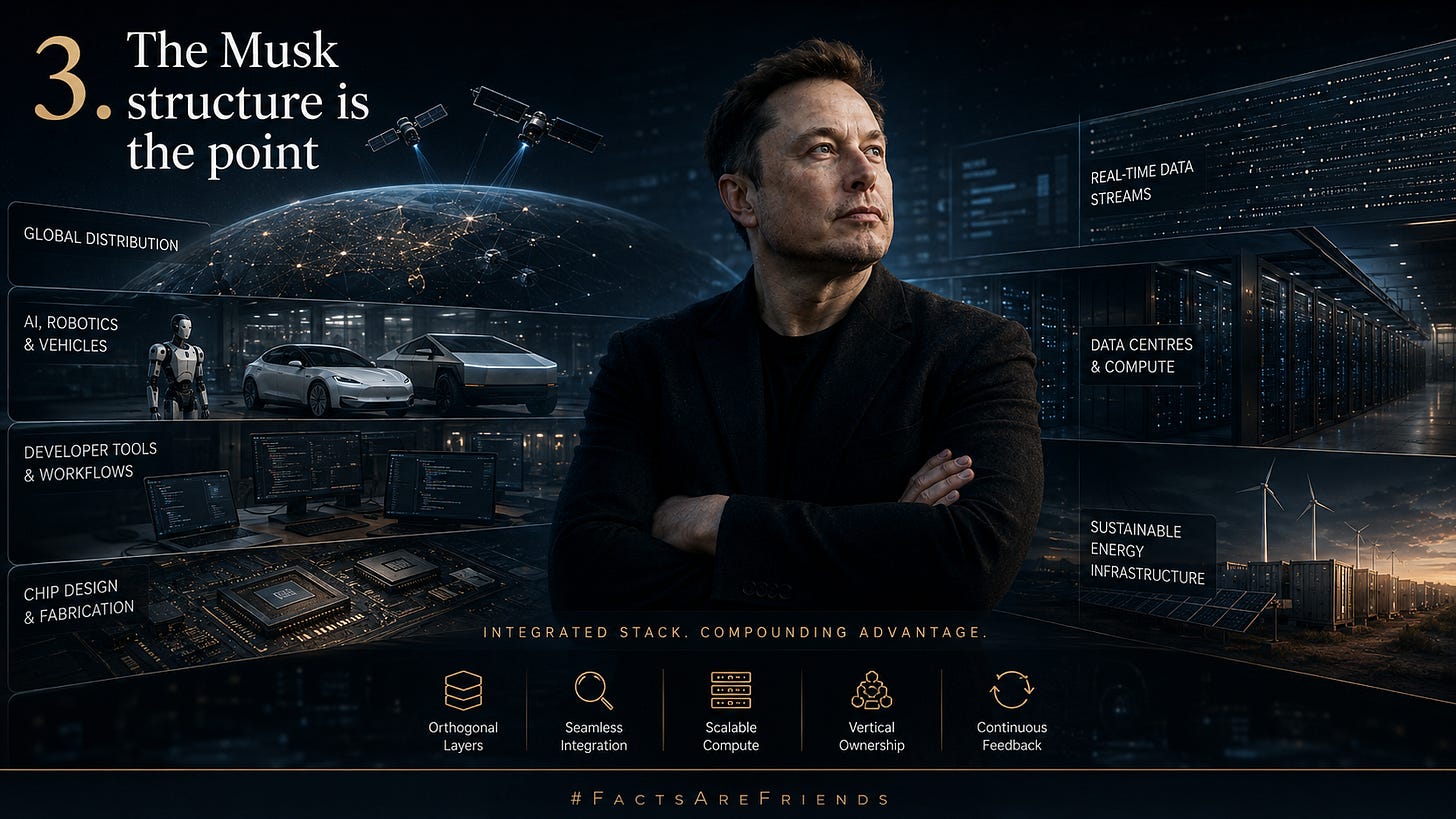
The real strategic genius of the Musk position is not any single company. It is the architecture of the whole.
In February 2026, SpaceX acquired xAI in an all-stock transaction, creating a combined entity valued at $1.25 trillion - the largest private merger in history. Rockets, Starlink, Grok, X (formerly Twitter) and the Colossus supercomputer are now under one roof. Today Grok may not be better than any of the foundational models, but Musk knows that all of them may lose ground to open-source models - and that regardless of which model wins that fight, Musk will likely control the infrastructure underneath it.
Starlink is the distribution moat. It operates approximately two-thirds of all active low Earth orbit satellites. The closest Western competitor generates less than 10% of Starlink’s scale. That distribution layer is already paying for itself. SpaceX’s first earnings call as a public company, held in August 2026, reported quarterly revenue of $7.8 billion, up 92% year on year, and Starlink subscriptions at 12 million, roughly double the prior year. Musk told investors the company’s internal projection for reaching $1 trillion in annual revenue had moved up from 2031 to 2030, with “a non-zero chance” of 2029. This is not a satellite internet business. It is a global distribution layer for AI inference - one that no competitor can replicate on any near-term timeline.
Tesla is the data engine. The real value of Tesla was never the car. It was always the dataset: real-world vision data at scale, feeding a cognitive architecture that transfers directly to Optimus robots. This is the same understanding of the physical world that will power the next generation of embodied AI. Nobody else has this data.
Cursor is the developer gateway - the fastest route to genuine adoption among professional developers, something Grok had singularly failed to achieve on its own. In April 2026, SpaceX secured an option to acquire Cursor - the AI coding tool with over one million paying users, more than 50,000 corporate clients and an annualised recurring revenue that several analysts described as the fastest climb from zero to $2 billion in B2B software history. SpaceX exercised that option for $60 billion in June 2026, days after the IPO. This is the front door into enterprise AI. As Dr Rembert Graf Kerssenbrock, a restructuring lawyer and AI commentator at Taylor Wessing, observed: “Grok as a platform will soon catch up to Claude Code and Codex” and in the meantime, Cursor fills the gap with immediate credibility. Dr Kerssenbrock’s prediction has already partly landed: Grok 4.6, released in August 2026, ships natively in Cursor on all plans and scores within one to two points of Anthropic’s leading models on independent benchmarks, at roughly 60% lower cost.
Terafab is the chip independence play - and the most underreported element of the whole strategy, because it is the one piece of the stack aimed squarely at removing Musk’s single biggest external dependency: Nvidia. In March 2026, Tesla and SpaceX, alongside Intel, announced a joint semiconductor fabrication plant targeting over one terawatt of AI compute capacity per year. The estimated investment is $55 billion for the initial phase and $119 billion for all phases. The full-scale facility is planned to cover up to 100 million square feet in Texas. If it works, Musk is no longer a customer of the chip supply chain. He owns it. Satellite imagery of the facility released in August 2026 revealed a striking detail: a vast circular structure at its centre, which Musk confirmed is a free electron laser built for extreme ultraviolet lithography - a direct technical challenge to ASML’s tin-droplet approach, and, if it works, a second dependency removed alongside TSMC.
In July 2026, Musk extended this data strategy to SpaceX itself, confirming that the company’s entire engineering dataset - excluding defence-sensitive material, and drawn from two decades of designing, building, launching and reusing orbital rockets - will be folded into training data for Grok’s next 2-trillion-parameter model. If Tesla supplies the embodied vision data, SpaceX now supplies the industrial engineering data: two decades of design decisions, failures and trade-offs that exist nowhere else in machine-readable form.
Put it together: energy sovereignty (orbital solar), distribution monopoly (Starlink), embodied AI data (Tesla), developer adoption (Cursor), chip independence (Terafab) and a social media platform (X) providing real-time data at 350 million posts per day. This is not an AI company. It is a civilisational stack.
The platform play - your competitors fund your infrastructure
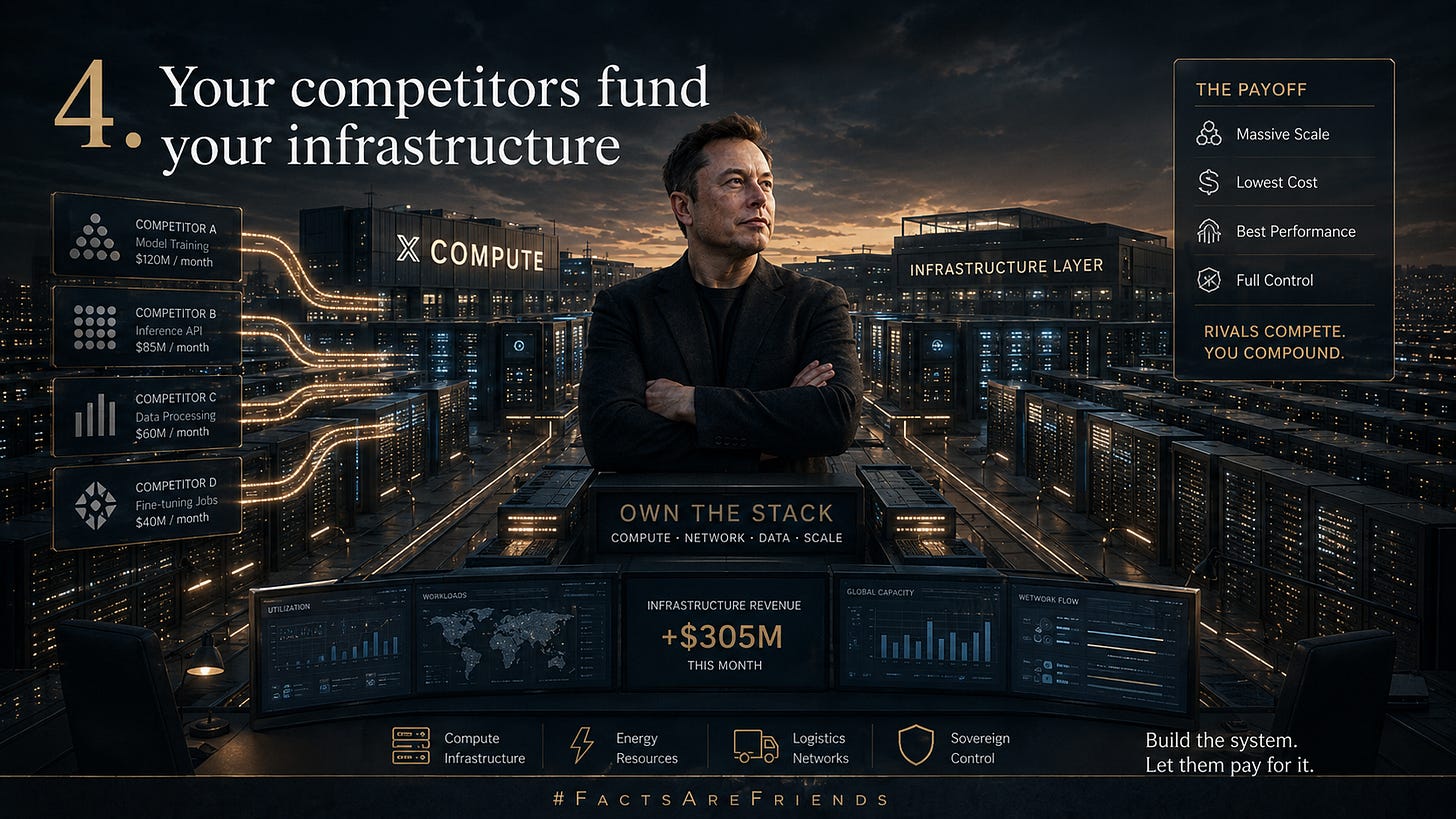
This is where the strategy becomes almost beautiful in its audacity. I’ve learned from the #TrojanHorseDebate here - Musk is not trying to beat Anthropic and Google at model development. He is renting them the compute on which they build and run their models - and letting them pay for the infrastructure that we can expect will eventually compete with them.
The Anthropic arrangement deserves particular attention, because it is more nuanced - and more revealing - than the headline suggests.
SpaceX built Colossus 1 to train Grok across three distributed data centre sites. But it seems that latency issues between Memphis and the other two locations made the architecture unworkable for training. The very cluster Musk had hyped as his AI crown jewel turned out to be unsuitable for his own primary purpose. With typical resilience and out of the box thinking he then rented it to Anthropic - turning a technical embarrassment into a revenue stream. SpaceX built Colossus as part of the xAI infrastructure push. The Anthropic deal then turned that infrastructure into a large external revenue stream. Whether that began as spare capacity, strategic leasing or a mixture of both, the commercial effect is clear: a direct competitor is helping fund the infrastructure layer.
Anthropic uses it most for inference: the continuous cost of running Claude for its millions of subscribers. Anthropic’s own announcement confirmed that the deal would directly relieve Claude’s long-standing usage throttling for Pro and Max subscribers.
Mike Gilpin, a legal technologist, pointed to the financial scale of this dependency:
“There are hints in the $1.25 billion per month that I believe Anthropic is paying to SpaceX in respect of future capacity. That feels like a down payment rather than consumption.”
He is right to notice. Google is ramping up to the best part of $1 billion per month as well. When your competitors’ operating costs flow through your balance sheet, you do not need to win the model race. You have already won a more important one.
Michael Nketiah, a lawyer and founder of JusticeReserve, captured the logic of these arrangements elegantly:
“The price of the future is lowest in the present; it rises with certainty.”
These are not simply compute contracts. They are structural dependencies being locked in early, when the switching costs are still manageable - and they will only become less manageable over time.
In the legal profession we call this “holding the pen” or “controlling the process.” The party who controls the drafting, the disclosure, the timing and the access to information does not need the strongest underlying case. They need to make the other side dependent on their cooperation.
Anthropic paying $1.25 billion a month to expand Claude capacity using SpaceX compute (Musk-controlled infrastructure) is, in legal terms, something close to an adversary funding your litigation costs. The structural position matters more than who currently has the better argument. Anthropic’s parallel move to secure independent capacity from TeraWulf in July 2026 is a reminder that dependency of this kind is a starting position, not a permanent one.
Legal valuations
For my readers who follow legal AI: the implications for platforms like Harvey and Legora are acute.
When Anthropic launched a Claude legal plug-in, listed legal software companies saw their stocks fall the same day. Harvey is valued at $11 billion and Legora at $5.6 billion - a combined $16.6 billion sitting on top of a global legal AI software market estimated by MarketsandMarkets at just $3.11 billion in 2025. That is not a typographical inconsistency. Investors are not pricing Harvey and Legora against the current legal AI software category; they are pricing them against the far larger prize they hope eventually to disrupt - the global legal services market itself, worth several hundred billion dollars annually in the US alone.
The valuations only make sense if the specialist layer becomes the wedge into that much bigger market, rather than a product competing within the narrower category it is classified under today.
Those valuations assume that the specialist layer retains its moat as that larger disruption unfolds. That assumption deserves scrutiny.
Good enough
The “good enough” doctrine I have written about before applies here with particular force: if the underlying model becomes good enough for the majority of legal tasks, the value of the specialist wrapper diminishes rapidly. The infrastructure owner may then control the layer on which that commoditisation runs.
Ted Theodoropoulos, a legal AI commentator recognised on the FT Law 50, made the same argument from the buyer’s side in July 2026. Rockefeller, he pointed out, did not win by drilling the most wells - he won by controlling the pipelines and refineries, because the wells were interchangeable and the rails were not. Ted was (as is so often the case) right.
Law firms currently spend most of their attention picking wells: which model, which point solution, which vendor’s demo looked best last quarter. Those choices will not matter for long, because the model underneath will be swapped out repeatedly. What will not be interchangeable is the connective layer - how AI reaches a firm’s own knowledge, data and workflows.
Ted’s argument is beyond theoretical: Ornn, a New York startup, raised $33 million from Andreessen Horowitz in June 2026 to build a commodities market for AI compute itself, complete with a Bloomberg Terminal-listed pricing index and futures contracts planned by the Intercontinental Exchange. If compute can now be priced and hedged like oil, the infrastructure layer is already behaving like the commodity market Rockefeller once cornered - which is precisely the position law firms, and Musk, are each trying to occupy from opposite ends of the same stack.
The bear case - and why it matters
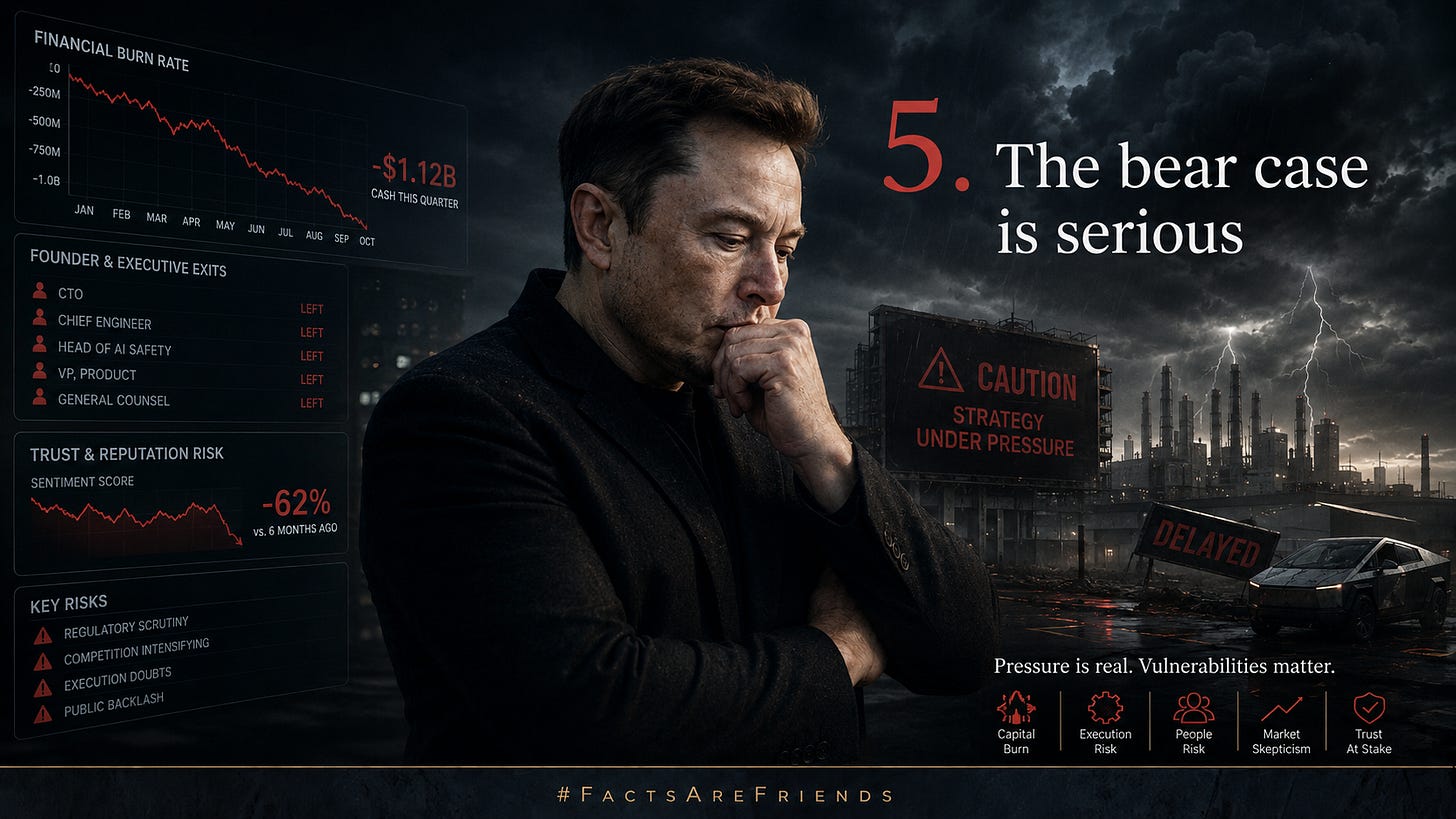
I do not want to pretend the risks are trivial. Any credible review should address them.
Grok has significant reputational problems. By late March 2026, every one of xAI’s eleven original co-founders had departed - the final two, Manuel Kroiss and Ross Nordeen, left within days of each other. Musk is now the only member of the founding team still at the company he built in 2023. Some of SpaceX’s own engineers have been slow to adopt Grok, and xAI staff have reportedly been using Claude for coding instead. The AI1 satellite programme is ambitious: prototype launches expected in early 2027, with commercial deployment beginning in 2028 - these are demanding timetables. Musk has missed his own targets before.
Matt Desch, the chief executive of satellite operator Iridium Communications, offered a more grounded outsider’s view on an earnings call in 2026. Asked about orbital data centres, he acknowledged the concept “looks like a problem that can be solved in space” but noted “massive technical challenges to overcome,” and suggested the enthusiasm may owe as much to valuation as to genuine near-term need: “I could jump on that bandwagon... to hitch our wagon to that for a valuation. But we’re a really pragmatic company that focuses on really delivering results in cash and growth, so I’d rather kind of stick to the themes that I’m currently around.”
The compute contracts with Anthropic and Google contain 90-day termination rights - a genuinely two-way vulnerability, discussed further below. The Terafab semiconductor plant is a multi-year, $119 billion undertaking whose success is by no means assured.
And the market has already tested the wider thesis in public, more violently than a first glance suggests. SpaceX priced its IPO at $135 in June 2026, traded as high as $225.64 within days - a valuation of roughly $2.8 trillion that briefly made Musk the world’s first (paper) trillionaire - then gave almost all of it back, falling as low as $104.83 in early August on a wave of pre-earnings scepticism. It has since rallied hard: a stronger-than-expected first earnings call (revenue of $7.81 billion, ahead of the $6.93 billion analysts expected), the completed $60 billion Cursor acquisition, and a lock-up expiry that passed without the flood of selling many had feared, together drove the stock up roughly 40% in a fortnight to close at $146.15 on 12 August - back above the IPO price, and, for now, vindicating the bulls; Morgan Stanley has set a $600 price target on the strength of the Cursor deal alone. A stock that has swung from $135 to $225 to $105 to $146 within ten weeks is not a verdict on the underlying strategy in either direction, but it is proof that the market’s confidence in Musk’s infrastructure bet remains genuinely unsettled - capable of turning sharply on a single earnings call, and just as capable of turning back.
Tesla’s own second-quarter results, reported on 22 July 2026, told a similar cautionary story: record revenue, but an operating margin that had collapsed to 1.4% and the company’s first negative free cash flow quarter since early 2024. The stock fell 14.5% over the following day, its worst single-day decline in over a year.
Beyond execution risk, there are at least four structural scenarios in which the infrastructure thesis itself could fail.
The ASI scenario. Dr Kerssenbrock raised this directly:
“Considering what we have already seen from Anthropic with Fable and Mythos, ASI might have already arrived before he can take advantage of his superior infrastructure.”
If artificial superintelligence arrives before the orbital data centre constellation is deployed - and Anthropic’s Fable 5 and Mythos 5, OpenAI’s 5.6 and Grok’s own latest models, with their step-change capabilities in autonomous software engineering and scientific research, suggest the timeline may be shorter than many expect - then the infrastructure play becomes irrelevant. The game changes entirely. This is the strongest counter-argument to the Musk thesis, and it should not be waved away.
Dr Kerssenbrock himself later complicated his own point: owning both the infrastructure and the energy supply for AI is, he suggested, “genius” precisely because it might let Musk “preserve control over increasingly more powerful AI-systems and control the increase in its intelligence” even after ASI arrives. If he is right, the ASI scenario does not necessarily defeat the infrastructure thesis - it may simply relocate the point of control from training compute to the power source underneath it.
The efficiency revolution. DeepSeek demonstrated in January 2025 that smaller, more efficient models trained on fewer chips can rival the performance of models built with vastly greater resources. If architectural innovation continues to outpace scaling laws, the “more compute wins” hypothesis weakens. Google’s work on Decoupled DiLoCo, which enables training across distributed sites with minimal bandwidth, points in the same direction. Infrastructure may matter less if the software becomes radically more efficient.
The regulatory fracture. In June 2026, the US Commerce Department barred Anthropic from distributing its most capable models - Fable 5 and Mythos 5 - to foreign nationals, forcing the company to disable both models worldwide within hours. Washington lifted the restriction by the end of the month, but the episode demonstrated something more durable than the ban itself: a government can now switch off a deployed frontier model overnight, and no contract or infrastructure investment protects against that. If AI becomes subject to the same export control regimes as advanced weapons systems, vertical integration within one national jurisdiction may prove less valuable than distributed, multi-jurisdictional capability. Musk’s concentration of assets within the US regulatory perimeter could become a vulnerability rather than a strength - a sovereign risk that outlives any single episode, however quickly it was resolved. When Fable 5 returned online on 1 July 2026, it came with conditions that amounted to a standing duty to government: a safety classifier targeting the specific exploit that triggered the shutdown, continuous monitoring of jailbreak attempts reported back to Washington, and early access for designated government partners to future frontier models. It was, by some accounts, the first time a frontier AI model had been placed under this kind of ongoing federal supervision.
The platform rebellion. If Anthropic, Google and others conclude that their dependency on Musk’s infrastructure is strategically intolerable, they will seek alternatives - and the 90-day termination clause noted above means they could act on that conclusion quickly. Google is already in talks with SpaceX about orbital data centres but is simultaneously developing its own Project Suncatcher satellite programme. Jeff Bezos’ Blue Origin has announced the TeraWave constellation of 5,400 satellites designed for high-throughput data centre networking. The window during which Musk’s infrastructure is uniquely indispensable may be shorter than the thesis requires. Anthropic’s own behaviour suggests the hedge is already under way. Its 20-year, $19 billion lease with TeraWulf, signed in July 2026, secures 401 MW of compute capacity entirely outside the Musk ecosystem - the clearest evidence yet that the labs paying to run on Colossus are simultaneously building their way out of dependency on it.
These caveats are important. Unless we doubt that the objectives can ever be achieved (and some may), most of them are really timing objections rather than structural ones (”when, not whether”) - the ASI scenario is the one genuine exception. Nobody disputes that the infrastructure matters. The challenge Musk has set himself in full view is whether he can build it fast enough - and, perhaps more important, whether anybody else can build it faster. Don’t count China out of the race, and the technical talent operating under that system, though underused by Western comparison, remains formidable.
Dr Kerssenbrock, responding to the essay’s thesis directly, made a point about mindset that belongs here. “Everyone who is pinpointed at flaws in his plans might be 100% right,” he wrote. “But he is working with a different mindset. To him and his team these details are mere issues that need to be solved. He does not claim that he has already solved them all, but that he will be able to solve them in the future and devote himself to it.” That is not a defence against the criticisms above - it is a description of why Musk himself may not think he needs one.
The scaling law and the race for compute

Dr Rembert Graf Kerssenbrock made a point in our LinkedIn exchange that deserves particular attention:
“Elon understands the scaling law, the fundamental law in computer science that was discovered with I believe GPT-3. More compute leads to lower test loss, more data leads to lower test loss, more parameters lead to lower test loss.”
In plain terms: feed a model more computing power, more training data or more parameters, and its performance improves in a fairly predictable line - no one has yet found the ceiling. That is why compute has become the industry’s scarce resource, not cleverness alone. If the scaling law holds - and the evidence so far broadly supports it - then whoever commands the most compute wins. Not necessarily today. But structurally. The model gap closes when you throw enough hardware at it. The infrastructure gap does not close at all unless you build the infrastructure.
Dr Kerssenbrock went further:
“If the claims about the data centres in space are true (which I simply don’t know), SpaceX could easily scale the whole training of LLMs to completely different levels than what we have seen before.”
The AI1 satellite design, with its interchangeable chip payload and 150 kW solar array, is the first concrete hardware answer to that proposition.
Independent technical analysis complicates this specific claim, however. Ars Technica’s engineering review of the AI1 design concludes that large-scale training - the workload that depends on thousands of GPUs synchronising in near-real time - is precisely the task most exposed to satellite-to-satellite latency, while inference work, which is far more tolerant of latency and easier to shard across a distributed constellation, is the more plausible near-term application. If that assessment holds, Dr Kerssenbrock’s scaling argument may prove right about orbital compute’s importance while wrong about which workload gets there first - which would still support the essay’s wider thesis, just via inference and distribution rather than training.
Michael Nketiah framed it in even broader terms:
“You may bet against Elon on timelines, but not on the overall outcome. While most of what he is building... may seem to be overvalued relative to current revenues, the actual products being built... are civilisational and, as such, may be undervalued in the long term. Most founders operate in the domain of conventional possibility; Elon does not play in that domain at all. The floor for him is what I call the domain of conventional impossibility, a product of first-principles thinking.”
It is a bold claim. But the structural logic is not easily dismissed.
China - the challenger nobody in Silicon Valley wants to talk about
In my opinion, if there is one force that could disrupt the Musk thesis, it is not Anthropic or Google. It is China.
A private conversation I had alongside the LinkedIn discussion surfaced an argument I had not fully considered: China’s energy infrastructure may be the single most important variable in the AI race that almost nobody in the West is discussing openly.
China’s State Grid Corporation operates the world’s most advanced ultra-high-voltage transmission network, with over 30 UHV lines capable of moving vast quantities of renewable energy from rural western provinces to industrial hubs with minimal loss. No Western country has anything remotely comparable. While the UK has struggled for over a decade to deliver a single high-speed rail line, China has built the world’s largest high-speed rail network - 45,000 kilometres - in roughly fifteen years. This infrastructure execution gap is enormous.
The numbers tell the story - and the story is that China is not merely competing on model quality, it is building the same kind of energy and compute infrastructure Musk is betting his empire on, at comparable speed. China’s data centre electricity capacity is on course to reach 30 gigawatts this year, a 30% increase. Chinese cloud service providers are expected to show that they increased capital expenditure by around 65% in 2025, with the top internet firms investing more than $70 billion in AI infrastructure. Beijing has designated a national compute target of 300 exaflops and committed a five-year budget near RMB 2 trillion - approximately $275 billion - to build an interconnected data centre grid spanning eastern demand hubs and western power bases. The state has set a goal of 80% of AI accelerators running on domestic chips by 2028.
China is also innovating in areas that the West has largely ignored. While the US debates whether to allow data centres near residential areas - with AI data centre bans multiplying across the country - China is deploying undersea data centres off Shanghai, using ocean cooling and offshore wind power to sidestep the land, water and energy constraints that are slowing Western buildout. A $37 billion project in Wuhu is converting farmland into centralised AI compute clusters. The approach is unapologetically state-directed, and it is fast.
Google, too - but don’t take your eye off China as the main competitor
Horatiu Druma-Strugariu, a principal legal AI engineer, made the point on LinkedIn that Google should not be counted out either, noting that “their entire model architecture is more efficient ab initio.” He has a point, and this connects directly to the China variable. Google’s Decoupled DiLoCo architecture, unveiled in April 2026, enables distributed training across multiple data centre sites with near-zero global downtime and orders of magnitude less bandwidth than conventional methods. If architectural efficiency can substitute for raw compute scale, the infrastructure advantage narrows. Michael Nketiah agreed, adding that Demis Hassabis is “one hell of a mind” and should not be underestimated. I don’t know anybody who knows anything about these things who would disagree with that.
But there is a deeper point here about China specifically. China can execute infrastructure at a speed and scale that no Western democracy can match. The autocratic advantage is real: no environmental impact assessments, no planning objections, no regulatory delays.
Tim Davies’ observation in our original conversation was characteristically blunt:
“The genie cannot be returned to the bottle. Once China releases at comparable quality, the American labs will have no choice but to follow.”
This creates a forcing function that paradoxically strengthens the Musk thesis. If model quality commoditises - through Chinese competition from below and open-source pressure from projects like DeepSeek and z.ai - the margin moves to whoever controls compute, energy and distribution.
The model layer becomes the commodity. The infrastructure layer becomes the moat. This is an argument I have held for quite some time.
But it also creates an alternative outcome that the Musk thesis does not adequately address: what if China builds the infrastructure faster? China controls approximately 15% of global AI compute today versus 75% for the United States. But that ratio is shifting. Huawei shipped an estimated 812,000 AI chips in 2025. Alibaba has launched a data centre powered entirely by its own Zhenwu semiconductors. The chip self-sufficiency drive is not aspirational. It is operational.
The gap is not only digital. On the manufacturing and robotics side, where Musk’s own infrastructure thesis depends on Tesla’s data advantage, China is not catching up - it has already arrived. BYD outsold Tesla globally in 2025. CATL commands roughly 40% of global battery manufacturing capacity, against Tesla’s own 4680 cell programme still working through yield problems. Unitree’s G1 humanoid, priced under $100,000, and UBTECH’s Walker series are already deployed on real factory floors; Optimus remains a prototype, with Tesla’s own Q2 2026 disclosures describing its first production lines as being used for “training data collection” rather than customer deployment. If embodied, real-world deployment data is the moat this essay has argued Tesla holds uniquely, China’s robotics manufacturers may already be collecting a version of it at scale.
Musk’s counter is that China cannot replicate Starlink’s orbital distribution layer or SpaceX’s launch capability. That is probably true today. But China has filed with the International Telecommunication Union for two megaconstellations totalling 200,000 satellites. The West’s assumption of permanent orbital superiority deserves the same scrutiny as every other assumption in this essay.
The narrative layer - why X matters more than you think
Dela Quist, a writer and strategic adviser on digital infrastructure, made an observation on LinkedIn that I want to highlight because it illuminates a dimension of the Musk strategy that most technology commentators miss entirely.
“Elon is one of the few people to build multiple billion- and trillion-dollar businesses with almost no advertising. PayPal, Tesla, SpaceX - all grew through product ambition and earned attention, not paid reach. That is why X matters. He did not buy it for the ad model. He bought it for narrative equivalency. Every industrialist eventually wants to control the frame, not just the product - and X gives him that.”
It is a wonderful contrast to Legora sponsoring Chelsea Football Club. I know which I think is the smarter, and more sustainable, approach.
Musk is playing a different game
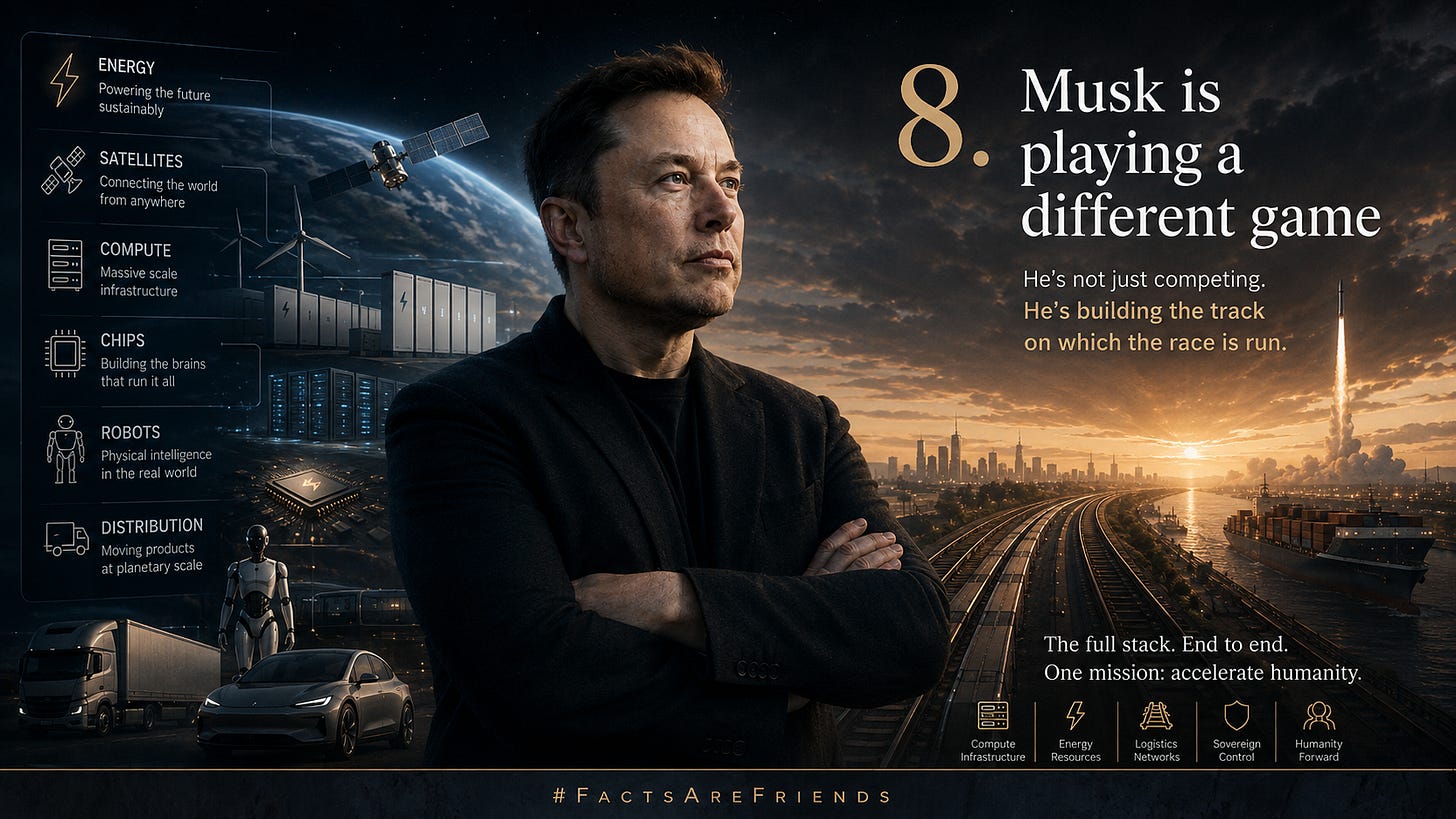
Musk is not simply competing in the model race.
He is building the ground on which he is placing the track, stadium and utility connections from which the race will be run and broadcast to the breathless public.
His competitors are training - and at least in Anthropic’s case, running - their models on his compute. His energy strategy addresses the constraint that may define AI capability for the next decade. His distribution moat through Starlink is unmatched. His chip independence plan, if it succeeds, removes one of the last major dependencies. Cursor gives him the developer gateway into enterprise AI that Grok had failed to create alone.
And he is accumulating lawyers. Quietly. Aggressively. Bloomberg has reported that SpaceX hired more than a dozen in-house lawyers in recent months, yet went to IPO without a named general counsel - a fact that legal academics describe as surprising for a company of this size. That is rarely a sign that a company expects to play a small game.
This could still go wrong. The timelines are aggressive and, frankly, tight. The losses are enormous. Grok’s reputational damage is real. China’s infrastructure build is formidable and accelerating. The ASI timeline may render the entire infrastructure thesis moot.
The share price tells its own version of this story, and it keeps rewriting itself. Within a month of listing, SpaceX stock rose 67% from its IPO price, fell back close to where it started, then fell further still to a low near $105 in early August - before rallying roughly 40% in the fortnight that followed to close back above its IPO price at $146.15 on 12 August. Conviction in the infrastructure thesis, it turns out, is something the market forms and loses in the space of days, not years.
These caveats are important, but the infrastructure play does not need to be perfectly on time - it needs to be first (or demonstrably better).
Starlink gives Musk distribution. Colossus gives him compute. Terafab may give him chip independence. Orbital solar may give him an answer to the energy ceiling. Tesla gives him embodied data. Cursor gives him developers. X gives him a real-time data stream - and, as Dela Quist reminded us, narrative control. And the lawyers - well. Where Musk goes, litigation follows. The question is whether he is the defendant or the architect.
That combination is difficult to bet against.
A postscript: commentary on the man
Everything above is a business argument, and it stands or falls on business grounds. What follows does not. I want to address it anyway, because I do not think an essay about a man trying to build a civilisational stack should look away from what kind of man is building it, or from the more mundane question of what happens to that stack if he cannot.
Dr Kerssenbrock raised a point in our exchange that I want to address, because it touches on something I care about deeply. He observed that “with the combination of robotics and Neuralink, [Musk] is working on his own immortality concept.”
That observation landed in the same week as a striking interview on Piers Morgan Uncensored, in which Dr Gabor Maté - the renowned Canadian physician and trauma expert - described Musk as a “genius-level reptile.”
Maté was not being gratuitously unkind. His framework, developed across decades of clinical work and articulated most fully in The Myth of Normal, holds that childhood trauma can produce extraordinary compensatory drive: genius-level cognitive function operating from what neuroscience calls the reptilian brain - the survival structures that handle threat detection, dominance and control - rather than from the integrated emotional self that processes empathy, vulnerability and connection.
Maté’s argument is that Musk’s capacity to build at civilisational scale may itself be a trauma response. The relentless execution, the inability to stop, the compulsive need to solve problems at planetary scale - these may be the coping mechanisms of a wounded child operating at a level of intelligence that makes the coping mechanisms look like vision.
It is a provocative thesis, and not only for a Christian - the same warning about brilliance untethered from restraint runs through Greek tragedy’s hubris myths as readily as it does through Scripture. But it is in Genesis 3 that I find it most precisely drawn: the creature who promises that “you will be like God” - the one who offers knowledge without wisdom, capability without constraint, immortality without accountability - is, of course, a reptile. The serpent’s promise is not that you will be stupid. It is that you will be brilliant.
The temptation was never ignorance. It was genius uncoupled from obedience.
I am not calling Musk a serpent. But I am observing that the architecture he is building - compute, energy, distribution, robotics, brain-computer interfaces and now the explicit pursuit of extended human capability - maps closely onto one of the oldest warnings we have about what happens when brilliant creatures pursue godlike power without the moral architecture to contain it.
The limitation of human lifespan was, in the Genesis account, the single greatest sanction that could be given to any human - and rightly so. The expulsion from Eden was fundamentally about removing access to the tree of life. Our whole purpose is driven by the temporal cycle, and it is right that we should give way to coming generations. If we do not do that, society stagnates and (or) the world overpopulates. The urgency that mortality gives to human endeavour is not a bug. It is a feature.
Maté would say: the drive to overcome death is itself a trauma response - the ultimate refusal to accept vulnerability. Scripture would say: the desire to live for ever without God is the original sin. These are different frameworks arriving at a remarkably similar conclusion.
That is a theological observation rather than a commercial one, but it leads directly to a commercial one. Because the psychology matters for a reason more prosaic than sin: so much of the stack described in this essay is not really owned by SpaceX, Tesla or xAI as institutions - it is owned by the continued, undivided attention of one man, and history is not encouraging on that point.
Apple after Steve Jobs did not collapse. It became, by most financial measures, more valuable than it had ever been. But it has also, by most people’s honest assessment, stopped setting the pace it once set. Tim Cook is an extraordinary operator; he is not, by his own admission, a product visionary in the mould of his predecessor. The company optimises brilliantly around a vision it no longer generates.
Amazon offers the more instructive comparison, precisely because it looks like a counter-example. Jeff Bezos stepped back from the CEO role in 2021, and the business did not stall - Andy Jassy has run AWS, and now Amazon, with real authority, and the infrastructure Bezos built has continued to compound long after he stopped making the day-to-day calls. But look closer: Bezos did not simply walk away. He spent two decades deliberately building the institutional capacity to think without him - a leadership bench with genuine authority, not merely delegated execution. The autonomy Jassy exercises today is the product of that investment, not an accident of Bezos’s absence.
Which pattern does Musk’s empire more closely resemble? Every one of xAI’s original co-founders has now left the company he built around them - a fact this essay has already established, and one that is not, on its own, proof of anything; founding teams turn over everywhere. But it does mean the model, the culture and the technical direction of the AI division rest more heavily on Musk’s continued personal involvement than almost any comparable business of this scale. Starlink, by contrast, appears to run with genuine operational depth under Gwynne Shotwell - which may be why it is the most consistently executed part of the entire portfolio.
The civilisational stack this essay describes is only as durable as the leadership underneath each business unit, and the combined group’s capacity to keep operating - and keep thinking - if its architect’s attention moves on, is diverted, or simply runs out. That is a question about organisational depth, not about any individual’s genius. It may also be the single most important unresolved variable in the entire thesis.
Musk’s own answer to the question this postscript keeps circling - what happens to everyone else - was given to The Economist in July 2026: money “won’t matter” by 2036, and the mechanism for supporting those displaced by AI and robotics should be state-issued, not personal. “I think the Treasury should just simply issue people checks,” he said, arguing that abundance rather than inflation would follow because goods and services would outpace the money supply. Asked directly whether he would distribute SpaceX or Tesla shares to ordinary citizens, in the way some have proposed an Alaska Permanent Fund-style vehicle might work, he did not answer the question. He described instead how much tax he already pays, and what his current 80% voting control in Tesla actually secures him: not wealth so much as time. Control, he said, is “the only thing” his ownership gives him, “until the AI is so smart that it’s in charge... at that point controlling companies won’t really matter.”
Commentators discussing the same interview pushed back both ways. Some argued that abundance in production does not automatically mean equal access, and that a financial system still built on scarcity-based valuation may not survive the transition intact. Others pushed the other way, arguing that a widening gap does not by itself mean the poorest are worse off: roughly 94% of humanity lived in extreme poverty in 1820, a figure now below 9%, and a rising floor alongside a widening gap is not a new pattern in human history. Whether Musk’s version of abundance repeats that two-century trend, or simply relocates who sits at the bottom, is a fair question neither side of that exchange fully answered - and it is not one this essay can answer either.
A note of Christian epistemic humility: certainty about the future is always misplaced. But the structural logic of vertical integration, energy sovereignty and distribution monopoly is historically robust. Those who have owned infrastructure have, more often than not, outlasted those who merely made better products.
A friend this morning in conversation described him as “evil.” Another asked which of the “tech bros” would we want as a benign dictator - Demis, Dario or another. Heated discussion. Surprising conclusion, based on Grok’s own search for truth: Elon. Anecdotal, a friendly chat in another context - but I found it informative. Personally I would go for Geoffrey Hinton - but perhaps he is not a real tech bro?
The real issue is no longer whether Musk wins the AI wars.
The real issue is what kind of world emerges if he does.
I am not yet sure how to answer that.
Facts are friends.
Quentin Solt is a UK-based legal consultant, Christian and technology commentator. He writes on AI, law and the future of business on Substack and LinkedIn. He also has a channel on Instagram.